
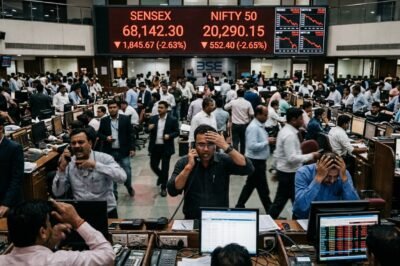
The Indian equity markets witnessed a day of extreme turbulence and significant wealth erosion on November 23, as the benchmark indices, Sensex and Nifty, succumbed to a massive global sell-off. From the opening bell, the atmosphere on Dalal Street was one of palpable anxiety, with the BSE Sensex crashing by over 1,100 points and the Nifty 50 slipping below the psychologically critical 25,500 mark. This sudden downturn caught many market participants off guard, particularly after a period of relative consolidation. The primary drivers behind this financial carnage were a combination of deteriorating global sentiment, rising US Treasury yields, and an aggressive exodus by Foreign Institutional Investors (FIIs) who are repositioning their portfolios in anticipation of shifting macroeconomic policies in the West. As the red screens dominated brokerage houses across the country, investors were left grappling with the reality of a sharp correction that has wiped out billions in market capitalization in a single trading session.
Market analysts had been warning of potential overvaluation in certain pockets of the Indian market, but the velocity of today’s decline suggests a deeper systemic concern regarding global liquidity. The interconnectedness of modern financial markets meant that as soon as Wall Street showed signs of fatigue and Asian peers like the Nikkei and Hang Seng began their retreat, the Indian markets were primed for a reaction. The breach of the 25,500 level for Nifty is particularly significant, as it was considered a strong support zone by technical analysts. The fall below this threshold has triggered a series of stop-loss orders, further accelerating the downward momentum. In this detailed analysis, we explore the multifaceted reasons behind this crash, the sectors that took the hardest hit, and what this means for the retail investor in the weeks to come.
The Magnitude of the Intraday Meltdown
The scale of today’s market crash is one for the record books in recent months. The Sensex’s 1,100-point drop represents more than just a numerical decline; it reflects a wholesale shift in investor psychology from ‘buying the dip’ to ‘selling the rally.’ Every major constituent of the index was under pressure, with heavyweights like Reliance Industries, HDFC Bank, and ICICI Bank leading the charge downwards. When these high-cap stocks move in tandem toward the red, the index has little chance of recovery. The Nifty 50 followed suit, showing no resilience as it sliced through multiple support levels with alarming ease. The volatility index, India VIX, surged by over 12%, indicating that fear is once again the dominant emotion in the marketplace.
Trading volumes were significantly higher than the monthly average, suggesting that this was not a mere technical correction but a high-conviction sell-off. Both mid-cap and small-cap indices, which often provide a cushion during large-cap volatility, were not spared either. In fact, the broader market breadth was heavily skewed in favor of the bears, with nearly four stocks declining for every one that managed to advance. This widespread participation in the sell-off indicates that the panic has spread beyond the top-tier stocks and is now infiltrating the entire ecosystem of the Indian equity market, leading to a massive reduction in the net worth of retail portfolios.
Global Contagion: Why World Markets Are Shaking
The roots of today’s crash are firmly planted in international soil. The primary catalyst appears to be the hawkish stance maintained by the US Federal Reserve, which has signaled that interest rates may stay higher for longer than the market initially anticipated. This has sent US Treasury yields climbing, making emerging markets like India less attractive for global fund managers. When the yield on the ‘risk-free’ US dollar increases, capital naturally flows out of riskier assets like Indian equities and back into the safety of US debt instruments. This ‘flight to safety’ is a classic market maneuver that often results in sharp drawdowns for developing economies.
Furthermore, geopolitical tensions in various parts of the world have added a layer of uncertainty to the global supply chain, keeping energy prices volatile. Since India is a major importer of crude oil, any spike in international prices directly impacts the country’s current account deficit and inflation trajectory. Today’s sell-off was also exacerbated by poor performance in the European markets, which opened in the red following disappointing corporate earnings and economic data from the Eurozone. This synchronized global retreat left Indian investors with no ‘green’ sanctuary to look toward, resulting in the localized panic seen on the NSE and BSE.
Sectoral Bloodbath: IT and Banking Under Siege
The pain was felt most acutely in the Information Technology (IT) and Banking sectors. The Nifty IT index fell by nearly 3.5%, driven by fears that a slowdown in the US and European economies will lead to reduced tech spending by global corporations. Major players like TCS, Infosys, and Wipro saw their stock prices tumble as investors repriced the growth expectations for the upcoming quarters. Given that a significant portion of Indian IT revenue is derived from overseas clients, any hint of a global recessionary environment acts as a massive headwind for these stocks. The sector, which was previously seen as a defensive bet, has now become a source of significant portfolio drag.
Banking and financial services, which carry the highest weightage in the Nifty 50, were equally battered. The Bank Nifty index plummeted as concerns over rising cost of funds and potential increases in Non-Performing Assets (NPAs) surfaced. HDFC Bank and Axis Bank were among the top losers, as institutional selling was concentrated in these highly liquid names. The banking sector is often considered the barometer of the economy, and its poor performance today suggests that the market is bracing for a period of slower credit growth and tighter margins. Even the usually resilient Auto and FMCG sectors could not withstand the selling pressure, as the overall sentiment turned sour.
Foreign Institutional Investors (FIIs) and Capital Flight
A major contributor to the current market weakness is the sustained selling by Foreign Institutional Investors (FIIs). Over the past several sessions, FIIs have been net sellers in the Indian cash market, and today that selling intensified into a flood. Data suggests that billions of rupees were pulled out in a single day as global funds rebalanced their allocations. While Domestic Institutional Investors (DIIs) have tried to provide some support by buying on dips, the sheer volume of foreign outflows has overwhelmed the domestic appetite for stocks. This mismatch between supply and demand is what led to the rapid collapse of price levels throughout the afternoon session.
The reason for this capital flight is two-fold. First is the relative valuation of India compared to other markets; with the Indian market trading at a premium to many of its peers, it is often the first place global managers look to when they need to raise cash or trim exposure. Second is the strengthening of the US Dollar Index. As the dollar gains strength against a basket of world currencies, including the Rupee, the returns for foreign investors are eroded when converted back into USD. This currency risk adds another layer of complexity to the investment thesis for India, prompting FIIs to take profits off the table and wait for a more stable currency environment.
Technical Outlook: Testing Crucial Support Levels
From a technical standpoint, the breach of 25,500 on the Nifty is a bearish signal that cannot be ignored. This level had acted as a pivot point for several weeks, and the fact that it was broken with such high volume suggests that further downside could be in the offing. The next major support for the Nifty is seen around the 25,200 and 25,000 marks. If the index fails to hold the 25,000 level, we could see a slide toward the 200-day Moving Average, which would signify a long-term trend reversal from bullish to bearish. Traders are currently advised to exercise extreme caution and avoid catching a falling knife until there are clear signs of price rejection at lower levels.
The Relative Strength Index (RSI) on the daily charts has entered the oversold territory, which might suggest a temporary technical bounce in the coming days. However, such bounces are often used by seasoned traders as an opportunity to exit long positions rather than initiate new ones. The ‘death cross’—where a short-term moving average crosses below a long-term moving average—is also being closely watched by technicians. Until the Nifty manages to close back above the 25,750 level on a sustained basis, the bias will remain firmly ‘sell on rise,’ making it a challenging environment for swing traders and long-term investors alike.
Future Implications: What Investors Should Do Now
In conclusion, the massive drop in the Sensex and Nifty today is a stark reminder of the volatility inherent in equity markets, especially when global macroeconomic conditions are in a state of flux. While the immediate reaction of many retail investors is to panic, history has shown that such corrections are often healthy for the long-term sustainability of a bull market. They flush out weak hands and bring valuations back to more reasonable levels, providing an entry point for disciplined investors who have been waiting on the sidelines. However, the current sell-off may not be over just yet, as the global factors that triggered it remain unresolved.
Investors should focus on quality rather than trying to find ‘cheap’ stocks in a falling market. Companies with strong balance sheets, consistent earnings growth, and low debt-to-equity ratios are likely to recover much faster than those that are highly leveraged or speculative. It is also a good time to review asset allocation and ensure that your portfolio is diversified enough to withstand such shocks. The coming days will be crucial as the market looks for a bottom; watching for a stabilization in global bond yields and a slowdown in FII selling will be key indicators. For now, patience is the most valuable asset an investor can possess in the face of this Dalal Street bloodbath.





































Leave a Reply