
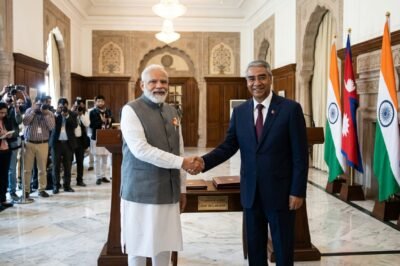
The corridors of Hyderabad House in New Delhi recently resonated with a profound sense of historical continuity and future-oriented ambition as Prime Minister Narendra Modi welcomed the Prime Minister of Nepal for a high-profile state visit. This meeting, characterized by a deep sense of mutual respect and shared cultural heritage, has transcended the traditional boundaries of bilateral diplomacy. The centerpiece of this visit, an announcement that has sent ripples through the educational and political circles of South Asia, is the establishment of an offshore campus of the Indian Institute of Technology (IIT) in Nepal. This move is not merely a bureaucratic agreement but a symbolic and practical transformation of the long-standing Roti-Beti relationship into a Knowledge-Technology partnership. By bringing the prestigious IIT brand to the foothills of the Himalayas, India is signaling its commitment to Nepal’s long-term human capital development. The visit underscores a pivotal shift in India’s ‘Neighborhood First’ policy, moving from traditional infrastructure-heavy projects to high-value intellectual investments. For Nepal, this represents an unparalleled opportunity to localize world-class engineering education, curbing the brain drain that has long plagued its developing economy while fostering a new generation of technocrats who can lead the nation into a digital future. The strategic implications of this visit extend far beyond the immediate agreements, suggesting a renewed synergy that seeks to balance regional power dynamics through educational excellence and economic integration.
The Strategic Evolution of Neighborhood First Policy
The announcement of an IIT campus in Nepal marks a significant evolution in India’s foreign policy approach toward its immediate neighbors. Historically, India-Nepal relations have been anchored by trade, transit, and shared cultural values. However, the modern geopolitical landscape requires a more nuanced engagement that addresses the aspirations of a young and tech-savvy Nepalese population. Prime Minister Modi’s ‘Neighborhood First’ policy has increasingly focused on creating shared prosperity through institutional capacity building. By choosing to establish an IIT campus, India is effectively sharing its most successful educational export. This move is designed to create a pool of highly skilled professionals within Nepal who are trained under the same rigorous standards as their Indian counterparts. This collaboration is expected to reduce the dependency of Nepalese students on foreign education markets, which often lead to permanent migration and the loss of talent.
Furthermore, this policy shift indicates a strategic response to the growing influence of other regional players in the educational and infrastructure sectors of Nepal. By embedding Indian educational excellence into the fabric of Nepal’s academic landscape, New Delhi is fostering a long-term bond that is difficult to replicate through mere financial aid or construction projects. This soft power play is aimed at creating a community of Nepalese leaders who are well-versed in Indian systems and values, thereby ensuring a smoother diplomatic and economic relationship for decades to come. The institutional presence of an IIT serves as a permanent anchor for bilateral cooperation, transcending the electoral cycles of both nations.
Technical Details of the IIT Nepal Campus and Educational Diplomacy
The specificities of the IIT offshore campus are rooted in a collaborative framework between the Indian Ministry of Education and Nepal’s academic authorities. While the exact location and faculty structure are being finalized, the commitment mirrors similar successful ventures such as IIT Madras in Zanzibar and IIT Delhi in Abu Dhabi. The Nepal campus is expected to offer specialized courses in engineering, data science, and renewable energy—fields that are critical to Nepal’s own developmental goals. This institution will likely operate under a model that ensures high academic standards while being sensitive to the local economic context. Admission processes will be rigorous, potentially involving a adapted version of the Joint Entrance Examination (JEE), ensuring that the brightest minds in Nepal have access to elite technical training without having to cross international borders.
Educational diplomacy has become a cornerstone of India’s global engagement strategy. By leveraging the ‘IIT brand,’ India is positioning itself as a global knowledge hub. For Nepal, this means access to a curriculum that is globally recognized and a network of alumni that spans the world’s most successful technology companies. The project will also involve faculty exchange programs and research collaborations between existing IITs in India and the new campus in Nepal. This synergy will not only benefit students but also uplift the research capabilities of Nepalese universities through osmosis. The creation of this campus is a testament to the belief that technical education is the most potent tool for poverty alleviation and industrial growth in the 21st century.
Economic Synergy and Market Implications for the Region
Beyond education, the PM Modi-led summit addressed critical economic sectors that will define the future of the Indo-Nepal corridor. The financial markets and trade sectors have closely monitored the agreements regarding the energy sector, which often run parallel to such high-profile educational announcements. Prime Minister Modi and his Nepalese counterpart discussed the ambitious goal of Nepal exporting 10,000 MW of power to India over the next decade. This energy deal provides the economic backbone that allows for large-scale investments like the IIT campus. When Nepal becomes an energy-surplus nation, it will require the technical expertise to manage complex grids and sustainable energy systems—expertise that the new IIT campus is perfectly positioned to provide.
From a market perspective, the integration of digital payment systems between India and Nepal was another highlight of the visit. The expansion of UPI-based transactions across the border is set to revolutionize tourism and small-scale trade. Investors are looking at these developments as a sign of decreasing friction in cross-border commerce. As educational and digital barriers fall, the potential for a unified economic zone in the Himalayan region grows. The IIT campus will act as an incubator for startups, potentially leading to a tech boom in Kathmandu and other urban centers. This ecosystem will attract venture capital and create a self-sustaining cycle of innovation and economic activity that could fundamentally alter Nepal’s GDP trajectory.
The Geopolitical Significance of Indo-Nepal Cooperation
In the broader context of South Asian geopolitics, the visit and the IIT announcement serve as a powerful statement of regional stability. Nepal sits at a critical junction between two Asian giants, and its alignment is of paramount importance to regional security. India’s decision to invest in Nepal’s high-level education sector reflects a deep-seated trust and a desire to see a stable, prosperous, and self-reliant Nepal. By focusing on youth and education, India is addressing the core demographic that will shape Nepal’s political future. This approach contrasts with debt-heavy infrastructure models, focusing instead on sustainable growth through human empowerment.
The strategic partnership also covers traditional areas such as connectivity and defense. The inauguration of new rail links and integrated check posts alongside the educational MoUs suggests a multi-dimensional approach to bilateral ties. Every new bridge, railway line, and campus reinforces the idea that the prosperity of India and Nepal is inextricably linked. The geopolitical stability of the region depends on these multifaceted connections. By ensuring that Nepal has the technical infrastructure and human resources to manage its own resources—be it hydropower or digital services—India is fostering a partnership based on equality and mutual benefit rather than dependency.
Addressing the Brain Drain and Human Capital Challenges
One of the most pressing socio-economic challenges for Nepal is the massive migration of its youth in search of better education and employment opportunities. The establishment of an IIT in Nepal is a direct intervention to address this ‘brain drain.’ By providing world-class education at home, Nepal can retain its most talented individuals who can contribute to the local economy. The presence of such a prestigious institution also encourages the development of ancillary industries, from publishing to specialized technology services, creating a local job market for the graduates it produces.
Moreover, the IIT campus will serve as a model for other educational institutions in Nepal. It sets a high benchmark for academic excellence, prompting local universities to upgrade their curricula and teaching methodologies. This competitive pressure is healthy for the domestic education sector. In the long run, the goal is to create a knowledge economy where innovation is driven by local talent. The human capital developed at the IIT Nepal campus will be the engineers who build Nepal’s dams, the entrepreneurs who launch its tech firms, and the policymakers who navigate its digital transformation. This is a long-term investment in the sovereignty and economic independence of Nepal.
Future Implications: A New Era of Collaboration
As we look toward the future, the implications of PM Modi’s announcement are vast. The establishment of the IIT campus in Nepal is likely to be the first of many such institutional collaborations. We can expect to see increased cooperation in space technology, climate change research, and disaster management—areas where both nations have a shared interest. The success of this project will serve as a blueprint for India’s engagement with other BIMSTEC and SAARC nations, positioning India not just as a regional leader, but as a regional mentor in the field of science and technology.
The next decade will see the first batch of graduates emerging from IIT Nepal, entering a market that is increasingly integrated with India’s. This will lead to a more synchronized regional labor market and a more robust exchange of ideas. The vision of a ‘Prosperous Nepal, Happy Nepali’ finds a strong partner in India’s ‘Viksit Bharat 2047’ goal. Together, these two nations are setting a global example of how neighboring countries can leverage their shared history to build a future defined by innovation, education, and mutual prosperity. The journey from Hyderabad House to a fully operational IIT campus in Nepal is more than just a logistical task; it is the construction of a bridge to the future.




































Leave a Reply