
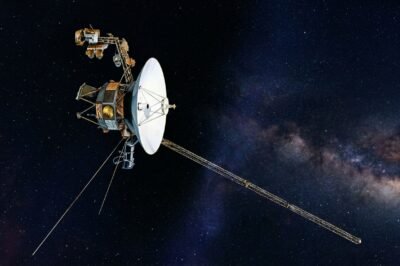
Humanity has always been a species defined by its horizons. From the first migrations across continents to the seafaring expeditions that mapped the globe, the drive to see what lies beyond has been ingrained in our collective DNA. On September 5, 1977, NASA launched a small, sophisticated probe named Voyager 1 from Cape Canaveral, Florida. Its mission was to conduct a grand tour of the outer planets, providing the first detailed glimpses of Jupiter and Saturn. Few at the time could have predicted that this machine would not only outlive its primary mission but would continue to function forty-six years later, venturing into the silent, cold expanse of interstellar space. Recently, Voyager 1 achieved a milestone that is as much a testament to physics as it is to engineering: it has reached a distance of one light-day from Earth. This means that at its current distance of approximately 26 billion kilometers, a radio signal traveling at the speed of light takes a full 24 hours to reach the spacecraft, and another 24 hours for its response to return to Earth. This news, highlighted by academic and civil service preparation platforms like Drishti IAS, serves as a profound benchmark in the history of space exploration, marking the first time a man-made object has ventured so far that the sun is but a bright star in its rearview mirror.
Understanding the One Light-Day Frontier
To grasp the magnitude of a light-day, one must first understand the scale of light speed. Light travels at approximately 299,792 kilometers per second. In a single day, light covers about 25.9 billion kilometers. For Voyager 1 to reach this distance is a feat of longevity that borders on the miraculous. When the probe was launched, the technology on board was state-of-the-art for the 1970s, featuring computers with less processing power than a modern car key fob and data storage systems based on digital tape recorders. Despite these limitations, the craft has successfully navigated the transition through the heliopause—the boundary where the solar wind meets the interstellar medium—and is now cruising through the space between the stars.
This distance introduces extreme challenges for mission control. When engineers at NASA’s Jet Propulsion Laboratory (JPL) send a command to Voyager 1, they must wait two full days to know if the command was received and executed correctly. This ‘ping’ time of 48 hours requires meticulous planning and a degree of patience that is rare in the modern, high-speed digital age. The spacecraft is currently moving at a velocity of about 38,000 miles per hour relative to the Sun, yet even at this blistering speed, it will take tens of thousands of years to reach the nearest neighboring stars. The crossing of the one light-day threshold is a symbolic transition from being a ‘solar system probe’ to becoming a true ‘interstellar emissary.’
Technological Resilience in the Deep Void
How does a machine built in 1977 survive the harsh environment of deep space for nearly five decades? The answer lies in the robust design and the incredible ingenuity of the engineers who have maintained it. Voyager 1 is powered by Radioisotope Thermoelectric Generators (RTGs), which convert the heat from the radioactive decay of plutonium-238 into electricity. Over time, the power output of these generators has declined, forcing NASA to prioritize which instruments remain active. One by one, heaters and non-essential systems have been turned off to conserve energy, allowing the probe’s most critical sensors to continue gathering data on the interstellar environment.
The resilience of Voyager 1 was tested recently when a computer glitch in the Flight Data System (FDS) caused the spacecraft to send back unreadable gibberish instead of scientific data. For months, the mission seemed lost. However, through a series of complex troubleshooting steps that involved re-routing code to different parts of the onboard memory—some of which had been physically damaged—engineers were able to restore the data stream. This recovery effort, performed from 26 billion kilometers away, is widely considered one of the greatest technical ‘long-distance’ repairs in history. It highlights the enduring quality of the hardware and the brilliance of the human minds that continue to shepherd Voyager 1 through the dark.
The Scientific Legacy of the Voyager Interstellar Mission
Voyager 1 has provided humanity with more ‘firsts’ than perhaps any other mission in history. It was the first to discover active volcanoes on Jupiter’s moon Io, the first to detect lightning on a planet other than Earth, and the first to explore the complex structure of Saturn’s rings in high resolution. However, its most significant scientific contribution may be its current work in the interstellar medium. By measuring the density of plasma and the strength of magnetic fields outside the Sun’s influence, Voyager 1 is providing data that cannot be obtained any other way.
- Mapping the Heliopause: Voyager 1 confirmed the location of the boundary where the Sun’s magnetic influence ends.
- Interstellar Dust and Rays: The probe measures cosmic rays that are normally blocked by the Sun’s heliosphere, offering insights into the chemistry of our galaxy.
- The Golden Record: Beyond its instruments, Voyager 1 carries a 12-inch gold-plated copper disk containing sounds and images selected to portray the diversity of life and culture on Earth, intended for any extraterrestrial intelligence that might find it.
The scientific data flowing from Voyager 1 helps cosmologists understand the life cycle of stars and the evolution of galaxies. By studying the environment through which Voyager travels, scientists can better predict how our own solar system interacts with the wider Milky Way. This information is crucial for future deep-space missions and for our broader understanding of the universe’s structure.
Comparing the Voyagers to Modern Exploration
While modern probes like the James Webb Space Telescope or the Perseverance rover on Mars feature vastly superior computing power and imaging capabilities, Voyager 1 remains unique because of its location. Modern missions are designed for specific targets—planets, moons, or Lagrange points. Voyager 1, along with its twin Voyager 2, is on a one-way trip out of our cosmic neighborhood. The philosophy of the Voyager era was one of ‘total exploration,’ where the goal was to push the boundaries of distance as much as the boundaries of knowledge.
Today, there are discussions about ‘interstellar light sails’ and ‘Breakthrough Starshot’ projects that aim to reach 20% of the speed of light using laser propulsion. While these concepts are exciting, they remain in the realm of theory or early-stage development. Voyager 1, meanwhile, is a physical reality—a ton of metal, wires, and glass that is actually ‘out there.’ It serves as a benchmark for what is possible with chemical rockets and gravitational assists (slingshotting around planets to gain speed). Its success has influenced every subsequent mission, from the Galileo probe to Jupiter to the New Horizons mission to Pluto.
The Financial and Strategic Value of Interstellar Longevity
From a business and financial perspective, the Voyager program is an example of an incredible Return on Investment (ROI). The total cost of the Voyager mission (including both 1 and 2) from its inception through 1989 was about $865 million. Adjusted for inflation, this is a significant sum, but when spread over nearly 50 years of continuous scientific output, the cost per year is remarkably low. The program has supported thousands of jobs, driven innovations in telecommunications and material science, and provided educational value that is essentially priceless.
Strategically, the Voyager mission cements the reputation of NASA and the United States as leaders in space exploration. For platforms like Drishti IAS, which focus on the intersection of science, technology, and global policy, the Voyager story is a case study in long-term strategic planning. It shows how investments made today can continue to yield dividends for decades, long after the original political and economic contexts have changed. In an era where many projects are judged by quarterly results, Voyager 1 stands as a monument to the power of thinking across generations.
The Final Frontier: What Lies Beyond the One Light-Day Marker
As Voyager 1 continues to drift further away, its future is both certain and mysterious. In the coming years, likely by 2030, the RTGs will finally lose enough power that the last of the scientific instruments will have to be turned off. At that point, Voyager 1 will become a silent ghost ship, sailing through the void. It will no longer send data back to Earth, and Earth will no longer be able to track its progress. However, because space is a near-vacuum, the probe will remain intact for millions, perhaps billions, of years. It will effectively become a time capsule of 20th-century humanity.
In about 300 years, Voyager 1 will reach the inner edge of the Oort Cloud—a theoretical sphere of icy bodies surrounding the solar system. It will take another 30,000 years to pass through it. Long after the cities that built it have crumbled and the languages its creators spoke have evolved or vanished, Voyager 1 will carry the Golden Record, a message of peace and curiosity from a small planet that once dared to touch the stars. The achievement of reaching one light-day of distance is a reminder that while we are small in the face of the cosmos, our reach, through our machines and our intellect, is truly limitless.

































Leave a Reply