
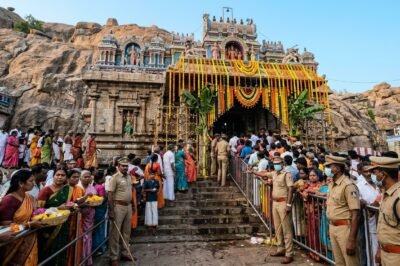
The historical and spiritual landscape of Tamil Nadu is currently witnessing a significant legal confrontation as the Madras High Court steps in to adjudicate a growing controversy surrounding the Thiruparankundram Deepam festival. At the heart of this dispute is the Subramanya Swamy Temple, one of the six revered abodes of Lord Murugan, where the annual Karthigai Deepam celebrations draw hundreds of thousands of devotees from across the globe. However, the atmosphere of piety has been clouded by the imposition of prohibitory orders by local administrative authorities, a move that has sparked widespread indignation and a subsequent legal challenge. The court’s decision to grant an urgent hearing underscores the gravity of the situation, balancing the constitutional right to religious freedom against the state’s responsibility to maintain public order and safety. This case is not merely a local administrative issue; it serves as a litmus test for the secular credentials of the state and the judiciary’s role in protecting ancient traditions from potentially overreaching executive mandates. As the legal teams prepare their arguments, the eyes of the public and various socio-religious organizations are fixed on the Madurai Bench of the Madras High Court, awaiting a verdict that could redefine the boundaries of state intervention in religious festivities.
The Genesis of the Thiruparankundram Deepam Conflict
The Thiruparankundram Subramanya Swamy Temple is steeped in antiquity, being the first of the Arupadaiveedu (six abodes of Murugan). Its rock-cut architecture and Puranic significance make it a focal point of Tamil heritage. The Karthigai Deepam festival, characterized by the lighting of the massive ‘Maha Deepam’ atop the hill, symbolizes the triumph of light over darkness. For centuries, this ritual has been conducted with minimal state interference, guided by established temple customs and traditional protocols. However, in recent years, administrative concerns regarding crowd density, infrastructural limitations, and potential communal sensitivities have led to increased regulatory scrutiny.
The current row erupted when the district administration issued prohibitory orders under Section 144 (or its equivalent in the new Bharatiya Nagarik Suraksha Sanhita), citing the need to prevent any untoward incidents and manage the massive influx of pilgrims. While the administration argues that these measures are purely preventative and aimed at ensuring public safety, critics and devotees view them as an unnecessary restriction on their right to worship. The petitioners argue that such orders are disproportionate and fail to consider the spiritual necessity of the rituals. They contend that the administration should focus on better facilitation rather than outright prohibition or restrictive measures that dampen the spirit of the festival.
Judicial Urgency: Why the Madras High Court Intervened
The Madras High Court’s decision to take up the matter urgently is a reflection of the time-sensitive nature of the festival. In Indian jurisprudence, the ‘urgency’ of a matter is often determined by the potential for irreparable harm or the expiration of a critical date. Since the Karthigai Deepam festival follows a strict lunar calendar, any delay in the court’s intervention would render the petitions moot. The petitioners made a strong case that the prohibitory orders were issued without adequate consultation with stakeholders, including the temple priests and local community leaders, who have managed these events for generations.
The court’s role in this context is to act as an arbiter between two competing interests: the ‘Parens Patriae’ jurisdiction of the state to protect its citizens and the fundamental rights of the citizens to practice their religion as guaranteed under Article 25 of the Constitution. By agreeing to an urgent hearing, the bench has signaled that it recognizes the deep-seated emotional and spiritual sentiments involved. The legal discourse is expected to delve into the specifics of the prohibitory orders, examining whether there was a factual basis for the perceived threat to public order or if the decision was an administrative overreach based on speculative concerns.
Religious Freedom vs. Public Order: A Constitutional Tug-of-War
The legal battle in the Madras High Court hinges on the interpretation of Articles 25 and 26 of the Indian Constitution. Article 25 guarantees the freedom of conscience and the right to freely profess, practice, and propagate religion, but it is not absolute; it is subject to public order, morality, and health. This creates a complex balancing act for the judiciary. The state often uses the ‘public order’ clause to justify restrictions on large gatherings, citing the potential for stampedes, traffic congestion, or communal friction. However, the petitioners in the Thiruparankundram case argue that ‘public order’ should not be used as a blanket excuse to suppress religious expression.
In previous landmark judgments, Indian courts have held that the state must provide ‘compelling evidence’ of a threat to public order before restricting religious practices. The ‘Essential Religious Practices’ doctrine may also come into play, as the court evaluates whether the specific rituals being restricted are core to the faith. If the lighting of the Deepam and the associated processions are deemed essential, the state faces a much higher burden of proof to justify any prohibitory orders. This section of the legal debate will likely form the crux of the high court’s final determination, setting a precedent for how Section 144 is applied to religious sites in the future.
Administrative Challenges and the Police Perspective
From the perspective of the Madurai district administration and the police department, managing a festival of this scale is a logistical nightmare. The narrow streets surrounding the Thiruparankundram hill are not designed to accommodate the modern volume of pilgrims, which can exceed several lakhs in a single day. The authorities highlight several key concerns that necessitated the prohibitory orders:
- Crowd Management: Preventing stampedes in the steep and narrow terrain of the temple hill.
- Security Threats: Mitigating risks associated with large public gatherings in a sensitive region.
- Infrastructural Load: The ancient temple structure and surrounding roads have limited capacity to handle the weight and movement of massive crowds.
- Fire Safety: The lighting of the Maha Deepam involves large quantities of ghee and camphor, posing a significant fire risk if not strictly regulated.
The administration maintains that the prohibitory orders are not meant to stop the festival but to regulate it. They argue that by restricting certain types of gatherings or movements, they can ensure a smoother flow of pilgrims and prevent accidents. However, the lack of communication between the bureaucracy and the devotee community often leads to a trust deficit, where safety measures are perceived as hostile acts against faith. The court will likely examine whether less restrictive alternatives could have been employed to achieve the same safety goals.
Socio-Political Ramifications and Community Impact
The Thiruparankundram Deepam row has significant socio-political implications in Tamil Nadu. Religion and politics are often deeply intertwined in the state, and any perceived slight to religious traditions can quickly become a political flashpoint. Various political parties and cultural organizations have voiced their support for the devotees, accusing the state government of being insensitive to Hindu traditions. This political pressure adds another layer of complexity to the legal proceedings, as the government must defend its administrative decisions without appearing anti-devotee.
Economically, the prohibitory orders affect the local ecosystem of Madurai. Thousands of small vendors, flower sellers, and lodge owners depend on the festival for their annual income. Restrictive orders that discourage pilgrims or limit their stay can lead to substantial financial losses for the local community. The court may consider these socio-economic factors when deciding on the proportionality of the state’s actions. The sentiment on the ground is one of frustration, with many locals arguing that the administration should invest in better infrastructure rather than simply banning or restricting movement every year during peak festival times.
Conclusion: Future Legal Implications and Path Forward
The Madras High Court’s handling of the Thiruparankundram Deepam row will be closely watched by legal experts and religious leaders across India. A ruling that favors the petitioners could lead to a more stringent requirement for the state to justify the use of prohibitory orders during festivals. Conversely, a ruling in favor of the administration would reinforce the state’s power to prioritize public safety over religious tradition. The ideal outcome, however, lies in a middle ground where the judiciary mandates a collaborative framework between temple authorities, devotees, and the administration.
Future implications of this case extend to how the state handles other major religious events like the Madurai Meenakshi Amman Chithirai festival or the Palani Thaipusam. It calls for a modernized approach to crowd management that utilizes technology, such as real-time monitoring and digital queue systems, rather than the archaic reliance on Section 144. Ultimately, the sanctity of Thiruparankundram must be preserved, and the light of the Deepam should continue to shine, but it must do so in an environment where the safety of every devotee is guaranteed through cooperation rather than coercion. The court’s final order will hopefully provide a roadmap for this harmonious coexistence of faith and governance.































Leave a Reply