
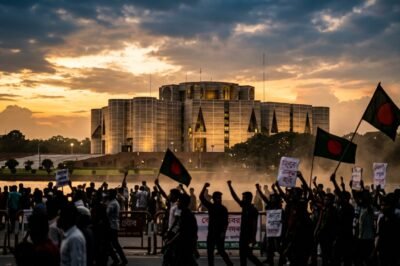
The announcement of Sheikh Hasina’s intended return to Bangladesh on the 16th of December has sent profound shockwaves through the corridors of power in Dhaka, New Delhi, and beyond. As the daughter of the nation’s founding father, Bangabandhu Sheikh Mujibur Rahman, her legacy has been inextricably linked with the country’s trajectory for the better part of five decades. However, her sudden and dramatic departure in August 2024, following a massive student-led uprising that culminated in the storming of her official residence, left a power vacuum that an interim government is now struggling to manage. The choice of December 16 is a masterclass in political symbolism; it is Bangladesh’s Victory Day, marking the country’s independence from Pakistan in 1971. By selecting this specific date, Hasina is clearly attempting to leverage the deep-seated emotional and historical sentiments associated with the liberation struggle, effectively positioning her return as a ‘restoration’ of the constitutional order she claims was illegally usurped. This move is fraught with immense risk, not just for her personal safety but for the fragile stability that the nation has managed to maintain under the leadership of Nobel Laureate Dr. Muhammad Yunus. Financial markets, already reeling from double-digit inflation and dwindling foreign reserves, are watching these developments with extreme trepidation, as the specter of renewed civil unrest and potentially violent clashes looms large over the economy.
The Symbolic Resonance of Victory Day and Political Narrative
The 16th of December, known as Bijoy Dibosh, is arguably the most sacred date in the Bangladeshi calendar. It commemorates the surrender of Pakistani forces and the birth of a sovereign nation, a feat achieved through a bloody nine-month war. For the Awami League, the party led by Hasina, this date has always been the cornerstone of their political identity. They have long claimed the exclusive mantle of the party that led the liberation, a narrative that Hasina has used to consolidate power over her fifteen-year tenure. By announcing a return on this day, she is making a calculated gamble to appeal to the nationalist fervor of her core supporters and the veterans of the 1971 war. She aims to bypass the current narrative of her being an ousted autocrat and instead reclaim the image of the rightful heir to the liberation legacy.
However, this strategy is highly divisive and potentially inflammatory. Opponents, particularly the student coordinators who led the ‘July Revolution,’ view this as a provocative act designed to incite violence and disrupt the transitional process. They argue that the Awami League’s use of 1971 symbolism has become a shield for authoritarianism. The interim administration now faces the daunting task of managing the security situation on a day that is already marked by massive public gatherings and high emotional intensity. The potential for a clash between those celebrating the ‘Victory Day’ of 1971 and those defending the ‘Second Independence’ of 2024 is a scenario that many analysts fear could lead to widespread instability.
Legal Constraints and the Interim Government’s Hardline Stance
From a legal and judicial standpoint, the return of Sheikh Hasina is complicated by a mountain of litigation that has accumulated since her departure. Dozens of cases, ranging from murder and abduction to crimes against humanity, have been filed against her and her top aides in various courts across the country. The International Crimes Tribunal (ICT) in Bangladesh, which Hasina herself once championed to try war criminals, has already issued arrest warrants for her in connection with the deaths of hundreds of protesters during the July-August movement. The interim government has been vocal about its intent to seek her extradition from India, where she has been residing in a secure location. If she were to land at Hazrat Shahjalal International Airport, she would likely face immediate arrest and transfer to a high-security facility.
This creates a high-stakes standoff. Her supporters might gather in the thousands to prevent such an arrest, leading to potential confrontations with law enforcement agencies and the military. Furthermore, the question of how she plans to enter the country remains a mystery. With her diplomatic passport reportedly revoked and numerous travel bans in place for Awami League leaders, a standard commercial arrival seems unlikely. Some speculate she might attempt a land crossing, while others believe she is banking on a groundswell of support that would make her arrest politically impossible for the interim government. The legal system is currently undergoing a process of rapid reform, with many judges associated with the previous regime being replaced, ensuring that any legal battle Hasina faces will be conducted under an intense, and likely unfriendly, spotlight.
Economic Implications: Markets, RMG Sector, and Investor Fear
The economic ramifications of this political uncertainty cannot be overstated. Bangladesh’s economy, once heralded as a ‘miracle’ of growth driven by the multi-billion dollar Ready-Made Garment (RMG) sector, is currently in a state of extreme flux. The RMG sector alone accounts for over 80% of the country’s export earnings and employs millions of people, mostly women. Political instability directly translates to supply chain disruptions, cancelled orders from global retail giants, and a catastrophic loss of investor confidence. When factories close due to unrest, the impact is felt globally, from high streets in London to shopping malls in New York. The Dhaka Stock Exchange (DSE) has already shown significant volatility in response to the mere rumor of Hasina’s return, with investors pulling capital in anticipation of further chaos.
Moreover, the interim government is currently in the middle of sensitive negotiations with the International Monetary Fund (IMF) and the World Bank for crucial loans intended to bolster foreign exchange reserves, which have fallen to critical levels. A period of prolonged instability or a breakdown in law and order could jeopardize these negotiations, leading to a balance-of-payments crisis and a potential default on international obligations. For the average citizen, this macro-economic instability manifests as runaway inflation. The price of essential commodities like rice, lentils, and oil has skyrocketed, and any further political turmoil will only exacerbate the suffering of the working class. Business leaders have called for political reconciliation, but the announcement of a December 16 return seems to push the country further away from such a resolution.
The Geopolitical Chessboard: India, China, and Western Interests
Regionally, the situation is a diplomatic minefield. India has long viewed Sheikh Hasina as its most reliable partner in South Asia, particularly concerning counter-terrorism and regional stability. Her presence in India since August has put New Delhi in a difficult position, balancing its historical ties with her against the need to build a functional relationship with the new administration in Dhaka. A planned return on December 16 forces India’s hand; allowing her to depart from Indian soil to challenge the current government could strain India-Bangladesh relations for a generation. Conversely, preventing her departure could be seen as an interference in internal Bangladeshi politics. New Delhi’s strategy will likely be one of ‘wait and watch,’ but the pressure is mounting.
Meanwhile, other global powers are watching closely. China, a major investor in Bangladesh’s infrastructure, is focused on the continuity of its projects and the safety of its personnel. The United States and the European Union have been vocal about the need for democratic reforms, accountability for human rights abuses, and the holding of free and fair elections. Hasina’s return could potentially align or clash with these international interests. If her return is seen as a move toward stabilizing the country and moving toward elections, it might find some quiet support; however, if it is viewed as a catalyst for civil war, the international community will likely distance itself. The global textile supply chain is the primary concern for the West, and any disruption there has immediate economic consequences in Western markets.
Social Unrest and the Student-Led Revolution’s Resolve
The student-led movement that ousted Hasina remains the most potent and organized force in Bangladeshi politics today. These groups, characterized by their decentralized leadership and savvy use of social media, have already expressed their vehement opposition to any political rehabilitation of the Awami League without a full accounting of the lives lost during the summer protests. They refer to the current period as ‘Bangladesh 2.0’ and see Hasina’s return as a counter-revolutionary attempt to undo their hard-won gains. The prospect of her return has already prompted calls for ‘all-out resistance’ from various student organizations and civil society groups. They argue that her return is not about participating in a democratic process but about subverting the new national consensus.
This generational divide is perhaps the most significant factor in the current crisis. The youth, who make up a vast majority of the population, are no longer willing to accept the binary, dynastic politics that have characterized Bangladesh for decades. They are demanding systemic change, including constitutional reforms and a complete overhaul of the police and judiciary. Any attempt by Hasina to return without addressing these grievances or acknowledging the ‘martyrs’ of the July uprising is likely to be met with fierce opposition on the streets. The interim government’s biggest challenge is to manage the expectations of this radicalized youth while preventing the country from sliding into total anarchy.
Future Implications: A Nation at a Critical Crossroads
In conclusion, Sheikh Hasina’s announcement of a return on December 16 is a high-stakes maneuver that could either lead to a definitive confrontation or a chaotic shift in the country’s political trajectory. The implications are manifold, touching upon historical identity, legal accountability, economic stability, and regional diplomacy. For Bangladesh, the road ahead is fraught with unprecedented uncertainty. The interim government must navigate these turbulent waters with a clear focus on the rule of law and the aspirations of the people who demanded change. The military’s role will also be crucial; having stayed neutral during the final days of the August uprising, their stance on Hasina’s return will determine the feasibility of her plans.
Ultimately, the events leading up to and on December 16 will define the character of the Bangladeshi state for years to come. Will it be a year that ends in reconciliation and a roadmap to democracy, or will it be the beginning of a prolonged period of civil strife? The international community, global investors, and, most importantly, the 170 million people of Bangladesh will be watching with bated breath. The mere announcement has already altered the political discourse, forcing all stakeholders to prepare for a potentially explosive end to the year. Bangladesh is at a crossroads, and the choice made on the upcoming Victory Day will resonate through its history forever.

































Leave a Reply