
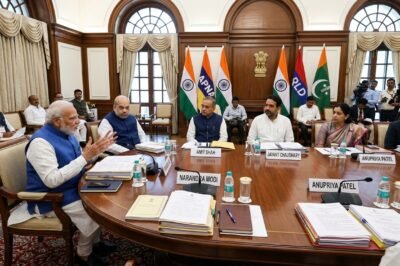
The heartland of Indian politics, Uttar Pradesh, is currently witnessing a masterclass in strategic maneuvering as the Bharatiya Janata Party (BJP) navigates the treacherous waters of seat-sharing. With the specter of the upcoming general elections looming large, the saffron party finds itself in a delicate balancing act, attempting to reconcile its own ambitious ‘Mission 80′ with the burgeoning aspirations of its four key regional allies. This is not merely a mathematical exercise of dividing eighty constituencies; it is a profound test of the BJP’s ability to maintain its ideological hegemony while acknowledging the indispensable role of caste-based regional satraps. The stakes could not be higher. For the BJP, UP is the cornerstone of its national dominance, and any friction within the National Democratic Alliance (NDA) could provide the necessary opening for a resurgent opposition bloc. The current ’50-seat puzzle’ refers to the complex negotiation over several dozen swing seats where both the national party and its partners claim a legitimate right to contest, creating a political bottleneck that requires surgical precision to resolve without alienating the grassroots cadre or the vital demographic vote banks represented by the allies.
The Quintessential Quartet: Understanding the BJP’s Alliance Ecosystem
To understand the current impasse, one must first analyze the four pillars supporting the NDA structure in Uttar Pradesh: the Apna Dal (Sonelal), the Suheldev Bharatiya Samaj Party (SBSP), the Nishad Party, and the recently inducted Rashtriya Lok Dal (RLD). Each of these parties brings a specific demographic advantage to the table, making them critical for the BJP’s pursuit of a clean sweep. The Apna Dal (S), led by Anupriya Patel, commands a significant influence over the Kurmi vote bank in Eastern UP. Having been a consistent partner since 2014, their demands for an increased share of seats are backed by a high strike rate in previous cycles, putting pressure on the BJP to concede more than the traditional two or three seats.
On the other hand, Om Prakash Rajbhar’s SBSP and Sanjay Nishad’s Nishad Party represent the Rajbhar and fisherman communities, respectively. These communities are pivotal in dozens of constituencies where they act as the decisive ‘swing’ vote. The RLD’s entry into the fold has further complicated the geometry, as Jayant Chaudhary’s party holds sway over the Jat-dominated regions of Western UP. The BJP’s challenge lies in the fact that while these allies are essential for securing specific caste clusters, giving away too many seats on ally symbols risks diluting the BJP’s own numerical strength in the Lok Sabha. The negotiation is therefore a high-stakes poker game where leverage is measured in decimal points of vote shares and the perceived loyalty of local strongmen.
Decoding the 50-Seat Conundrum: A Game of Political Chicken
The core of the dispute revolves around roughly 50 seats where the BJP has traditionally been strong but where allies now believe they have a superior claim due to shifting local dynamics or the inclusion of new partners like the RLD. The ’50-seat puzzle’ is essentially a conflict between the BJP’s desire to maximize the number of candidates fighting on the ‘Lotus’ symbol and the allies’ need to prove their relevance to their own voter bases by contesting on their independent symbols. Historically, the BJP has preferred that candidates from smaller allies contest on the BJP symbol to ensure better coordination and a unified identity. However, leaders like OP Rajbhar and Sanjay Nishad are increasingly resistant to this ‘merger-by-proxy’ strategy, fearing it will erode their party’s unique identity over the long term.
Furthermore, the BJP’s central leadership is meticulously reviewing the performance of sitting MPs in these contested zones. Internal surveys suggest that anti-incumbency is a factor in several high-profile seats. This has led to a scenario where allies are suggesting that they be given these ‘difficult’ seats, promising a fresh face and a consolidated caste vote to overcome the fatigue associated with the incumbent BJP representatives. The BJP, conversely, is wary of ceding ground in areas where they have spent a decade building organizational roots. This creates a friction point that requires the intervention of the highest levels of the party’s command, including Home Minister Amit Shah and BJP President J.P. Nadda.
Caste Calculations and the Numerical Might of Regional Satraps
The politics of Uttar Pradesh remains inextricably linked to the ‘Mandal’ versus ‘Kamandal’ narrative, and the current seat-sharing discussions are a testament to this reality. The BJP’s success over the last decade has been built on a ‘non-Yadav OBC’ and ‘non-Jatav Dalit’ coalition. The four allies are the gatekeepers of these very segments. For instance, the Nishad Party represents a community that is seeking inclusion in the Scheduled Caste category, a demand that the BJP must handle with extreme sensitivity. In many seats in the Purvanchal region, the Nishad vote accounts for 15-20% of the electorate, making it impossible for a BJP candidate to win without the active endorsement of Sanjay Nishad.
Similarly, the SBSP’s influence over the Rajbhar community is a critical counterweight to the Samajwadi Party’s influence in districts like Ghazipur, Azamgarh, and Mau. The RLD’s integration is particularly significant because it aims to bridge the gap between Jats and Muslims in Western UP, or at least prevent the consolidation of Jats behind the opposition. The BJP’s math is simple: if the allies are satisfied, the ‘Plus Vote’ they bring ensures a victory margin that is insurmountable. If they are dissatisfied, their voters might stay home or, worse, cross-vote for the I.N.D.I.A bloc, turning a safe seat into a battlefield. The 50-seat puzzle is thus a struggle to quantify the ‘loyalty value’ of these communities against the ‘brand value’ of the Prime Minister’s leadership.
Internal Resistance: The BJP’s Local Cadre vs. Ally Aspirations
While the top leadership might be willing to compromise for the sake of the larger alliance, the grassroots reality is often more contentious. In many of the 50 seats under discussion, the local BJP organization has spent years cultivating leadership and preparing for the elections. The prospect of these seats being handed over to an ally is met with significant internal resistance. Local workers often feel that their hard work is being sacrificed at the altar of coalition politics, leading to potential sabotage during the campaign phase. This ‘internal rebellion’ is one of the primary reasons why the seat-sharing announcement is being delayed.
To mitigate this, the BJP is exploring a ‘formula of adjustment’ where local BJP leaders might be asked to contest on an ally’s symbol, or vice versa, to maintain a semblance of local continuity. However, this is a double-edged sword. It can lead to confusion among the electorate and a lack of clarity in the campaign messaging. The party’s ‘Panna Pramukhs’ (page in-charges) are the backbone of its electoral machinery, and keeping them motivated is essential. If a seat is transferred to an ally, the BJP must ensure that its local machinery works just as hard for the partner candidate as it would for one of its own. This level of synchronization is rare and requires immense diplomatic effort from the state leadership under Chief Minister Yogi Adityanath.
The Ripple Effect: Economic Stability and Investor Sentiment
While the discussion is primarily political, the outcome of the UP seat-sharing arrangement has significant implications for the state’s economic trajectory. Uttar Pradesh has set an ambitious goal of becoming a $1 trillion economy, and political stability is the bedrock of this vision. Investors and market analysts closely watch the political climate of UP, as it is seen as a bellwether for national policy continuity. A seamless seat-sharing agreement would signal a strong and stable government-in-waiting, bolstering investor confidence in the ‘Double Engine’ growth model that the BJP frequently touts.
Moreover, the sectors that are currently driving UP’s growth—infrastructure development, defense corridors, and textile hubs—require sustained political patronage. Any sign of weakness or instability in the ruling coalition could lead to a slowdown in decision-making processes. The BJP’s ability to manage its allies is therefore seen as a proxy for its ability to manage the state’s complex socio-economic landscape. For the business community, a unified NDA provides a predictable regulatory environment, whereas a fractured alliance could introduce elements of populism and policy volatility that markets generally dislike. Thus, the resolution of the 50-seat puzzle is as much an economic necessity as it is a political one.
Strategy Over Sentiment: The Central Leadership’s Pragmatic Approach
The BJP’s central leadership, known for its cold, data-driven pragmatism, is unlikely to let sentimentality dictate the seat-sharing outcome. Every demand made by the allies is being cross-referenced with internal data, past performance, and current popularity ratings. The party’s ‘win-at-all-costs’ mantra means that seats will only be conceded where the ally has a demonstrably better chance of winning than a BJP candidate. This might mean some tough love for the allies, with the BJP potentially offering ministerial berths in the state or central cabinet in lieu of Lok Sabha tickets.
There is also the factor of the ‘Opposition Strength’. In seats where the Samajwadi Party and Congress have formed a strong joint front, the BJP is even less likely to take risks with ally candidates unless they are exceptionally strong. The 50-seat puzzle is effectively a filtration process where only the most viable candidates will survive. The central leadership is also keeping a close eye on the ‘rebel factor’ from other parties, as several high-profile leaders from the opposition might be inducted into the NDA, further complicating the seat-distribution matrix. The final list will likely be a mix of tactical retreats and strategic assertions, designed to maximize the total tally rather than individual party egos.
Conclusion: The Future Implications of the Balancing Act
The resolution of the BJP’s seat-sharing puzzle in Uttar Pradesh will serve as a definitive indicator of the party’s health and its grip on the Indian political narrative. Successfully navigating the ‘Four Allies, Many Ambitions’ scenario would demonstrate that the BJP remains the undisputed gravity center of Indian politics, capable of bending regional interests to its national will without causing a fracture. However, if the negotiations lead to public disgruntledness or the exit of any ally, it could signal a vulnerability that the opposition will be quick to exploit. The coming weeks will reveal whether the ’50-seat puzzle’ was a stumbling block or a stepping stone toward another landslide victory. Ultimately, the BJP’s ability to solve this political equation will determine the shape of the next government in New Delhi, making this one of the most critical pre-election developments in the country.


































Leave a Reply