
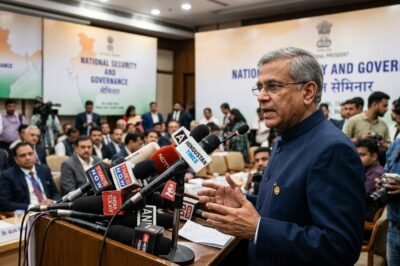
The Indian political landscape has long been defined by the symbiotic, yet occasionally complex, relationship between the Bharatiya Janata Party (BJP) and its ideological parent, the Rashtriya Swayamsevak Sangh (RSS). Following the 2024 General Elections, this relationship has come under renewed scrutiny from political analysts and activists alike. When Abhijeet Dipke of Citizens for Justice and Peace (CJP) asserted that the BJP remains in power primarily due to the foundational strength of the RSS, he touched upon a nerve that resonates through the corridors of power in New Delhi. The statement ‘They should listen to Mohan Bhagwat’ serves as a poignant reminder of the internal checks and balances that exist within the Hindutva ecosystem. As the BJP navigates the complexities of a coalition government, the guidance and sometimes the subtle critiques from the RSS Sarsanghchalak, Mohan Bhagwat, have become central to the national political discourse. This analysis delves into why the RSS remains the indispensable backbone of the BJP, the implications of recent friction between the two entities, and why Dipke’s commentary reflects a broader sentiment regarding the necessity of ideological alignment for the ruling party’s continued success. ## The Core Ideology: How the RSS Shapes BJP’s Governance The relationship between the RSS and the BJP is not merely one of political support; it is an organic connection rooted in the philosophy of Integral Humanism and the goal of cultural national reconstruction. The RSS provides the BJP with a steady stream of dedicated cadres, known as swayamsevaks, who form the grassroots workforce during election cycles. These individuals are trained in a specific discipline that emphasizes selflessness and ideological commitment, qualities that are often missing in purely transactional political organizations. Abhijeet Dipke’s observation highlights that the BJP’s electoral machinery is deeply embedded in this vast network of shakhas (branches). Without the silent, persistent work of the RSS at the booth level, the BJP’s ability to mobilize voters would be significantly diminished. This governance model relies on the RSS to act as a moral compass, ensuring that the political wing does not stray too far from its core civilizational objectives. ## Mohan Bhagwat’s Critical Narrative: A Shift in Tone? In the aftermath of the recent electoral results, Mohan Bhagwat delivered a speech that many interpreted as a subtle warning to the BJP leadership. He spoke about the dangers of arrogance and the necessity of consensus-building in a diverse nation. Bhagwat’s emphasis on the fact that a ‘true sevak’ (servant) should not be arrogant was seen as a commentary on the centralized leadership style that has dominated the BJP over the last decade. Abhijeet Dipke’s call for the BJP to ‘listen to Mohan Bhagwat’ suggests that the RSS leadership is sensing a disconnect between the party’s top-down approach and the grassroots reality. For the RSS, political power is a means to an end, not the end itself. When the party appears to prioritize individual personalities over organizational collective wisdom, the RSS leadership often steps in to recalibrate the movement. This shift in tone signals that the RSS is prepared to exercise its role as the senior partner in the ideological alliance, demanding more accountability and a return to the consultative processes that characterized the era of Atal Bihari Vajpayee. ## Abhijeet Dipke’s Perspective: The Power Dynamics Explained Abhijeet Dipke, representing the CJP, brings a critical outsider-insider view to the discussion. By stating that the BJP is in power because of the RSS, he acknowledges the structural reality of Indian right-wing politics. Dipke’s analysis focuses on the dependency of the BJP on the RSS’s social legitimacy. The RSS manages thousands of schools, health clinics, and social service projects across India, which creates a reservoir of goodwill that the BJP taps into during elections. Dipke argues that if the BJP ignores the warnings of Bhagwat, it risks alienating the very volunteers who make its victories possible. The CJP’s perspective is particularly relevant as it highlights how the RSS acts as a buffer between the state and the society. If the BJP’s policies face public backlash, it is often the RSS that has to perform the damage control on the ground. Dipke’s assertion is a reminder that the BJP’s ‘invincibility’ is a curated product of RSS labor, and any rift between the two could lead to a rapid erosion of the BJP’s organizational edge. ## Historical Context: The Evolution of the Sangh Parivar To understand why the RSS-BJP relationship is at a crossroads, one must look at the history of the Sangh Parivar. From the formation of the Bharatiya Jana Sangh in 1951 to the birth of the BJP in 1980, the RSS has always provided the ideological framework and the leadership personnel. Many of the BJP’s top leaders, including Narendra Modi and Amit Shah, began their careers as RSS pracharaks. However, the relationship has seen phases of tension before. During the Vajpayee years, the RSS-affiliated Swadeshi Jagran Manch was often at odds with the government’s economic liberalization policies. Today, the friction is less about policy and more about the nature of organizational authority. The current era has seen the BJP grow into the world’s largest political party, leading some within its ranks to believe they have outgrown the need for RSS supervision. Dipke’s commentary serves to debunk this notion, arguing that the BJP’s massive scale is still anchored by the RSS’s ideological purity and disciplined network. ## Internal Friction vs. Strategic Alignment: Managing Public Perception While some see Mohan Bhagwat’s comments as a sign of a deep rift, others view them as a strategic performance intended to maintain the RSS’s image as an independent social organization. By critiquing the BJP, the RSS reinforces its stance that it is not a political tool but a cultural entity concerned with the long-term health of the nation. This ‘friction’ allows the RSS to distance itself from the government’s unpopular decisions while retaining the power to influence its future direction. Abhijeet Dipke’s call to listen to Bhagwat highlights the importance of this perception management. If the public perceives the RSS as being fully subsumed by the BJP, the Sangh loses its moral authority. Therefore, occasional public disagreements are necessary for the health of the broader Hindutva movement. They provide a mechanism for internal correction and prevent the movement from becoming stagnant or overly focused on a single leader’s cult of personality. ## Electoral Impacts: The Role of Grassroots Mobilization Statistics from recent elections show that in regions where RSS activity is high, the BJP’s voter turnout and conversion rates are significantly better. The RSS’s ability to conduct door-to-door campaigns and manage local community concerns is a force multiplier for the BJP. Abhijeet Dipke’s analysis points to the fact that the 2024 results saw a slight dip in the BJP’s performance in areas where RSS cadres were reportedly less enthusiastic. This correlation underscores the point that the BJP cannot win on optics and media management alone; it needs the ‘boots on the ground’ that only the RSS can provide. For the BJP to maintain its dominance in upcoming state elections and the 2029 general election, it must ensure that the RSS cadre remains motivated and aligned with the party’s messaging. Ignoring Bhagwat’s advice could lead to a ‘silent withdrawal’ of RSS support, which would be catastrophic for the BJP’s electoral prospects. ## Conclusion on Future Implications The future of the BJP-RSS relationship will likely be characterized by a return to more traditional forms of consultation. As Abhijeet Dipke suggests, the BJP’s path to long-term stability lies in acknowledging its debt to the RSS and integrating Mohan Bhagwat’s broader vision into its governance style. The implications for India are profound: a more influential RSS could mean a greater focus on grassroots social issues and a shift away from the highly centralized, personality-driven politics of the last decade. If the BJP heeds the call to ‘listen to Mohan Bhagwat,’ we may see a period of internal consolidation and ideological sharpening. However, if the party chooses to ignore these warnings, it may find itself increasingly isolated, struggling to maintain its hold on power without the silent engine of the Sangh to drive it forward. The coming years will reveal whether the BJP can balance the demands of modern governance with the timeless expectations of its ideological parent.
Beyond the Ballot: An In-Depth Analysis of the RSS-BJP Power Dynamic and Mohan Bhagwat’s Evolving Rhetoric
Posted by
Stories





-

Hunkkaar Teaser Analysis: Aneet Padda’s Gritty Transformation and the Evolving Landscape of Indian Thrillers
-

Mithila Palkar: The Relatable Queen of Indian Web Series and Her Meteoric Rise
-

Wamiqa Gabbi: The Meteoric Rise of Indian Web Series’ Most Versatile Leading Lady
-

Triptii Dimri Biography: The Evolution of India’s Newest Cinematic Sensation and Web Series Star
-

Wamiqa Gabbi: The Rise of India’s New Digital Icon and the Future of OTT Stardom
-

Mithila Palkar: The Unstoppable Evolution of India’s Digital Darling and Her Journey to the Silver Screen
-

Mithila Palkar: The Comprehensive Journey of India’s Web Series Sensation and Digital Pioneer
-

Mithila Palkar: The Relatable Queen of Indian Web Series and Her Inspiring Journey to Stardom
-

Sobhita Dhulipala Biography: The Meteoric Rise of India’s Most Versatile Web Series Star
-

Mithila Palkar: The Unstoppable Journey of India’s Digital Darling and Web Series Queen
-

Triptii Dimri: The Complete Biography of India’s Newest Cinematic Sensation and Web Series Icon
-

Wamiqa Gabbi: The Ethereal Rise of India’s Most Versatile Web Series Star
-

Sobhita Dhulipala: The Unstoppable Rise of India’s Most Versatile Web Series Icon
-

Wamiqa Gabbi: The Meteoric Rise of the New Queen of Indian Web Series and Her Unstoppable Journey to Stardom
-

Triptii Dimri: The Meteoric Rise of India’s New Cinema Sweetheart and Web Series Icon
-

Wamiqa Gabbi: The Versatile Queen of Indian OTT and Her Phenomenal Rise to Stardom
-

Tripti Dimri Biography: The Rise of India’s New National Crush and Her Journey from Laila Majnu to OTT Stardom
-

Wamiqa Gabbi Biography: The Meteoric Rise of India’s Newest OTT Sensation and Versatile Powerhouse
-

Wamiqa Gabbi Biography: The Meteoric Rise of the Digital Queen of Indian Web Series
-

The Rise of Wamiqa Gabbi: A Deep Dive into the Journey of India’s Most Versatile OTT Sensation
-

The Meteoric Rise of Triptii Dimri: Biography, Acting Prowess, and the Journey of India’s Newest Cinema Sensation

Launching Soon: The Future of News with Our E-Newspaper
In the ever-evolving landscape of media and technology, we are thrilled to announce the upcoming launch of our innovative e-newspaper, set to redefine the way news is consumed in the digital age. Embracing the convenience and accessibility that the digital world offers, our e-newspaper aims to deliver real-time news updates, insightful articles, and interactive features directly to your devices. With a commitment to journalistic integrity and a passion for storytelling, we are dedicated to keeping you informed, engaged, and connected, no matter where you are. Stay tuned for the launch of our e-newspaper, where the future of news awaits at your fingertips.
Recent News
- Netanyahu Orders West Bank Closure Following Attack on Israelis Ahead of Elections

- Jio Platforms and OYO Parent Company IPOs Move Forward Amid Market Interest

- Financial Stability Key to Achieving Price Stability, Says RBI Governor Shaktikanta Das

- First Batch of 60 Indians Rescued from Cambodia Cybercrime Centers Return Home: A Deep Dive into the Human Trafficking Crisis

- Pune Porsche Crash: Juvenile Justice Board Remands Minor to Observation Home Until June 5
- US stocks jump after biggest wipeout for Dow Jones in over a year

Politics
- Netanyahu Orders West Bank Closure Following Attack on Israelis Ahead of Elections
- Court Convicts Medha Patkar in Defamation Case: A Deep Dive into the Legal Battle with Delhi LG V K Saxena
- In Abhijeet Dipke’s Message To “Cockroaches”, Pause In Protests And A “Real Leaders” Reveal – NDTV

- The Ethics and Optics of Military Justice: Analyzing Trump’s Decision to Bar Livestreaming the Fort Hood Gunman Execution

- Delhi’s Political Pressure Cooker: Analyzing the Anti-CEC Protests and Security Gridlock

- Anti-CEC protests LIVE: CJP leaders Das, Ranka booked for unauthorised entry at Jantar Mantar – The Hindu

Categories
- Art & Culture 106
- Auto 85
- Beauty 15
- Blog 307
- Books 7
- Business 370
- Celebrities 217
- Crime Files 139
- Democracy 308
- Education 84
- Entertainment 154
- Environment 133
- epaper 1
- Fashion 37
- Food 59
- Gadgets 89
- Guide 150
- Handicrafts 14
- Health 281
- Healthy Living 108
- History 5
- incidents 169
- Lifestyle 41
- Music 7
- Photography 15
- Politics 460
- Science & Technology 160
- Sports 283
- Tech 142
- Television 4
- Travel 68
- Travel & Tourism 30
- Trends 57
- Weather 9
- Web Series 97
- Workout 4
- World 665
Leave a Reply