
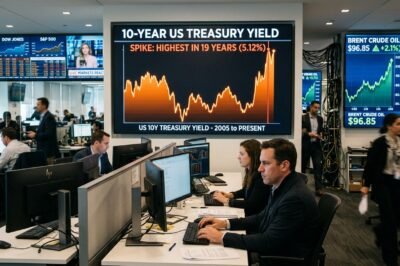
The global financial ecosystem is currently grappling with a transformative period of volatility as the benchmark 10-year US Treasury yield has surged to a level not seen in nearly two decades. This dramatic escalation, touching heights reminiscent of the pre-2008 financial crisis era, has sent shockwaves through international markets, reconfiguring the expectations of investors, policymakers, and consumers alike. At the heart of this fiscal turbulence lies a complex interplay between stubborn inflationary pressures and a significant spike in global oil prices, which have recently breached critical thresholds. As the yield on the world’s most influential debt instrument climbs, it serves as a stark reminder of the ‘higher for longer’ interest rate regime championed by the Federal Reserve. This shift is not merely a technical adjustment within the bond market but a fundamental repricing of risk across the globe. Investors are now forced to reconcile with a reality where the risk-free rate of return is significantly higher, putting pressure on equities, real estate, and emerging market currencies. The confluence of rising energy costs and tightening monetary policy has created a high-stakes environment where every basis point movement in the Treasury market carries the weight of potential economic contraction or a localized banking crisis. Understanding this 19-year peak requires a deep dive into the mechanics of sovereign debt, energy geopolitics, and the central bank’s unwavering commitment to price stability.
The Intersection of Sovereign Debt and Crude Oil
The primary catalyst for the recent jump in yields is the relentless climb of crude oil prices. As Brent and West Texas Intermediate (WTI) crude approach the $100 per barrel mark, concerns about a second wave of inflation have intensified. Oil is the lifeblood of the global economy, and its cost directly influences the price of transportation, manufacturing, and consumer goods. When energy prices rise, the headline inflation rate often follows, making it difficult for central banks to justify pausing their interest rate hikes. This inflationary expectation is being baked into bond yields; investors demand higher returns to compensate for the eroding purchasing power of future fixed-income payments. Furthermore, the supply-side constraints orchestrated by OPEC+ members, particularly Saudi Arabia and Russia, have tightened the market at a time when demand remains surprisingly resilient. This geopolitical maneuvering has created a floor for oil prices that complicates the Federal Reserve’s task. If energy remains expensive, the ‘last mile’ of returning inflation to the 2% target becomes significantly more difficult, leading market participants to sell off bonds in anticipation of even tighter monetary conditions. The relationship between the 10-year yield and crude oil has become a feedback loop: higher oil fuels inflation expectations, which drives yields up, which in turn strengthens the US dollar, making oil (priced in dollars) even more expensive for the rest of the world.
Unpacking the 19-Year Peak: Historical Context and Realities
To find a precedent for the current 10-year Treasury yield levels, economists must look back to 2007, just before the onset of the Great Financial Crisis. However, the economic landscape today is vastly different from the mid-2000s. In 2007, the global economy was dealing with a housing bubble and excessive leverage in the private sector. Today, the pressure stems from a combination of massive post-pandemic fiscal stimulus, disrupted supply chains, and a fundamental shift in labor market dynamics. Reaching a 19-year peak signifies a definitive break from the post-2008 era of Quantitative Easing (QE) and zero-interest rate policies (ZIRP). For over a decade, yields were suppressed by central bank intervention, creating an environment that favored growth stocks and aggressive borrowing. Now, the ‘Term Premium’—the extra compensation investors demand for the risk of holding long-term debt—is returning to the market. This historical milestone reflects a normalization of the bond market, but the speed of the transition is what causes the most concern. As yields rise, the price of existing bonds falls, leading to significant unrealized losses on the balance sheets of financial institutions that are holding long-dated Treasuries. This dynamic was a key factor in the regional banking stresses seen earlier this year and remains a latent risk as yields continue their northward trajectory.
The Role of the Federal Reserve’s ‘Higher for Longer’ Strategy
Central to the bond market sell-off is the communication strategy of the Federal Reserve. Chair Jerome Powell and other FOMC members have consistently signaled that even if they stop raising the benchmark federal funds rate, they are in no hurry to cut it. This ‘higher for longer’ stance has recalibrated the entire yield curve. Short-term rates have been high for some time, but the long end of the curve (the 10-year and 30-year bonds) is finally catching up as the market accepts that a return to 2% interest rates is not on the horizon. The Federal Reserve is facing a dual challenge: maintaining employment while crushing inflation. Currently, the US labor market remains remarkably tight, with low unemployment rates giving the Fed the ‘cover’ it needs to keep rates elevated. However, the rise in long-term yields effectively does the Fed’s work for it by tightening financial conditions. As yields rise, borrowing becomes more expensive for corporations and individuals, which should theoretically slow down economic activity. The risk, however, is an ‘over-tightening’ scenario where the surge in yields leads to a hard landing or a deep recession. The Fed’s balance sheet reduction program, known as Quantitative Tightening (QT), is also contributing to the yield surge. By allowing billions of dollars in Treasuries to roll off its balance sheet each month, the Fed is reducing the supply of buyers, forcing the private market to absorb a massive influx of new government debt.
The Impact of US Deficit Spending
Another critical factor contributing to the yield peak is the sheer volume of Treasury issuance. The US government is running substantial fiscal deficits, necessitating the sale of trillions of dollars in new bonds. In the past, the Fed or foreign governments like China and Japan were reliable buyers of this debt. Today, however, the Fed is a net seller, and foreign appetite for Treasuries has softened due to geopolitical tensions and the rising cost of currency hedging. This supply-demand imbalance is a significant tailwind for yields. When there is more supply of bonds than there is demand at a certain price, prices must fall and yields must rise to attract new buyers. This fiscal reality is becoming a primary driver of the long end of the curve, independent of immediate inflation data.
Global Market Contagion and the Strengthening US Dollar
The ramifications of a 19-year peak in US yields extend far beyond American borders. Because the US Treasury bond is the world’s benchmark ‘safe haven’ asset, its yield dictates the pricing of debt globally. As US yields rise, capital is naturally drawn toward the United States in search of higher returns, leading to a significant strengthening of the US dollar. A stronger dollar is a double-edged sword. While it helps lower inflation within the US by making imports cheaper, it exports inflation to the rest of the world. Countries that import commodities priced in dollars—such as oil and food—find their costs skyrocketing as their local currencies weaken. Emerging markets are particularly vulnerable; many of these nations have debt denominated in US dollars. As the dollar strengthens and US yields rise, the cost of servicing that debt becomes prohibitive, raising the specter of sovereign defaults. Even developed economies like the Eurozone and Japan are feeling the heat. The Japanese Yen, in particular, has faced immense pressure as the gap between US yields and the Bank of Japan’s near-zero rates widens. This has forced international central banks to consider their own interest rate hikes or direct currency interventions to prevent a total collapse of their exchange rates, further tightening global liquidity.
Sector-Specific Impacts: Real Estate, Equities, and Emerging Markets
The surge in the 10-year yield has immediate and tangible effects on various sectors of the economy. Perhaps the most visible impact is in the housing market. Mortgage rates in the US are typically benchmarked against the 10-year Treasury. As the yield hit its 19-year peak, 30-year fixed mortgage rates have climbed toward 7.5% or even 8% in some regions, a level not seen by a generation of homebuyers. This has caused a dramatic slowdown in home sales and reduced the affordability of housing to record lows. In the equity markets, higher yields act as a gravity force on stock valuations. When investors can get a nearly 5% guaranteed return from the US government, they are less willing to pay high multiples for growth stocks that may not see significant earnings for years. Technology stocks, which are sensitive to interest rates because their future cash flows are discounted at higher rates, have seen increased volatility. Furthermore, the corporate sector is facing a ‘maturity wall’ where debt taken out during the low-interest-rate era must be refinanced at these new, much higher rates. This could lead to a squeeze in corporate profit margins and a potential reduction in capital expenditure and hiring. For emerging markets, the combination of high oil and high US yields is a ‘perfect storm’ that threatens to derail post-pandemic recovery efforts, as capital flight toward the US safety net accelerates.
Conclusion: Navigating the New Era of Fiscal Uncertainty
The ascent of the US 10-year Treasury yield to a 19-year peak represents a watershed moment for the global financial system. Driven by the twin engines of surging energy costs and a hawkish Federal Reserve, this move signals that the era of ‘easy money’ is firmly in the rearview mirror. As oil prices continue to fluctuate near triple digits, the inflationary threat remains a potent force that will likely keep yields elevated for the foreseeable future. Investors and policymakers must now navigate a landscape where the cost of capital is fundamentally higher, and the margin for error is significantly thinner. While the US economy has shown remarkable resilience thus far, the cumulative impact of high yields, expensive energy, and a strong dollar will inevitably test the limits of global growth. The coming months will be crucial as the market watches for signs of a definitive peak in yields or, conversely, a break toward even higher levels that could precipitate a broader economic recalibration. In this new era, the traditional rules of the game have changed, and the ability to adapt to a high-yield environment will define the winners and losers of the next decade. Success will depend on fiscal discipline, strategic energy management, and a keen eye on the evolving relationship between sovereign debt and the real economy.






































Leave a Reply