
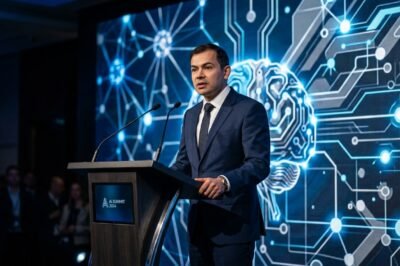
In the rapidly shifting landscape of global technology, few voices carry as much weight as that of Sir Demis Hassabis, the visionary co-founder and CEO of Google DeepMind. During a recent discourse that has sent ripples through the corridors of power in both Silicon Valley and Washington D.C., Hassabis characterized recent high-profile artificial intelligence hacks as mere ‘early warning shots.’ This sobering assessment serves as a critical wake-up call for a world increasingly reliant on automated systems and neural networks. As the boundary between physical and digital reality continues to blur, the vulnerabilities exposed by early-stage AI exploitations highlight a systemic fragility that could have catastrophic consequences if left unaddressed. For investors, policymakers, and tech enthusiasts alike, the message is clear: the current era of relative digital stability is under threat from an unprecedented surge in sophisticated, AI-driven cyber-adversaries. The ‘honeymoon phase’ of generative AI is effectively over, replaced by a grim realization that the same tools designed to revolutionize healthcare and climate science are being weaponized by state actors and criminal syndicates to dismantle the foundations of digital trust.
The Context of the Early Warning Shots
When Hassabis speaks of ‘early warning shots,’ he is referring to a specific series of incidents where large language models (LLMs) and autonomous agents were manipulated to bypass security protocols. These incidents, though contained, demonstrated a proof-of-concept that is terrifying in its simplicity and scale. For years, cybersecurity was a game of cat and mouse played with static code. Today, the introduction of AI has fundamentally changed the physics of this conflict. According to reports from Reuters and other major financial outlets, the sophisticated nature of these breaches suggests that attackers are no longer just looking for ‘open windows’ but are instead training their own models to find architectural flaws in the very fabric of internet infrastructure.
DeepMind, as a leading architect of the current AI revolution, has a front-row seat to these emerging threats. Hassabis’s warnings align with a growing consensus among intelligence agencies that the barrier to entry for high-level cyberattacks has been drastically lowered. A novice hacker, aided by a fine-tuned LLM, can now generate polymorphic code that evades traditional signature-based antivirus software. This democratization of destruction is what Hassabis identifies as the true danger, signaling that the ‘warning shots’ are not just a display of power, but a live-fire exercise for future conflicts that could target national grids, financial ledgers, and healthcare databases on a global scale.
The Evolving Threat Landscape in the Age of Generative AI
The transition from traditional malware to AI-augmented threats represents a paradigm shift in digital warfare. One of the primary concerns highlighted by Hassabis and his contemporaries is the speed at which these attacks can iterate. Traditional hacking required a human in the loop to identify a vulnerability, write the exploit, and execute it. With AI, this cycle is compressed from weeks to seconds. We are entering an era of ‘automated exploitation,’ where malicious models can probe millions of endpoints simultaneously, learning from each failed attempt until they find a path to penetration. This is not just a theoretical risk; it is an active evolution of the digital ecosystem.
Furthermore, the psychological dimension of these attacks cannot be overstated. AI excels at social engineering on a massive scale. By scraping social media and corporate communications, AI can generate perfectly tailored phishing emails or deepfake audio that can deceive even the most vigilant employees. Hassabis emphasizes that these techniques are currently being tested in ‘low-stakes’ environments to refine their efficacy. When these ‘warning shots’ give way to full-scale operations, the objective will not just be data theft, but the total erosion of institutional credibility. If people cannot trust their emails, their bank statements, or even the voices of their colleagues, the digital economy faces a crisis of faith that no firewall can fix.
Market Implications for Big Tech and Cybersecurity
The financial markets have reacted with a mixture of trepidation and strategic reallocation following these warnings. For Alphabet Inc. (Google’s parent company), the dual pressure of leading the AI race while simultaneously securing the global digital commons is immense. Investors are increasingly scrutinizing the ‘security spend’ of tech giants, viewing it no longer as an overhead cost but as a core competitive advantage. The valuation of cybersecurity firms like CrowdStrike, Palo Alto Networks, and Zscaler has seen a significant ‘security premium’ as the market realizes that AI safety is the next great trillion-dollar industry. Hassabis’s comments underscore a shift where the ‘defensive AI’ market is expected to outpace the growth of creative AI tools in the coming decade.
From a macroeconomic perspective, the ‘early warning shots’ imply a period of increased capital expenditure for all Fortune 500 companies. As businesses integrate AI into their supply chains and customer interfaces, the ‘attack surface’ grows exponentially. This necessitates a ‘Zero Trust’ architecture that is inherently expensive to implement and maintain. Analysts suggest that companies failing to heed Hassabis’s warning may face not only technical debt but also massive insurance premiums and legal liabilities. The financial fallout from a major, AI-coordinated breach could rival the economic impact of a natural disaster, leading to a flight to quality where only the most secure platforms survive the upcoming shakeout.
The Dual-Use Nature of AI: Shield vs. Sword
At the heart of Hassabis’s analysis is the ‘dual-use’ dilemma that has haunted technological breakthroughs since the dawn of the nuclear age. The same neural network architectures that allow DeepMind’s AlphaFold to predict protein structures can, in theory, be repurposed to design novel bioweapons or discover zero-day vulnerabilities in critical software. This duality creates a strategic paradox: to build better defenses, companies must first understand how to build better weapons. This ‘red teaming’ process—where developers act as hackers to find flaws—is now a mandatory component of AI development at Google and its peers.
However, the ‘shield’ is often at a disadvantage. An attacker only needs to be right once, while a defender must be right every single time. Hassabis argues that for the shield to prevail, we need a ‘hardened’ AI infrastructure that is built with security as a primary constraint rather than an afterthought. This involves ‘adversarial robustness,’ where models are trained to resist manipulation and ‘jailbreaking.’ The challenge lies in the fact that as we make models more secure, they often become less flexible or more computationally expensive. Balancing these trade-offs will be the defining technical challenge for the next generation of engineers who must turn the lessons from these ‘warning shots’ into a resilient digital armor.
Regulatory Pressure and the Need for Global Governance
Hassabis’s vocal stance also serves as a catalyst for legislative action. Currently, the regulatory landscape for AI is a patchwork of regional initiatives, from the EU’s AI Act to executive orders in the United States. However, cyber threats are inherently borderless. A ‘warning shot’ fired from a server in one hemisphere can hit a target in another in milliseconds. Hassabis is a proponent of international cooperation, suggesting that we need something akin to the IAEA (International Atomic Energy Agency) for artificial intelligence. This body would oversee the safety standards of the most powerful ‘frontier models’ to ensure they aren’t being used for malicious purposes.
The political implications are equally stark. Governments are beginning to realize that AI security is national security. The Reuters report highlights how state-sponsored groups are already leveraging LLMs to enhance their offensive capabilities. This creates an arms race where neutral commercial entities like Google DeepMind are caught in the middle. The call for ‘early warning systems’ is not just for the private sector but for a global monitoring network that can identify and neutralize AI-based threats before they go viral. Without a unified regulatory framework, the ‘early warning shots’ will inevitably escalate into a fragmented, high-stakes digital conflict that could stifle global innovation for years.
Conclusion: Navigating the Future of Digital Security
The warnings issued by Demis Hassabis represent a pivotal moment in the history of the information age. We have moved beyond the theoretical risks of artificial intelligence into an era of tangible, documented threats. These ‘early warning shots’ are not an excuse for despair, but a mandate for action. The future of the digital economy depends on our ability to transition from a reactive security posture to a proactive, AI-native defense strategy. This will require unprecedented collaboration between competing tech giants, rigorous international oversight, and a fundamental rethinking of how we build and deploy intelligent systems.
Ultimately, the resilience of our society will be measured by how we respond to these precursors of conflict. If we treat these incidents as isolated glitches, we risk a catastrophic failure of the systems that underpin modern life. However, if we heed Hassabis’s call and invest in the ‘defensive AI’ of tomorrow, we can turn these warning shots into the foundation of a more secure and stable digital future. The race is on, and as Hassabis rightly notes, the clock is already ticking. The window for preparation is narrowing, and the next ‘shot’ may not be a warning, but a direct hit on the heart of the global digital infrastructure.






































Leave a Reply