
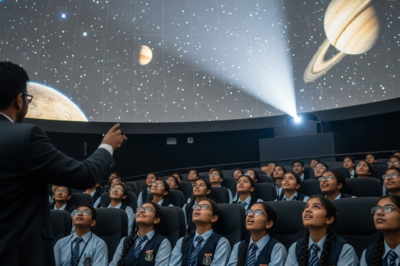
The universe has always been a source of profound mystery and endless fascination for humanity. From the early stargazers who mapped the constellations to the modern astrophysicists probing the depths of black holes, the quest for cosmic knowledge is a fundamental part of the human experience. In a significant move to foster this curiosity among the younger generation, the Guwahati Planetarium has officially announced a series of special astronomical shows specifically curated for school students during their upcoming breaks. This initiative is not merely a scheduled event but a strategic effort to bridge the gap between theoretical classroom learning and the awe-inspiring reality of the cosmos. As the leading center for astronomical research and public awareness in North East India, the Guwahati Planetarium’s decision comes at a time when space science is witnessing a renaissance in India, spurred by the monumental successes of ISRO’s Chandrayaan and Aditya-L1 missions.
The Educational Significance of Astronomical Observation
For school students, seeing the rings of Saturn or the craters of the moon projected in a high-definition dome environment is a transformative experience. Educational psychologists have long argued that visual and experiential learning significantly improves retention and interest in STEM (Science, Technology, Engineering, and Mathematics) subjects. The Guwahati Planetarium’s special shows are designed to take advantage of this by providing a multi-sensory journey through space. Instead of reading about the lifecycle of a star in a textbook, students will witness the birth of a protostar and its eventual transformation into a supernova or a white dwarf. This immersive approach helps in demystifying complex concepts such as gravity, light-years, and celestial mechanics, making science accessible and exciting rather than intimidating. Furthermore, by targeting students during their breaks, the institution ensures that learning continues outside the rigid structure of the school curriculum, encouraging self-driven inquiry and a genuine passion for discovery.
Decoding the Special Show Schedule for School Students
The upcoming schedule at the Guwahati Planetarium is meticulously planned to cater to different age groups and levels of understanding. The shows are expected to cover a wide array of topics, ranging from the basics of our Solar System for primary students to the intricacies of General Relativity and Dark Matter for senior secondary students. One of the highlights of the special program is a dedicated segment on India’s achievements in space exploration. This segment will detail the engineering marvels behind the Polar Satellite Launch Vehicle (PSLV) and the strategic importance of the Gaganyaan mission. Additionally, there will be live interactive sessions where resident astronomers and educators will answer questions, debunk space myths, and provide guidance on how students can pursue careers in aerospace engineering and astrophysics. The timing of these shows is strategically aligned with school holidays to ensure maximum participation, and special group booking facilities are being made available to educational institutions and non-governmental organizations working with underprivileged children.
The Evolution of Guwahati Planetarium: From 1994 to Today
Since its inception in 1994, the Guwahati Planetarium has been a landmark of scientific temper in the region. Located on the banks of the mighty Brahmaputra River, its iconic dome-shaped architecture has welcomed millions of visitors. Over the decades, the planetarium has undergone several technological upgrades to keep pace with global standards. Initially starting with an optomechanical projection system, it has now transitioned into a hybrid environment that combines the precision of traditional star projectors with the versatility of digital fulldome systems. The current setup allows for a seamless blend of historical star maps and real-time data from space telescopes like James Webb and Hubble. This evolution reflects the commitment of the Assam State Science and Technology Council (ASTEC) to provide world-class facilities to the citizens of Assam. The special shows for students are a continuation of this legacy, utilizing the latest technology to inspire the next generation of scientists and thinkers in the North East.
Why This Initiative is Crucial During School Breaks
School breaks are often seen as a period of relaxation, but they also offer a unique opportunity for enrichment activities that are often sidelined by the pressure of examinations. The ‘Special Astronomical Shows’ initiative serves as a productive alternative to the increasing digital screen time that plagues modern childhood. By bringing students to the planetarium, parents and educators provide them with a social and educational experience that stimulates the brain in ways that a mobile game or a television show cannot. Moreover, these sessions provide a platform for like-minded students to meet and discuss their interests, potentially leading to the formation of astronomy clubs and science circles within schools. In an era where critical thinking and scientific literacy are more important than ever, initiatives like this play a vital role in shaping a well-informed citizenry capable of understanding global challenges such as climate change, space debris, and the future of energy.
Collaborative Efforts and Community Outreach
The success of the special shows is also a result of collaborative efforts between the Guwahati Planetarium, local schools, and various science advocacy groups. The administration has reached out to school boards to integrate these visits into their extra-curricular calendars. Furthermore, the planetarium is planning to host workshops on telescope making and night-sky observation in conjunction with the dome shows. This holistic approach ensures that students do not just remain passive observers but become active participants in the scientific process. For many students from rural areas around Guwahati, a visit to the planetarium is a once-in-a-lifetime opportunity. To address this, the planetarium often coordinates with government schemes to provide subsidized or free entry for students from government schools, ensuring that the wonders of the universe are not restricted to those who can afford it. This inclusivity is central to the mission of the Guwahati Planetarium, making science a democratic pursuit.
Navigating the Visit: A Guide for Parents and Educators
Planning a visit to the Guwahati Planetarium during the special show period requires some preparation to ensure a smooth experience. The planetarium is located in the heart of the city at Latasil, making it easily accessible via public transport and private vehicles. Given the expected high turnout during the school break, it is highly recommended to check the official website or local news bulletins for the exact show timings and ticket availability. Most shows run for approximately 45 minutes to an hour. Visitors should also take the time to explore the outdoor exhibits and the science park located within the premises, which feature interactive models of physical principles. For school groups, the planetarium offers guided tours that provide additional context to the shows. It is also important to note that maintaining silence and following safety protocols inside the dome is essential to ensure that everyone can enjoy the immersive visual and auditory experience without distraction.
Looking Ahead: The Future of Space Science Awareness
The special shows at the Guwahati Planetarium are a microcosm of a larger movement towards scientific awareness in India. As the country moves towards its goal of having its own space station and sending humans to the moon, the need for a scientifically literate youth population has never been higher. The planetarium is not just a building with a projector; it is a catalyst for dreams. Every child who gazes up at the simulated night sky and wonders about the possibility of life on other planets is a potential contributor to our future. In the coming years, we can expect the Guwahati Planetarium to further expand its digital library, perhaps incorporating virtual reality (VR) and augmented reality (AR) to provide even more personal and interactive experiences. As we look to the stars, institutions like the Guwahati Planetarium remain our grounded link to the infinite, reminding us of our small yet significant place in the grand tapestry of the universe.
Conclusion
In conclusion, the Guwahati Planetarium’s announcement of special astronomical shows for school students is a commendable step towards promoting scientific inquiry and educational excellence in Assam. By providing a high-quality, engaging, and accessible platform for learning, the planetarium is fulfilling its role as a beacon of knowledge. Whether you are a student, a parent, or an educator, these shows offer a unique opportunity to step away from the mundane and witness the extraordinary. The lessons learned under the dome—of curiosity, of the scale of the universe, and of the power of human ingenuity—will undoubtedly resonate with the students long after the shows have ended, perhaps inspiring the next great Indian scientist to begin their journey today.






































Leave a Reply