
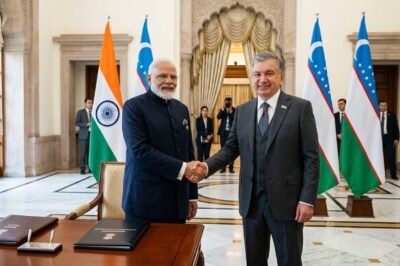
The diplomatic landscape of Central Asia has witnessed a monumental shift as India and Uzbekistan officially transitioned their relationship to a Comprehensive Strategic Partnership. This significant upgrade, announced during high-level bilateral discussions, signals a deepening of trust and a shared vision for a stable, prosperous Eurasia. The relationship between New Delhi and Tashkent has always been rooted in historical commonalities and mutual respect, but the current geopolitical environment has necessitated a more robust framework for cooperation. By elevating their ties, both nations are acknowledging that their partnership is no longer just about trade or cultural exchange; it is a critical pillar of regional security and economic integration. At the heart of this new agreement is an ambitious goal: to increase bilateral trade to 5 billion dollars. This target represents more than a sevenfold increase from current levels, reflecting a bold confidence in the untapped potential of their economic synergy. As India seeks to expand its footprint in Central Asia through its ‘Connect Central Asia’ policy, Uzbekistan emerges as its most vital partner, serving as a gateway to a resource-rich and strategically vital region. This analysis explores the multi-faceted layers of this partnership, the roadmap to the 5 billion dollar trade target, and the broader implications for the global balance of power. The Evolution of India-Uzbekistan Relations: From Historical Silk Road to Modern Synergy. The ties between India and Uzbekistan are not a modern invention but a continuation of a millennium-old dialogue. Historically, the Silk Road served as a conduit for the exchange of ideas, religions, and goods between the two regions. The influence of Central Asian architecture, cuisine, and language on the Indian subcontinent is a testament to this deep-rooted connection. In the contemporary era, Uzbekistan was one of the first countries to recognize India’s independence, and India was among the first to establish diplomatic relations with Uzbekistan after it gained independence from the Soviet Union in 1991. Over the last three decades, the relationship has evolved from one of friendly cooperation to a strategic partnership in 2011. The current elevation to a Comprehensive Strategic Partnership (CSP) signifies a mature relationship that encompasses every aspect of national endeavor, including space exploration, nuclear energy, and advanced defense technology. This evolution is driven by a mutual understanding that in a multipolar world, regional powers must collaborate to safeguard their interests against external pressures and radicalism. Analyzing the 5 Billion Dollar Trade Target: Economic Blueprint and Sectoral Growth. Setting a 5 billion dollar trade target is a clear indication that both nations are ready to move past the incremental growth of the previous decade. Currently, bilateral trade hovers around 700 to 800 million dollars, heavily dominated by pharmaceuticals and chemical products. To reach the 5 billion dollar mark, India and Uzbekistan have identified several ‘sunrise’ sectors. Firstly, pharmaceuticals will remain a cornerstone, but the focus is shifting from simple export-import to joint manufacturing units in Uzbekistan’s special economic zones. Secondly, agriculture and food processing offer immense potential. India’s expertise in agricultural technology and Uzbekistan’s vast arable land provide a perfect match for ensuring food security. Thirdly, the mineral sector is crucial; Uzbekistan is one of the world’s largest producers of gold and uranium, resources that are vital for India’s energy security and economic stability. Furthermore, cooperation in the textile industry, where Uzbekistan is a major cotton producer and India has advanced processing capabilities, will be a major driver of this growth. The establishment of a joint working group on trade and investment will facilitate the removal of non-tariff barriers and streamline customs procedures to meet this ambitious deadline. The Strategic Significance of Connectivity: Chabahar Port and the INSTC Corridor. Perhaps the biggest challenge to the India-Uzbekistan partnership has been the lack of direct land connectivity due to regional geopolitical constraints. To circumvent this, both nations have prioritized the development of the International North-South Transport Corridor (INSTC) and the effective utilization of Iran’s Chabahar Port. Uzbekistan has expressed strong interest in using the Shahid Beheshti Terminal at Chabahar for its exports to the Indian market and beyond. By integrating Uzbekistan into the multimodal transport network, India is effectively creating a ‘southern corridor’ that bypasses traditional bottlenecks. The recent discussions have also touched upon the construction of the Trans-Afghan railway, which would connect Termez in Uzbekistan to Mazar-e-Sharif and eventually to the ports of the Indian Ocean. While the political situation in Afghanistan remains a variable, the strategic intent to link the landlocked Central Asian states to the warm waters of the Arabian Sea is a shared priority that will redefine trade routes in the 21st century. Defense and Security Cooperation: Counter-Terrorism and Regional Stability. Security cooperation is a fundamental pillar of the Comprehensive Strategic Partnership. Both India and Uzbekistan face common threats from religious extremism, drug trafficking, and cross-border terrorism emanating from unstable regions. The ‘DUSTLIK’ joint military exercises, which have been held annually, demonstrate the growing interoperability between the two armed forces. These exercises focus on counter-insurgency and counter-terrorism operations in mountainous and urban terrains. Beyond drills, the partnership now includes cooperation in defense production and the modernization of Uzbekistan’s military infrastructure using Indian credit lines. There is also a significant emphasis on intelligence sharing and cybersecurity. As the digital landscape becomes a new frontier for warfare, India’s prowess in software and Uzbekistan’s strategic location make them ideal partners in building a resilient digital defense mechanism. Their shared stance on a peaceful and stable Afghanistan is also a crucial element of their regional security policy, advocating for an inclusive government in Kabul that does not allow its territory to be used for terrorism. Technological and Cultural Exchange: Digital Public Infrastructure and Soft Power. India’s ‘Digital India’ success story has found a captive audience in Tashkent. As part of the new partnership, India has offered to share its Digital Public Infrastructure (DPI) stack, including UPI and Aadhaar-like systems, to help Uzbekistan modernize its governance and financial services. This ‘Tech-Diplomacy’ is complemented by a strong focus on human resource development. The opening of campuses of Indian universities like Amity and Sharda in Uzbekistan has made the country a hub for Indian-style education in Central Asia. Culturally, the popularity of Indian cinema, yoga, and classical dance continues to be a powerful tool of soft power. The ‘Indology’ departments in Uzbek universities and the active Indian Cultural Centre in Tashkent ensure that the people-to-people ties remain vibrant. This holistic approach ensures that the partnership is not just a high-level government-to-government interaction but a multi-layered engagement that involves students, entrepreneurs, and artists. The Geopolitical Implications for Central Asia and the Global South. The strengthening of India-Uzbekistan ties has far-reaching implications for the geopolitical balance in Eurasia. For Uzbekistan, India provides a democratic and reliable alternative to the over-dependence on other regional giants like Russia and China. It allows Tashkent to practice a truly multi-vector foreign policy. For India, Uzbekistan is the lynchpin of its Central Asia strategy. A strong presence in Uzbekistan allows India to project its influence in a region that is often described as the ‘heartland’ of the world. Furthermore, as both nations are prominent voices in the Global South, their collaboration within the Shanghai Cooperation Organisation (SCO) and the United Nations helps in advocating for a more equitable global order. The upgrade to a Comprehensive Strategic Partnership is a signal to the world that India and Uzbekistan are ready to take on greater responsibilities in maintaining regional peace and driving global economic growth. Future Implications and Conclusion. The road ahead for India and Uzbekistan is paved with both opportunities and challenges. While the $5 billion trade target is ambitious, the institutional framework laid out by the Comprehensive Strategic Partnership provides a solid foundation for achieving it. The success of this partnership will depend on the timely implementation of connectivity projects and the ability of both nations to navigate the complex security dynamics of the region. As India continues its ascent as a global economic powerhouse, its partnership with a reform-oriented and strategically located Uzbekistan will be a defining feature of its foreign policy. The transformation of this relationship from a historical friendship into a modern, comprehensive, and strategic alliance marks the beginning of a new chapter where both nations work in tandem to shape the future of Eurasia. In conclusion, the New Delhi-Tashkent axis is set to become one of the most consequential partnerships of this decade, blending economic ambition with strategic necessity.
India and Uzbekistan Elevate Relations to Comprehensive Strategic Partnership: A New Era of Central Asian Diplomacy
Posted by
Stories





-

Hunkkaar Teaser Analysis: Aneet Padda’s Gritty Transformation and the Evolving Landscape of Indian Thrillers
-

Mithila Palkar: The Relatable Queen of Indian Web Series and Her Meteoric Rise
-

Wamiqa Gabbi: The Meteoric Rise of Indian Web Series’ Most Versatile Leading Lady
-

Triptii Dimri Biography: The Evolution of India’s Newest Cinematic Sensation and Web Series Star
-

Wamiqa Gabbi: The Rise of India’s New Digital Icon and the Future of OTT Stardom
-

Mithila Palkar: The Unstoppable Evolution of India’s Digital Darling and Her Journey to the Silver Screen
-

Mithila Palkar: The Comprehensive Journey of India’s Web Series Sensation and Digital Pioneer
-

Mithila Palkar: The Relatable Queen of Indian Web Series and Her Inspiring Journey to Stardom
-

Sobhita Dhulipala Biography: The Meteoric Rise of India’s Most Versatile Web Series Star
-

Mithila Palkar: The Unstoppable Journey of India’s Digital Darling and Web Series Queen
-

Triptii Dimri: The Complete Biography of India’s Newest Cinematic Sensation and Web Series Icon
-

Wamiqa Gabbi: The Ethereal Rise of India’s Most Versatile Web Series Star
-

Sobhita Dhulipala: The Unstoppable Rise of India’s Most Versatile Web Series Icon
-

Wamiqa Gabbi: The Meteoric Rise of the New Queen of Indian Web Series and Her Unstoppable Journey to Stardom
-

Triptii Dimri: The Meteoric Rise of India’s New Cinema Sweetheart and Web Series Icon
-

Wamiqa Gabbi: The Versatile Queen of Indian OTT and Her Phenomenal Rise to Stardom
-

Tripti Dimri Biography: The Rise of India’s New National Crush and Her Journey from Laila Majnu to OTT Stardom
-

Wamiqa Gabbi Biography: The Meteoric Rise of India’s Newest OTT Sensation and Versatile Powerhouse
-

Wamiqa Gabbi Biography: The Meteoric Rise of the Digital Queen of Indian Web Series
-

The Rise of Wamiqa Gabbi: A Deep Dive into the Journey of India’s Most Versatile OTT Sensation
-

The Meteoric Rise of Triptii Dimri: Biography, Acting Prowess, and the Journey of India’s Newest Cinema Sensation

Launching Soon: The Future of News with Our E-Newspaper
In the ever-evolving landscape of media and technology, we are thrilled to announce the upcoming launch of our innovative e-newspaper, set to redefine the way news is consumed in the digital age. Embracing the convenience and accessibility that the digital world offers, our e-newspaper aims to deliver real-time news updates, insightful articles, and interactive features directly to your devices. With a commitment to journalistic integrity and a passion for storytelling, we are dedicated to keeping you informed, engaged, and connected, no matter where you are. Stay tuned for the launch of our e-newspaper, where the future of news awaits at your fingertips.
Recent News
- Asian Games 2026 Kabaddi: A Comprehensive Analysis of Scores, Match Results, and the Evolving Points Table

- Allu Arjun and Atlee’s Raaka Sets Guinness World Record for Using Motion-Capture with 37 Performers Simultaneously

- Revolutionary Chemical Recycling: Turning Plastic Waste Into High-Grade Gasoline and Diesel

- Lava Virat Curve: A New Benchmark for Endurance and Performance in the Mid-Range Segment

- Clinicians’ Words Hold Power to Heal or Harm Patients: A Comprehensive Analysis

- Decoding the Motorola Signature 27: A New Era of Mobile Photography and Design

Politics
- India Rejects Pakistan-China Boundary Joint Commission: A Detailed Analysis of Sovereign Rights and Geopolitical Tensions
- Seven Former Australia Captains Voice Grave Welfare Concerns for Imran Khan: A Cricket-Diplomacy Crisis

- Sanjeev Sanyal’s Stand: Why ‘Dhurandhar’ Is a Cultural Narrative, Not Propaganda
- Strategic Reshuffle: Analyzing the Impact of Sachin Pilot Replacing Bhupesh Baghel in Punjab

- The Pentagon’s High-Stakes Hunt: Mass Polygraph Tests and the Investigation into the Iran War Data Leak

- PM Modi Recycles Half Water-Half Air Line At Shri Ram College, 13 Years After Big Launch Speech – NDTV
Categories
- Art & Culture 101
- Auto 85
- Beauty 15
- Blog 278
- Books 7
- Business 359
- Celebrities 217
- Crime Files 139
- Democracy 308
- Education 84
- Entertainment 154
- Environment 133
- epaper 1
- Fashion 37
- Food 59
- Gadgets 87
- Guide 150
- Handicrafts 11
- Health 270
- Healthy Living 107
- History 5
- incidents 160
- Lifestyle 41
- Music 7
- Photography 15
- Politics 435
- Science & Technology 160
- Sports 253
- Tech 130
- Television 2
- Travel 68
- Travel & Tourism 30
- Trends 46
- Weather 8
- Web Series 97
- Workout 4
- World 660
Leave a Reply