
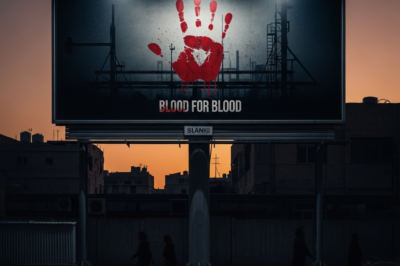
In a move that has sent shockwaves through international diplomatic circles and ignited a firestorm of media coverage, the Iranian government has unveiled a massive, provocative billboard in the heart of Tehran. The display, located in the prominent Valiasr Square—a site often reserved for significant state propaganda—depicts former United States President Donald Trump, his wife Melania Trump, and several of their children laid out in coffins. Emblazoned with the haunting phrase "Blood for Blood," the imagery serves as a visceral reminder of the deep-seated animosity and the unresolved tensions stemming from the 2020 assassination of Iranian General Qasem Soleimani. This latest development is not merely a piece of urban art; it is a calculated political statement intended to signal Iran’s unwavering commitment to what it calls "Hard Revenge." As global observers parse the implications of such a graphic display, it becomes clear that the psychological warfare between Washington and Tehran is entering a new, more personal phase, targeting not just a political figure, but his entire lineage.
The Visual Language of Symbolic Aggression
The billboard in Valiasr Square is a masterclass in state-sponsored psychological operations. The aesthetics of the display are designed to evoke maximum emotional response. Utilizing high-contrast shadows and a somber color palette, the image portrays the Trump family with clinical, yet morbid, precision. The inclusion of Melania Trump and the Trump children represents a significant departure from standard political rhetoric. Historically, while Iranian propaganda has frequently targeted US presidents, it has seldom extended its vitriol to their families in such a graphic manner. This shift suggests a move toward a more holistic form of vendetta, implying that the perceived crimes of the father are visited upon the house. The phrase "Blood for Blood" (or "Khoon dar Barabar-e Khoon" in Persian) draws on ancient concepts of retributive justice, rooted in the Lex Talionis—an eye for an eye. By displaying this in a public square where thousands of citizens pass daily, the Iranian leadership is reinforcing a narrative of national resilience and inevitable retribution to its domestic audience while simultaneously projecting defiance to the Western world.
The Ghost of Qasem Soleimani: A Catalyst for Perpetual Conflict
To understand the depth of the "Blood for Blood" message, one must revisit the events of January 3, 2020. On that day, a US MQ-9 Reaper drone strike near Baghdad International Airport killed Qasem Soleimani, the commander of the Quds Force and arguably the second most powerful man in Iran. Soleimani was more than a military leader; he was a cultural icon and a master strategist of Iran’s regional influence. His death was viewed by Tehran as an act of state-sponsored terrorism and a direct violation of international sovereignty. Following the assassination, Iran’s Supreme Leader Ayatollah Ali Khamenei promised "harsh revenge." While Iran did launch a series of ballistic missile strikes against the Al-Asad Airbase in Iraq shortly after, the Iranian leadership has consistently maintained that those actions were only the beginning. The new billboard serves as a visual manifestation of this ongoing promise. It underscores the fact that for the Islamic Revolutionary Guard Corps (IRGC) and the hardline factions in Tehran, the account with Donald Trump remains open. The imagery of the Trump family in coffins suggests that the retribution Iran seeks is not merely military or strategic, but deeply personal and existential.
Targeting the Trump Family: A Shift in Iranian Rhetoric
The decision to include the Trump children and the former First Lady in the coffin imagery is a calculated escalation that has drawn condemnation from various international human rights groups and political analysts. Traditionally, diplomatic protocols—even between adversaries—tended to keep family members out of the direct line of fire regarding state propaganda. By breaking this unwritten rule, Iran is signaling that the standard rules of engagement have been discarded. This move can be interpreted in several ways. First, it may be an attempt to leverage the protective instincts of the American public and the Trump family themselves, creating a sense of constant vulnerability. Second, it reflects the IRGC’s belief that the entire Trump administration was complicit in the "martyrdom" of Soleimani. In the Iranian narrative, those who stood by and benefited from the Trump presidency are viewed as accessories to the act. This expansion of the target list to include family members serves to intensify the threat profile, forcing US security agencies to maintain high levels of protection for the Trump family long after they have left the White House, thereby draining resources and maintaining a state of perpetual high alert.
The Domestic Utility of State-Sponsored Propaganda
While the international community views the billboard as a provocation, its primary audience is domestic. Iran is currently navigating a complex internal landscape characterized by economic hardships due to sanctions and internal dissent. State-sponsored propaganda like the Valiasr Square billboard serves as a unifying tool. By focusing public anger on an external "Great Satan" and the specific individual responsible for the death of a national hero, the regime seeks to consolidate its base. The "Blood for Blood" narrative taps into the deep religious and cultural themes of martyrdom and justice that are central to the identity of the Islamic Republic. It provides a sense of purpose and a promise of eventual victory over perceived oppression. Furthermore, such displays are used to gauge the public’s revolutionary fervor. The frequency and intensity of these billboards often correlate with internal political needs, serving as a barometer for the regime’s efforts to maintain the revolutionary spirit in the face of modernizing pressures and economic strain.
Regional Security and the Threat of Asymmetric Warfare
The implications of this heightened rhetoric extend far beyond the borders of Iran and the United States. Allies of both nations are watching closely, as any escalation in the US-Iran feud has immediate consequences for regional stability. For Gulf nations like Saudi Arabia and the UAE, such provocations increase the risk of miscalculation. If Iran feels emboldened to move beyond symbolic threats to actual asymmetric attacks—whether through cyber warfare, proxy militias, or targeted operations—the entire Middle East could be plunged into a broader conflict. The "Blood for Blood" message is a reminder that Iran’s reach is long and its memory is longer. Intelligence agencies across the globe have noted a rise in Iranian-linked plots targeting former US officials on foreign soil. This billboard serves as the ideological justification for such operations. It frames the hunt for those involved in the Soleimani strike not as a criminal enterprise, but as a sacred duty of the state. This normalization of targeting political figures and their families sets a dangerous precedent in international relations, blurring the lines between statecraft and vendetta-driven violence.
Diplomatic Deadlocks and the Future of US-Iran Ties
From a diplomatic perspective, the billboard represents a significant hurdle to any potential de-escalation. Currently, the Joint Comprehensive Plan of Action (JCPOA) or the "Iran Nuclear Deal" remains in a state of limbo. While the Biden administration has expressed a desire to return to diplomacy, the shadow of the Trump-era "Maximum Pressure" campaign and the Soleimani assassination continues to loom large. When Tehran produces imagery depicting the former US President’s family in coffins, it makes it politically impossible for any US administration to offer significant concessions without appearing weak. Conversely, for the Iranian leadership, any move toward rapprochement that does not address the "blood debt" of Soleimani is seen as a betrayal of the revolution. This creates a recursive loop of hostility where propaganda fuels policy, and policy fuels further propaganda. The "Blood for Blood" billboard is a visual representation of this deadlock. It suggests that until a form of "justice" satisfactory to the IRGC is met, the path to diplomatic normalcy remains blocked by the coffins of the past.
Conclusion: The Endless Cycle of Retribution
The unveiling of the "Blood for Blood" billboard in Tehran is a chilling reminder that in the world of high-stakes geopolitics, symbols often carry as much weight as sanctions or soldiers. By depicting the Trump family in such a macabre fashion, Iran is reinforcing its narrative of unyielding resistance and historical grievance. While it may be easy to dismiss this as mere theater, the reality is that such propaganda shapes the mindset of a generation and dictates the boundaries of possible diplomacy. As the world watches this graphic display of animosity, the question remains whether the cycle of retribution can ever truly be broken, or if the "blood for blood" philosophy will continue to dictate the future of US-Iran relations for decades to come. The billboard stands not just as a threat, but as a monument to a conflict that has become deeply personal, dangerously public, and seemingly permanent.




































Leave a Reply