
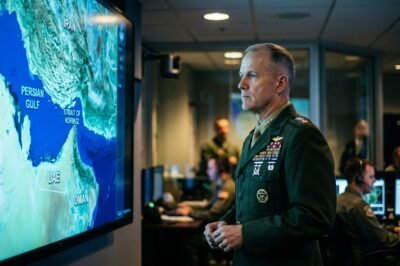
The geopolitical landscape of West Asia is currently teetering on the edge of a transformative and potentially devastating shift as Tehran signals a fundamental change in its defensive and offensive posturing. The recent statements from Iran’s security chief regarding a ‘new war strategy’ directed at the United States have sent shockwaves through international diplomatic circles, suggesting that the era of predictable shadow boxing may be coming to a close. This escalation coincides with sharp warnings from Scott Bessent, who has cautioned global actors against providing any form of support to Tehran, effectively drawing a line in the sand for international commerce and diplomacy. As the world watches the unfolding situation on the ground via live updates, the rhetoric is no longer just about regional hegemony but about a direct challenge to the established U.S.-led order in the Middle East. The following analysis explores the intricate layers of this ‘new strategy,’ the economic ramifications of Bessent’s warnings, and the broader implications for global security. We stand at a historical juncture where the traditional rules of engagement are being rewritten in real-time, demanding a deep dive into the motivations and capabilities of the primary actors involved.
The Genesis of Iran’s New War Strategy
To understand the gravity of the Iranian security chief’s proclamation, one must examine the evolution of the Islamic Republic’s military doctrine. For decades, Tehran has relied on a policy of strategic patience and the utilization of a ‘ring of fire’ consisting of regional proxies such as Hezbollah in Lebanon, the Houthis in Yemen, and various militias in Iraq and Syria. This ‘Forward Defense’ model was designed to keep conflict away from Iranian borders. However, the ‘new war strategy’ mentioned suggests a shift toward more direct engagement and the integration of advanced technologies that could circumvent traditional U.S. deterrents. This strategy likely includes the mass deployment of loitering munitions, enhanced ballistic missile precision, and a more aggressive cyber-warfare stance. By signaling a new strategy, Tehran is informing the Pentagon that the cost of intervention has risen significantly. The Iranian leadership is seemingly betting on a multi-domain approach that targets not just military assets, but the political will of the American public and the economic stability of its regional allies. This change in tone marks a transition from a defensive crouch to a proactive, albeit risky, stance intended to force a U.S. withdrawal from the region.
The Bessent Warning: Economic Deterrence in Action
Parallel to the military escalation is a tightening of the economic screws, as highlighted by the warnings from Scott Bessent. As a key figure in the financial and political discourse, Bessent’s assertion that ‘everyone’ should refrain from backing Tehran serves as a precursor to a more aggressive ‘Maximum Pressure’ 2.0 campaign. This warning is not just directed at state actors but at private corporations, shipping magnates, and financial institutions that might be tempted to facilitate Iranian trade. The implications are clear: the U.S. is preparing to treat any support for Tehran—whether logistical, financial, or political—as a direct affront to American interests. This economic brinkmanship aims to isolate Iran to a degree that makes the cost of its new war strategy unsustainable. However, this approach also risks alienating neutral parties and traditional allies who depend on regional energy flows. The threat of secondary sanctions looms large, creating a climate of uncertainty in global markets. Bessent’s rhetoric suggests that the financial front of this conflict is becoming just as volatile as the military one, with ‘economic warfare’ becoming a primary tool of U.S. foreign policy.
Technological Shifts and Asymmetric Capabilities
A core component of the new strategy involves the democratization of high-tech weaponry. Iran has increasingly demonstrated its ability to produce high-end military hardware despite decades of sanctions. The proliferation of one-way attack drones and the development of hypersonic missile capabilities have fundamentally altered the balance of power. No longer is the U.S. Navy’s dominance in the Persian Gulf unquestioned; the threat of ‘swarming’ tactics and precision strikes on carrier strike groups has forced a re-evaluation of maritime security. Furthermore, Iran’s investment in electronic warfare and satellite technology suggests a move toward space-based or space-dependent combat capabilities. This technological leap allows Tehran to project power far beyond its immediate vicinity, reaching as far as the Mediterranean and the Indian Ocean. The ‘new strategy’ is thus a reflection of these technological gains, moving away from the ‘quantity over quality’ approach of the 1980s toward a sophisticated, tech-centric military posture that aims to negate the conventional advantages of the United States.
Regional Alliances and the Proxy Network Paradox
While Tehran hints at a more direct strategy, its reliance on the ‘Axis of Resistance’ remains a cornerstone of its regional influence. The challenge for Iran is balancing its new, more assertive posture with the management of its various proxy groups. Each group has its own domestic interests, and a direct Iranian confrontation with the U.S. could jeopardize the political standing of these groups in their respective countries. Conversely, a failure to act decisively could be seen as a sign of weakness, potentially fracturing the network. The ‘new war strategy’ must therefore account for the synchronization of these diverse forces. We are seeing signs of this in the coordinated strikes across multiple fronts, from the Red Sea to the Golan Heights. This ‘unity of fronts’ strategy is designed to overstretch U.S. and Israeli intelligence and military resources, creating a dilemma where defending one area leaves another vulnerable. The complexity of this network makes a traditional military solution nearly impossible, forcing the U.S. to engage in a grueling war of attrition.
The Role of International Mediators and Global Stability
As the rhetoric intensifies, the role of international mediators like Qatar, Oman, and even China has become increasingly critical. These nations occupy a unique position as bridges between Tehran and Washington. However, the ‘new war strategy’ signals a dwindling patience for traditional diplomacy. If the security chief’s words are to be taken literally, Iran may be moving toward a ‘fait accompli’ approach, where they establish new realities on the ground before negotiations can even begin. This puts immense pressure on the United Nations and other international bodies to find a de-escalation path before a minor skirmish triggers a full-scale regional war. The global community is particularly concerned about the Strait of Hormuz, through which a significant portion of the world’s oil flows. Any disruption here, as part of Iran’s new strategy, would trigger a global economic recession, making the conflict a matter of life and death for economies far removed from the Middle East. The tension between Bessent’s call for isolation and the global need for regional stability creates a diplomatic vacuum that is currently being filled by military posturing.
Future Implications: A New Era of Middle Eastern Conflict
Looking ahead, the ‘new war strategy’ and the warnings against backing Tehran suggest that the West Asia conflict is entering a more dangerous and unpredictable phase. The possibility of a direct clash between U.S. forces and the Iranian military is higher than it has been in decades. Such a conflict would likely not be confined to a single theater but would be a multi-dimensional war involving cyber attacks on critical infrastructure, maritime disruption, and high-intensity missile exchanges. The geopolitical map of the Middle East could be permanently redrawn, with the influence of traditional powers waning in favor of a more fragmented and volatile regional order. For the global economy, the stakes could not be higher. Investors must brace for a period of extreme volatility in energy markets and a potential realignment of trade routes. The ‘new war strategy’ is not just a military plan; it is a declaration that the status quo is no longer acceptable to Tehran, and the world must now prepare for the consequences of that realization. As we move forward, the focus will remain on whether diplomacy can catch up with the rapid pace of military escalation or if the ‘new strategy’ will lead to an inevitable and catastrophic confrontation.







































Leave a Reply