
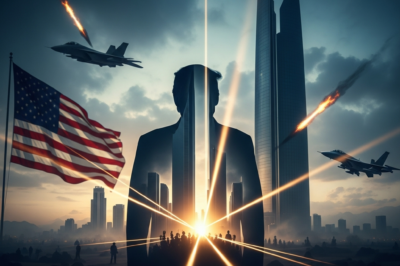
The geopolitical landscape of West Asia is currently hovering at a precarious tipping point, with tensions reaching levels not seen in decades. In a recent and highly provocative statement that has reverberated across global diplomatic circles, former US President Donald Trump has asserted that under his leadership, the United States would ‘hit Iran hard’ in response to any provocations. This declaration comes at a time when the region is already a powder keg, fueled by the ongoing conflict between Israel and Hamas, the frequent exchanges of fire between the IDF and Hezbollah, and the increasingly direct confrontation between Tehran and Jerusalem. Trump’s rhetoric serves as a stark reminder of the ‘Maximum Pressure’ campaign that defined his first term, signaling a potential return to a high-stakes, confrontational approach to Middle Eastern affairs. As the West Asia war continues to evolve, with shifting frontlines and the involvement of various state and non-state actors, the global community is watching with bated breath to see if these words will translate into a new era of direct military engagement or if they are part of a broader electoral strategy designed to project strength on the international stage.
The Escalation of Rhetoric: Deciphering Trump’s Bold Assertion
Donald Trump’s recent comments, specifically highlighting that the U.S. should threaten to destroy Iran’s nuclear program or its economic infrastructure if provoked, represent a significant departure from the current Biden-Harris administration’s more cautious diplomatic balancing act. Trump’s stance is predicated on the belief that the perceived weakness of the current administration has emboldened Tehran, leading to the massive missile barrages launched by the Islamic Revolutionary Guard Corps (IRGC) against Israeli targets. By vowing to hit Iran ‘harder than ever before,’ Trump is positioning himself as the only candidate capable of re-establishing deterrence in the region. This approach resonates with a significant portion of the American electorate that favors a ‘Peace through Strength’ doctrine. However, critics argue that such aggressive rhetoric could inadvertently trigger the very all-out war that diplomats are working tirelessly to prevent. The nuance of the situation lies in whether these statements are merely campaign bluster or a legitimate preview of a revised National Security Strategy that prioritizes direct kinetic action over long-term diplomatic engagement and economic sanctions.
Historical Context: From the JCPOA Withdrawal to the Maximum Pressure Campaign
To understand the current friction, one must look back at the historical trajectory of US-Iran relations during the Trump presidency. In 2018, Trump unilaterally withdrew the United States from the Joint Comprehensive Plan of Action (JCPOA), often referred to as the Iran Nuclear Deal. He argued that the deal was fundamentally flawed and allowed Iran to continue its regional expansionism through proxies like Hezbollah in Lebanon, the Houthis in Yemen, and various militias in Iraq and Syria. Following the withdrawal, the ‘Maximum Pressure’ campaign was initiated, involving the imposition of draconian economic sanctions designed to cripple Iran’s oil exports and isolate it from the global financial system. The pinnacle of this era was the 2020 assassination of General Qasem Soleimani, the commander of the Quds Force, in a drone strike in Baghdad. This event brought the two nations to the brink of war. Today’s threats are essentially a continuation of that philosophy, suggesting that the underlying grievances and strategic objectives of the Trump foreign policy team remain unchanged: the total containment of Iran’s regional influence and the dismantlement of its nuclear aspirations.
The Current Battlefield: Proxy Wars and Direct Missile Exchanges
The conflict in West Asia is no longer confined to the shadows. While for years Iran and Israel engaged in a ‘shadow war’ of assassinations, cyberattacks, and maritime sabotage, the events following October 7, 2023, have brought the conflict into the open. Iran’s ‘Axis of Resistance’—a network of allied groups—has been activated on multiple fronts. In the north, Hezbollah has displaced thousands of Israeli civilians, leading to a massive Israeli ground and air operation in Lebanon. To the south, the Houthis have effectively closed the Bab el-Mandeb Strait to much of Western commercial shipping, necessitating a US-led naval coalition. Most significantly, Iran has now twice launched direct missile strikes from its own soil toward Israel, citing the deaths of key leaders like Ismail Haniyeh and Hassan Nasrallah. Trump’s threat to ‘hit hard’ refers specifically to these escalations. The military reality is that a direct US strike on Iran would likely target IRGC headquarters, missile production facilities, and perhaps most controversially, the Natanz and Fordow nuclear sites. Such an escalation would fundamentally transform the current localized conflicts into a regional conflagration with global consequences.
Geopolitical Implications for Regional Stability and Alliances
The prospect of a harder US line against Iran has profound implications for regional alliances. Gulf nations like Saudi Arabia and the United Arab Emirates find themselves in a delicate position. While they view Iran’s regional ambitions with deep suspicion, they are also wary of being caught in the crossfire of a US-Iran war. The Abraham Accords, a landmark achievement of the Trump administration, sought to normalize relations between Israel and several Arab states, primarily to form a united front against Tehran. A return to a more aggressive US stance could either solidify this anti-Iran bloc or, conversely, cause some states to hedge their bets and seek a rapprochement with Tehran to avoid becoming targets. Furthermore, the role of Russia and China cannot be ignored. Both nations have strengthened their ties with Iran in recent years, with Iran providing drones for Russia’s war in Ukraine and China signing long-term strategic investment deals with Tehran. A US strike on Iran would likely draw a sharp reaction from Moscow and Beijing, potentially leading to a broader global realignment that pits a Western-led bloc against a new Eurasian alliance.
The Domestic Angle: US Foreign Policy as a Pivotal Campaign Issue
As the United States moves closer to its next general election, foreign policy has moved from the periphery to the center of the political discourse. Trump’s ‘hit them hard’ rhetoric is strategically designed to contrast with what he portrays as the Biden administration’s ‘appeasement’ and ‘incompetence.’ The narrative being pushed by the Republican camp is that the world was safer and more stable under Trump, citing the lack of new major conflicts during his term. On the other hand, the Democratic platform emphasizes the importance of multilateralism, alliances like NATO, and the use of diplomacy to prevent nuclear proliferation. The outcome of the US election will therefore serve as a referendum on how the world’s most powerful military should engage with West Asia. A Trump victory could lead to an immediate escalation of pressure on Iran, while a Democratic victory would likely see a continued attempt to manage the conflict through a mix of targeted sanctions and diplomatic de-escalation efforts. The stakes for the American voter involve not just national security, but also the economic fallout of another potential war in the Middle East.
Economic and Humanitarian Consequences: The Global Toll
The human and economic cost of a full-scale war in West Asia involving Iran and the United States would be catastrophic. From an economic perspective, Iran sits on the Strait of Hormuz, a narrow waterway through which roughly 20% of the world’s oil supply passes. Any conflict that disrupts this flow would result in an immediate and dramatic spike in global energy prices, potentially triggering a worldwide recession. For developing nations like India, which are heavily dependent on energy imports, the economic shock would be severe. On the humanitarian front, the region is already reeling from the devastation in Gaza and Lebanon. A direct war with Iran would lead to thousands more casualties, massive displacement of people, and the total collapse of regional infrastructure. The potential for a refugee crisis that dwarfs the 2015 Syrian crisis is a very real possibility. Furthermore, the environmental impact of strikes on oil and nuclear facilities would be felt for generations. When Trump speaks of ‘hitting hard,’ the logistical reality of such an action involves a cascade of secondary effects that could destabilize the global order far beyond the borders of the Middle East.
Conclusion: The Volatile Path Ahead
In conclusion, Donald Trump’s warning that the U.S. will ‘hit Iran hard’ is more than just a soundbite; it is a declaration of a strategic worldview that prioritizes overwhelming military deterrence over incremental diplomacy. As the West Asia war continues to simmer and occasionally boil over, the rhetoric from Washington will play a decisive role in shaping the actions of both allies and adversaries. The path forward is fraught with danger, and the margin for error is razor-thin. Whether through the ballot box or through the barrel of a gun, the relationship between the United States and Iran is heading toward a definitive resolution. The global community must prepare for a future where the current ‘gray zone’ conflict could rapidly transform into a high-intensity war, altering the course of history and the security of the 21st century. The words of political leaders today are the seeds of the military operations of tomorrow, and in the volatile landscape of West Asia, those seeds are being planted in very fertile ground.



































Leave a Reply