
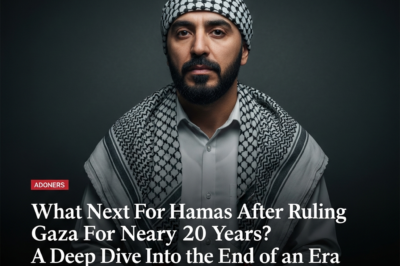
The Gaza Strip, a narrow coastal enclave that has been under the firm grip of Hamas for nearly two decades, stands at a historic and devastating crossroads. Since seizing control in 2007 following a violent rift with the Palestinian Authority, Hamas has transformed Gaza from a potential Mediterranean hub into a fortress of resistance and a flashpoint for global geopolitics. However, the events following the October 7 attacks have triggered a paradigm shift that many analysts believe marks the beginning of the end for Hamas as a governing body. As the Israeli military offensive continues to dismantle the group’s physical and administrative infrastructure, the world is left asking: what happens next? The question is not merely about the survival of a militant group, but about the future of two million people, the viability of Palestinian statehood, and the stability of the entire Middle East.
The Historical Context: From Resistance to Governance (2007–2023)
To understand the current crisis, one must look back to the 2006 Palestinian legislative elections, where Hamas won a surprising majority, fueled by a reputation for social service provision and a rejection of the corruption perceived within the Fatah-led Palestinian Authority. The subsequent 2007 Battle of Gaza saw Hamas forcibly expel Fatah, leading to a total administrative takeover. For the next 17 years, Hamas operated a complex hybrid model: it was simultaneously a governing body providing municipal services, a social welfare organization, and a heavily armed militant group. This period was defined by a strict blockade imposed by Israel and Egypt, designed to contain the group’s military capabilities. Despite multiple rounds of conflict in 2008, 2012, 2014, and 2021, Hamas managed to maintain its grip, leveraging its tunnel network and international support from actors like Iran and Qatar to survive. The group built a sophisticated tax system and civil service, essentially creating a ‘state within a state’ that operated independently of the West Bank.
The Infrastructure of Power: How Hamas Maintained Control
Hamas’s longevity in Gaza was not accidental. It was the result of a meticulously built infrastructure that intertwined civilian life with militant activity. The ‘Metro,’ a vast network of subterranean tunnels, served not only as a military asset but as a lifeline for smuggling goods and maintaining communication under the gaze of Israeli surveillance. Domestically, Hamas enforced a strict social code and suppressed political dissent, ensuring that no internal rivals could challenge its authority. Economically, the group benefited from hundreds of millions of dollars in aid from Qatar, which was often transferred with Israeli acquiescence in a failed attempt to maintain a fragile ‘calm for cash’ status quo. This funding allowed Hamas to pay its civil servants and security forces, creating a loyalist base that depended on the group for their livelihoods. However, this governance model was always precarious, as it relied on the endurance of the civilian population under permanent siege conditions.
The Catalyst of October 7 and the Israeli Military Response
The October 7 attacks changed the calculus for everyone involved. By launching a massive, coordinated strike on Israeli soil, Hamas breached the long-standing ‘containment’ policy. In response, Israel shifted its objective from ‘mowing the grass’—a term used for periodic military strikes to degrade Hamas’s capabilities—to the total ‘elimination’ of Hamas as a political and military entity. The resulting war has seen the destruction of vast swathes of Gaza’s urban landscape, the displacement of nearly 90% of its population, and the systematic dismantling of Hamas’s governing institutions. Police stations, ministries, and social service centers have been targeted, effectively ending Hamas’s ability to govern in the traditional sense. While the group may persist as an insurgency or an underground movement, its days as a formal ruling body in Gaza appear to be numbered, as the physical requirements for governance have been obliterated.
The Humanitarian Crisis and Public Perception
As the conflict drags on, the humanitarian situation in Gaza has reached catastrophic levels. With famine looming and healthcare systems collapsed, the civilian population is bearing the brunt of the political fallout. Historically, Hamas has relied on a mix of ideological support and the ‘rally around the flag’ effect during times of conflict. However, reports from within the enclave suggest a growing, albeit quiet, resentment toward the leadership that many feel gambled the safety of the entire population on a high-stakes military maneuver. The question of Hamas’s future popularity is complex; while some see them as the only force standing up to the occupation, others see them as responsible for the total destruction of their homes and future. Any post-war governance plan must account for this deeply traumatized and polarized population.
Post-Conflict Scenarios: Who Will Govern Gaza?
The most pressing question for the international community is the ‘Day After’ plan. Several scenarios are currently being debated in diplomatic circles. One possibility is the return of a ‘revitalized’ Palestinian Authority (PA), though this faces significant hurdles including the PA’s lack of popularity and Israel’s current refusal to accept a Fatah-led Gaza. Another scenario involves an international peacekeeping force or a coalition of Arab nations (such as Egypt, Jordan, and the UAE) taking temporary administrative control to oversee reconstruction. However, Arab nations have been hesitant to commit troops or funds without a clear path toward a Palestinian state. A third, more chaotic scenario, is the ‘Somalization’ of Gaza, where local clans or armed gangs fill the power vacuum left by Hamas, leading to prolonged lawlessness and instability. Israel has also floated the idea of ‘civilian bubbles’ led by local Palestinians unaffiliated with Hamas, but finding leaders willing to cooperate without being branded as collaborators remains a monumental challenge.
Regional Geopolitics and the ‘Axis of Resistance’
The future of Hamas is also inextricably linked to its regional patrons. Iran, which provides the bulk of Hamas’s military funding and training, views the group as a key pillar of its ‘Axis of Resistance.’ If Hamas is decisively defeated in Gaza, it would represent a major strategic blow to Tehran’s regional influence. Conversely, the political leadership of Hamas, currently based in Qatar, is under immense pressure. There are discussions about the leadership moving to other countries, such as Turkey or Lebanon, which would further complicate diplomatic efforts for a ceasefire. The role of Egypt remains paramount; as the only other country bordering Gaza, its cooperation in security and reconstruction is non-negotiable. The regional fallout of the end of Hamas rule could either lead to a broader escalation involving Hezbollah or, paradoxically, create an opening for a new regional security architecture involving Israel and its Arab neighbors.
The Future of the Palestinian National Project
Ultimately, the end of Hamas’s two-decade rule in Gaza will force a reckoning within the Palestinian national movement. For years, the division between Hamas in Gaza and Fatah in the West Bank has been used by critics to argue that the Palestinians have no unified leadership to negotiate with. If Hamas is removed from power, the pressure for a unified, technocratic government will intensify. However, the ideology of Hamas—as a movement representing a specific brand of political Islam and armed resistance—cannot be eliminated by bombs alone. Even if its formal governance ends, its influence will likely persist in the hearts and minds of many, or as a clandestine shadow power. The transition from the ‘Hamas era’ to whatever comes next will be the most significant shift in Palestinian politics since the Oslo Accords, determining whether the region moves toward a two-state solution or descends into further cycles of violence and occupation.






































Leave a Reply