
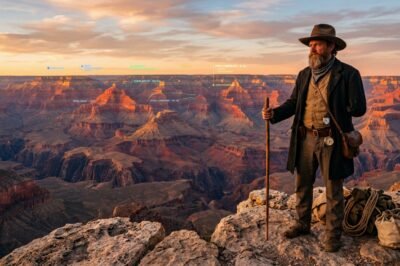
In the late 19th century, the American West was a canvas of ‘terra incognita,’ a blank space on maps that beckoned the brave and the reckless. Among them was Major John Wesley Powell, a one-armed veteran of the Civil War who possessed an insatiable curiosity and a titanium will. In May 1869, Powell and a crew of nine men set out from Green River, Wyoming, embarking on a journey that would forever alter the geographic consciousness of the United States. They were descending into the ‘Great Unknown,’ a 1,000-mile stretch of the Colorado River that had never been systematically explored by European descendants. It was during this perilous voyage, amidst the roar of cataracts and the towering walls of red rock, that Powell chose to call the chasm the ‘Grand Canyon.’ Before this, it was often referred to as the ‘Big Canyon,’ a name that failed to capture the sublime scale and spiritual gravity of the landscape. Today, over 150 years since Powell’s wooden boats battered against the rapids, science is rewriting the story of this natural wonder. From groundbreaking isotopic dating to the analysis of the canyon’s deep tectonic history, the legacy of 1869 continues to evolve, merging the romanticism of exploration with the cold, hard precision of modern geological data. This analysis explores how Powell’s naming of the canyon was merely the beginning of a scientific journey that spans centuries. The Legacy of Major John Wesley Powell: A Visionary’s 1869 Expedition. To understand the significance of the Grand Canyon’s naming, one must first understand the man who dared to map it. Major John Wesley Powell was not just an explorer; he was a self-taught geologist and ethnologist. Despite having lost his right arm at the Battle of Shiloh, Powell led his expedition with a fervor that bordered on the obsessive. The 1869 trip was a logistical nightmare. Using four heavy oak and pine boats—the Emma Dean, the Kitty’s Sister, the No Name, and the Maid of the Canyon—Powell’s team faced starvation, treacherous rapids, and the constant threat of the unknown. Three members of the crew eventually abandoned the expedition, only to be killed shortly thereafter, underscoring the lethal stakes of the mission. Powell’s success was not just in survival but in documentation. He kept meticulous journals, noting the stratigraphy of the canyon walls and the behavior of the river. His observations laid the groundwork for the United States Geological Survey (USGS), which he would later lead. The 1869 expedition wasn’t just a trip down a river; it was the birth of American land management and a pivotal moment in the history of the Western frontier. Beyond the Name: The Transition from Big Canyon to Grand Canyon. While the Spanish explorer García López de Cárdenas was the first European to see the canyon in 1540, and various trappers had skirted its edges, the site lacked a definitive, evocative name in the American lexicon. It was frequently labeled on early 19th-century maps as the ‘Big Canyon of the Colorado.’ Powell found this utilitarian name insufficient. In his writings, he began to use the term ‘Grand Canyon’ to reflect the awe-inspiring verticality and the sheer geological depth of the gorge. The name ‘Grand’ suggested a majesty that ‘Big’ could not convey. It transformed the canyon from a geographical obstacle into a national monument of the mind. This nomenclature was part of a larger effort by Powell to categorize the West not as a wasteland, but as a complex ecosystem with limited water resources—a prophetic view that many of his contemporaries ignored. By naming the canyon, Powell effectively ‘branded’ the American wilderness, turning a terrifying void into a central icon of American identity and natural heritage. Modern Geological Revolutions: Dating the Ancient Chasm. For decades, the scientific consensus was that the Grand Canyon was roughly 6 million years old, carved by the Colorado River as the Colorado Plateau began to rise. However, in the 150 years since Powell’s expedition, technology has allowed us to look deeper into the stones. Recent research using thermochronology—a technique that measures when rocks cooled as they moved toward the surface—suggests that parts of the canyon may be as old as 70 million years. This ‘Old Canyon’ hypothesis posits that ancient ‘paleo-canyons’ were carved by rivers flowing in different directions long before the modern Colorado River even existed. This scientific debate honors Powell’s original curiosity but applies a level of detail he could never have imagined. Scientists today use mass spectrometry to date individual sand grains and mineral crystals, uncovering a timeline that stretches back nearly two billion years at the canyon’s base. The canyon is no longer seen as a single event but as a palimpsest of geological history, with different segments forming at different times and eventually being linked together by the modern river system. The Hydrological Crisis: The Colorado River 150 Years Post-Powell. Powell was one of the first to warn that the West did not have enough water to support massive agricultural expansion. Today, his warnings resonate with haunting clarity. The Colorado River, the very force that Powell battled in 1869, is now one of the most controlled and contested waterways in the world. The construction of the Hoover Dam and the Glen Canyon Dam has fundamentally altered the canyon’s ecology. In Powell’s time, the river was a silty, warm, and volatile flood-prone environment. Today, the water released from the dams is clear, cold, and steady, which has led to the extinction of native fish and the erosion of sandbars that Powell once used for camping. Current scientific studies focus on ‘pulse flows’—artificial floods designed to mimic the natural cycles Powell witnessed. These efforts represent a desperate attempt to use engineering to fix the problems created by engineering, highlighting the delicate balance between human utility and environmental preservation that Powell first alluded to in his 1878 ‘Report on the Lands of the Arid Region.’ Technological Sovereignty: Mapping the Unseen Depths. While Powell used a simple sextant and lead lines to gauge depth and position, 21st-century scientists employ an arsenal of high-tech tools. Airborne LiDAR (Light Detection and Ranging) has allowed researchers to strip away vegetation and water from digital models, revealing the intricate topography of the canyon floor and hidden archaeological sites. Underwater sonar mapping has provided a view of the riverbed that Powell could only guess at, showing massive boulder fans and deep plunge pools created by the rapids. These technological advancements have shifted the focus from discovery to management. We are no longer asking ‘what is there?’ but rather ‘how is it changing?’ Satellite telemetry now monitors the canyon’s health in real-time, tracking everything from rockslides to the migration patterns of California condors. This digital twin of the canyon allows for a level of stewardship that is essential in an era of climate change, ensuring that the ‘Grand’ nature of the canyon is preserved for another 150 years. Indigenous Perspectives and the Reconstruction of Discovery. It is a critical modern realization that Powell did not ‘discover’ the Grand Canyon. For the Havasupai, Hopi, Hualapai, Navajo, Southern Paiute, and Zuni, the canyon was and is a permanent home and a sacred site. Over 150 years after Powell’s expedition, science is finally beginning to integrate Traditional Ecological Knowledge (TEK) into its frameworks. Indigenous oral histories often contain records of geological and climatic events—such as major floods or volcanic eruptions—that predate Western scientific records. Recognizing the Grand Canyon as a cultural landscape, rather than just a geological one, is the next frontier of exploration. The naming of the canyon by Powell was a colonial act, but the ongoing dialogue between the 11 associated tribes and the National Park Service represents a move toward a more inclusive history. This shift acknowledges that while Powell mapped the river, the Indigenous people understood the soul of the canyon long before 1869. Conclusion: The Future of the Grand Canyon. As we look back on 150 years of exploration and science, the Grand Canyon remains as enigmatic as ever. Major John Wesley Powell gave it a name, but the canyon continues to define itself through the relentless forces of erosion and the emerging truths of geological science. The next century will likely be defined by our ability to protect this landscape from the twin threats of aridification and over-tourism. The ‘Great Unknown’ that Powell feared has become a ‘Great Known’ that we must now responsibly manage. As science continues to peel back the layers of the canyon’s ancient history, we are reminded of our own fleeting presence in the face of deep time. The Grand Canyon is a laboratory, a cathedral, and a warning—a place where the history of the earth is written in stone, waiting for the next generation of explorers to read its pages.
150 Years of the Grand Canyon: From John Wesley Powell’s 1869 Discovery to Modern Geological Revaluations
Posted by
Stories





-

Hunkkaar Teaser Analysis: Aneet Padda’s Gritty Transformation and the Evolving Landscape of Indian Thrillers
-

Mithila Palkar: The Relatable Queen of Indian Web Series and Her Meteoric Rise
-

Wamiqa Gabbi: The Meteoric Rise of Indian Web Series’ Most Versatile Leading Lady
-

Triptii Dimri Biography: The Evolution of India’s Newest Cinematic Sensation and Web Series Star
-

Wamiqa Gabbi: The Rise of India’s New Digital Icon and the Future of OTT Stardom
-

Mithila Palkar: The Unstoppable Evolution of India’s Digital Darling and Her Journey to the Silver Screen
-

Mithila Palkar: The Comprehensive Journey of India’s Web Series Sensation and Digital Pioneer
-

Mithila Palkar: The Relatable Queen of Indian Web Series and Her Inspiring Journey to Stardom
-

Sobhita Dhulipala Biography: The Meteoric Rise of India’s Most Versatile Web Series Star
-

Mithila Palkar: The Unstoppable Journey of India’s Digital Darling and Web Series Queen
-

Triptii Dimri: The Complete Biography of India’s Newest Cinematic Sensation and Web Series Icon
-

Wamiqa Gabbi: The Ethereal Rise of India’s Most Versatile Web Series Star
-

Sobhita Dhulipala: The Unstoppable Rise of India’s Most Versatile Web Series Icon
-

Wamiqa Gabbi: The Meteoric Rise of the New Queen of Indian Web Series and Her Unstoppable Journey to Stardom
-

Triptii Dimri: The Meteoric Rise of India’s New Cinema Sweetheart and Web Series Icon
-

Wamiqa Gabbi: The Versatile Queen of Indian OTT and Her Phenomenal Rise to Stardom
-

Tripti Dimri Biography: The Rise of India’s New National Crush and Her Journey from Laila Majnu to OTT Stardom
-

Wamiqa Gabbi Biography: The Meteoric Rise of India’s Newest OTT Sensation and Versatile Powerhouse
-

Wamiqa Gabbi Biography: The Meteoric Rise of the Digital Queen of Indian Web Series
-

The Rise of Wamiqa Gabbi: A Deep Dive into the Journey of India’s Most Versatile OTT Sensation
-

The Meteoric Rise of Triptii Dimri: Biography, Acting Prowess, and the Journey of India’s Newest Cinema Sensation

Launching Soon: The Future of News with Our E-Newspaper
In the ever-evolving landscape of media and technology, we are thrilled to announce the upcoming launch of our innovative e-newspaper, set to redefine the way news is consumed in the digital age. Embracing the convenience and accessibility that the digital world offers, our e-newspaper aims to deliver real-time news updates, insightful articles, and interactive features directly to your devices. With a commitment to journalistic integrity and a passion for storytelling, we are dedicated to keeping you informed, engaged, and connected, no matter where you are. Stay tuned for the launch of our e-newspaper, where the future of news awaits at your fingertips.
Recent News
- Netanyahu Orders West Bank Closure Following Attack on Israelis Ahead of Elections

- Jio Platforms and OYO Parent Company IPOs Move Forward Amid Market Interest

- Financial Stability Key to Achieving Price Stability, Says RBI Governor Shaktikanta Das

- First Batch of 60 Indians Rescued from Cambodia Cybercrime Centers Return Home: A Deep Dive into the Human Trafficking Crisis

- Pune Porsche Crash: Juvenile Justice Board Remands Minor to Observation Home Until June 5

- US stocks jump after biggest wipeout for Dow Jones in over a year

Politics
- Netanyahu Orders West Bank Closure Following Attack on Israelis Ahead of Elections
- Court Convicts Medha Patkar in Defamation Case: A Deep Dive into the Legal Battle with Delhi LG V K Saxena

- In Abhijeet Dipke’s Message To “Cockroaches”, Pause In Protests And A “Real Leaders” Reveal – NDTV

- The Ethics and Optics of Military Justice: Analyzing Trump’s Decision to Bar Livestreaming the Fort Hood Gunman Execution

- Delhi’s Political Pressure Cooker: Analyzing the Anti-CEC Protests and Security Gridlock

- Anti-CEC protests LIVE: CJP leaders Das, Ranka booked for unauthorised entry at Jantar Mantar – The Hindu

Categories
- Art & Culture 106
- Auto 85
- Beauty 15
- Blog 307
- Books 7
- Business 370
- Celebrities 217
- Crime Files 139
- Democracy 308
- Education 84
- Entertainment 154
- Environment 133
- epaper 1
- Fashion 37
- Food 59
- Gadgets 89
- Guide 150
- Handicrafts 14
- Health 281
- Healthy Living 108
- History 5
- incidents 169
- Lifestyle 41
- Music 7
- Photography 15
- Politics 460
- Science & Technology 160
- Sports 283
- Tech 142
- Television 4
- Travel 68
- Travel & Tourism 30
- Trends 57
- Weather 9
- Web Series 97
- Workout 4
- World 665
Leave a Reply