
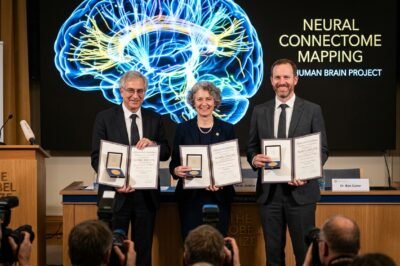
The prestigious halls of the Karolinska Institute in Stockholm have once again become the epicenter of global scientific acclaim with the announcement of the 2026 Nobel Prize in Physiology or Medicine. This year, the Nobel Assembly has chosen to recognize the groundbreaking contributions of a trio of scientists whose work in the field of optogenetics has fundamentally transformed our understanding of the brain and its intricate circuitry. This revolutionary technique, which utilizes light to control the activity of genetically modified neurons with millisecond precision, was once the stuff of science fiction. Today, it stands as the cornerstone of modern neuroscience, offering hope where there was once only darkness for patients suffering from a myriad of neurological and psychiatric conditions. The recognition of these pioneers underscores a decades-long journey from the discovery of light-sensitive proteins in green algae to the successful restoration of partial vision in human patients. As the world watches, the 2026 award highlights not just a singular discovery, but an entire paradigm shift in how we interact with biological systems. By bridging the gap between physics and biology, this year’s laureates have provided researchers with a \”light switch\” for the mind, enabling the dissection of neural pathways that govern everything from basic motor functions to the complex nuances of human emotion and memory. The announcement marks a celebration of interdisciplinary collaboration, proving that when biology, genetics, and optics converge, the potential for medical advancement is limitless.
The Foundations of Light-Control: A Historical Perspective
To appreciate the magnitude of this Nobel win, one must look back to the early 2000s when the concept of optogenetics first emerged from the intersection of microbiology and neurobiology. The fundamental challenge of neuroscience has always been the inability to selectively activate specific types of neurons without affecting neighboring cells. Traditional methods like electrical stimulation were blunt instruments, activating everything in the vicinity of an electrode, which often led to side effects and muddied data. The 2026 laureates solved this by looking toward nature—specifically, light-gated ion channels called opsins found in microorganisms. These proteins, such as channelrhodopsin-2 from the green algae Chlamydomonas reinhardtii, naturally convert light into electrical signals to help the algae navigate toward light sources. The stroke of genius lay in the realization that these proteins could be transplanted into mammalian neurons. By introducing the genes for these opsins into specific brain cells using viral vectors, the researchers found they could make those neurons responsive to light, allowing for a level of control that was previously thought impossible.
The early years of this research were met with skepticism, as many in the scientific community doubted that a microbial protein could function correctly within the complex environment of a mammalian brain. However, through rigorous experimentation and the refinement of genetic delivery systems, the laureates demonstrated that optogenetics could be used to precisely drive neural activity in living animals. This breakthrough allowed scientists to observe, for the first time, how specific circuits in the brain correlate with specific behaviors. Whether it was triggering a mouse to run in circles or stopping an aggressive impulse with a flash of blue light, the evidence was undeniable. The 2026 Nobel Prize honors this persistence and the subsequent explosion of research that followed, which saw optogenetics adopted by thousands of laboratories worldwide, effectively ending the era of ‘black box’ neuroscience and beginning an era of total transparency in neural mapping.
Engineering the Neural Switch: A Masterclass in Biotechnology
The technical sophistication of optogenetics is what truly sets it apart as a Nobel-worthy achievement. The process begins with the selection of a viral vector, typically an adeno-associated virus (AAV), which acts as a delivery vehicle for the opsin gene. These viruses are engineered to be harmless while remaining highly efficient at infiltrating neurons. What makes the trio’s work so remarkable is their development of cell-type-specific promoters. These genetic instructions ensure that the light-sensitive proteins are only produced in a specific subset of neurons—for instance, those that release dopamine or those that regulate inhibitory signals. This specificity is the key to the technology’s success, as it allows researchers to dissect the brain’s ‘wiring diagram’ with surgical precision without physically cutting into the tissue more than necessary. Once the neurons are ‘sensitized’ to light, thin fiber-optic cables are implanted to deliver light pulses directly to the target area.
The evolution of this technology has also seen the development of different types of opsins. While initial work focused on Channelrhodopsin for activation, the laureates also pioneered the use of Halorhodopsin and Archaerhodopsin for inhibition. These proteins respond to different wavelengths of light, such as yellow or green, and act to suppress neuronal firing. By using a combination of different lights and different proteins, scientists can now play the brain like a piano, stimulating some areas while simultaneously silencing others. This level of control has been instrumental in understanding complex diseases like epilepsy, where the ability to ‘turn off’ an overactive seizure focus with light could provide a side-effect-free alternative to traditional drugs or invasive surgery. The 2026 prize recognizes not just the discovery of these proteins, but the massive bioengineering effort required to make them compatible with the human clinical environment.
Clinical Breakthroughs: From Laboratory to the Clinic
Perhaps the most compelling reason for the 2026 Nobel committee’s decision is the recent success of optogenetics in human clinical trials. For years, the technology was confined to animal models, but the last decade has seen a rapid push toward therapeutic applications. One of the most stunning examples is the treatment of retinitis pigmentosa, a genetic disorder that causes blindness by destroying the photoreceptors in the eye. In a series of landmark trials, researchers used optogenetics to turn the remaining cells in the retina into new photoreceptors. By injecting a viral vector carrying an opsin gene into the eye, they enabled a blind patient to perceive light and shapes for the first time in decades. This success story served as a proof of concept for the entire field, demonstrating that light-controlled biology could safely and effectively restore lost functions in humans.
- Restoration of Vision: Converting retinal ganglion cells into light-sensitive units to bypass damaged photoreceptors.
- Parkinson’s Disease: Using light to regulate the subthalamic nucleus, offering a more precise version of Deep Brain Stimulation (DBS).
- Chronic Pain: Targeting peripheral nerves with inhibitory opsins to block pain signals without the use of opioids.
- Cardiac Rhythm Control: Employing light to act as a biological pacemaker, regulating heartbeats without electrical leads.
Beyond vision, optogenetics is being explored as a treatment for Parkinson’s disease. Traditional Deep Brain Stimulation uses electrodes to deliver electrical pulses, which can sometimes spread to unintended brain regions, causing speech or motor issues. Optogenetic stimulation, however, can be targeted exclusively to the neurons involved in motor control, potentially offering a much cleaner and more effective therapy. Similarly, in the realm of psychiatry, researchers are looking at how light can be used to reset the neural circuits associated with major depressive disorder and post-traumatic stress disorder (PTSD). The 2026 Nobel Prize highlights these clinical milestones, signaling that optogenetics has moved beyond a research tool and is now a legitimate frontier of modern medicine.
Mapping the Mind: Insights into Human Behavior and Memory
The impact of optogenetics on our understanding of psychology and cognition cannot be overstated. Before this technology, our knowledge of how the brain processes memory and emotion was largely based on correlative data—observing which areas ‘lit up’ during an MRI scan. Optogenetics changed the game by allowing for causal manipulation. Scientists could finally ask: \”If I activate this specific cluster of neurons, will a memory be recalled?\” In a series of famous experiments, the laureates and their colleagues were able to identify ‘engram cells’—the physical traces of specific memories. They demonstrated that they could artificially trigger a memory of a specific event simply by shining a light on the neurons that were active when the memory was first formed. This discovery has profound implications for our understanding of identity and the biological basis of the self.
Furthermore, the technology has shed light on the neural basis of social behavior and addiction. By manipulating circuits in the prefrontal cortex and the nucleus accumbens, researchers have identified the specific pathways that drive compulsive drug-seeking behavior and social withdrawal. These insights are currently being used to develop new pharmacological treatments that target these pathways more effectively. The 2026 Nobel Prize recognizes that the trio did not just create a tool; they opened a window into the human soul, providing a physical explanation for the most abstract elements of our experience. The ability to map the connectome—the vast web of neural connections—in such detail has fundamentally altered the curriculum of every medical school and psychology department in the world.
The Ethical Implications of Precise Neural Manipulation
As with any technology that allows for the direct control of the brain, optogenetics brings with it a host of ethical considerations that the 2026 laureates and the broader scientific community have had to navigate. The ability to ‘switch’ behaviors on and off raises significant questions about agency and free will. If a person’s mood or actions can be dictated by a fiber-optic implant, where does the biological self end and the technology begin? The Nobel committee’s recognition of this field also brings these questions to the forefront of public discourse. Ensuring that these tools are used for therapeutic purposes and not for more nefarious forms of behavioral control is a challenge that ethicists and scientists are currently tackling together. The 2026 award serves as a reminder that with great power comes great responsibility, and the development of optogenetics must be accompanied by robust regulatory frameworks.
Data privacy is another burgeoning concern, particularly as neural implants become more sophisticated. The possibility of ‘brain-jacking’—where a wireless light-delivery system could be hacked to alter a person’s neural activity—is no longer a hypothetical scenario for sci-fi writers but a technical challenge for cybersecurity experts in the medical field. The laureates have been vocal advocates for the ethical deployment of their technology, emphasizing its role in healing rather than enhancement. As we move into an era where brain-computer interfaces (BCIs) become more common, the principles established by the optogenetics pioneers will be crucial in guiding the ethical evolution of neurotechnology. The prize, therefore, celebrates not just the science, but the thoughtful and cautious way in which this powerful tool has been introduced to the world.
Conclusion: A New Chapter for Medical Science
In conclusion, the 2026 Nobel Prize in Physiology or Medicine awarded for the development of optogenetics marks one of the most significant milestones in the history of science. By giving us the ability to talk to the brain in its own language—the language of light and electricity—the three laureates have fundamentally changed the trajectory of human health. We are standing on the precipice of a new era where neurological disorders that were once considered death sentences or lifelong burdens may soon be managed with the simple flick of a switch. The journey from green algae to the Nobel podium is a testament to the power of curiosity-driven research and the importance of thinking outside the box. As we look to the future, the implications of this work will continue to ripple through medicine, philosophy, and technology for generations to come. The 2026 prize is more than just an award; it is a beacon of hope for millions, illuminating the path toward a deeper understanding of ourselves and a future where the mysteries of the mind are finally brought to light.




































Leave a Reply