
The High-Stakes Diplomatic Collision at the United Nations
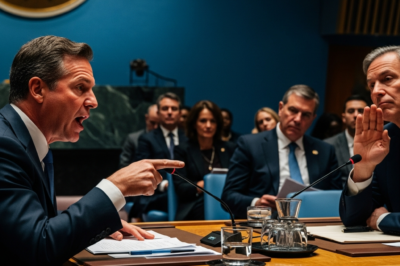
The hallowed halls of the United Nations Security Council recently witnessed a diplomatic confrontation of extraordinary intensity, signaling a new low in the already fractured relationship between Israel and the international body. The flashpoint occurred during a high-level hearing focused on the ‘Children and Armed Conflict’ (CAAC) report, a document that has become a lightning rod for controversy since its latest iteration included the Israel Defense Forces (IDF) on what is colloquially known as the ‘List of Shame.’ The clash, characterized by sharp exchanges and a reported directive to ‘be quiet’ amidst the rising heat of the debate, featured Israel’s Permanent Representative to the UN, Gilad Erdan, and top UN officials, including Virginia Gamba, the Special Representative of the Secretary-General for Children and Armed Conflict. This event is not merely a momentary lapse in diplomatic decorum; it represents a fundamental dispute over the methodology of international oversight, the realities of asymmetric urban warfare, and the moral branding of democratic nations in the context of counter-terrorism operations.
The Mechanics of the Clash: The “Be Quiet” Moment and Diplomatic Friction
The core of the confrontation centered on the presentation of the annual report by the UN Secretary-General on Children and Armed Conflict. According to reports from NDTV and other international observers, the atmosphere was thick with tension from the outset. Ambassador Gilad Erdan, who has built a reputation for his uncompromising and theatrical defense of Israeli policies, took direct aim at the UN’s data collection and the perceived bias of its agencies. The friction peaked during a procedural or substantive disagreement where the directive to ‘be quiet’—or a similar sentiment meant to stifle Erdan’s vocal interruptions—emerged. This verbal sparring highlights the frustration of UN officials who are attempting to maintain the procedural integrity of their sessions against what they perceive as disruptive grandstanding, while the Israeli side views such sessions as ‘kangaroo courts’ where the verdict is decided long before the evidence is presented. The clash was a microcosm of the broader struggle between institutional international law and the sovereign right of a state to defend itself against non-state actors like Hamas.
Understanding the “List of Shame”: Context and Historical Precedent
To understand why this hearing turned so volatile, one must understand the weight of the ‘List of Shame.’ Formally an annex to the Secretary-General’s report, this list names entities—both state forces and non-state armed groups—that commit ‘grave violations’ against children. These violations include the recruitment and use of children in conflict, killing and maiming, rape and other forms of sexual violence, attacks on schools and hospitals, and the denial of humanitarian access. For years, Israel had successfully lobbied to stay off this list, arguing that its military procedures are designed to minimize civilian harm. However, the scale of the conflict in Gaza following the October 7 attacks by Hamas changed the UN’s calculus. By including the IDF alongside groups like ISIS, Al-Qaeda, and the Russian military, the UN has crossed a Rubicon that Israel views as an unforgivable moral equivalence. The Israeli envoy’s outrage is rooted in the belief that being listed alongside terror organizations devalues the very purpose of the list and ignores the context of Hamas’s use of human shields.
Israeli Perspective: Allegations of Bias and the “Human Shield” Defense
During the hearing, Erdan’s arguments were predicated on the notion that the UN is fundamentally biased against Israel. He argued that the report relies on data provided by the Hamas-run health ministry in Gaza, which he claims does not distinguish between civilians and combatants, nor between children and young adults who may be active participants in hostilities. Erdan emphasized that the IDF is a professional army that issues warnings, uses precision strikes, and investigates its own conduct—measures he asserts are not taken by any other military in similar urban settings. The Israeli envoy argued that by focusing on the consequences of Israel’s defensive actions rather than the cause—Hamas’s entrenchment within civilian infrastructure—the UN is effectively rewarding the use of human shields. From Jerusalem’s perspective, the UN officials involved in the report are not neutral arbiters but are instead influenced by a political agenda aimed at delegitimizing the Jewish state.
The UN Mandate: Virginia Gamba and the Search for Accountability
On the other side of the clash, Virginia Gamba and the UN apparatus defended the integrity of their Monitoring and Reporting Mechanism (MRM). Gamba’s role is to document violations regardless of the political context or the intentions of the actors involved. For the UN, the numbers are undeniable: the sheer volume of child fatalities and the destruction of educational and healthcare facilities in Gaza necessitate inclusion in the report. The UN officials argue that the ‘List of Shame’ is a tool for engagement, not just condemnation, meant to pressure all parties into signing action plans to prevent further violations. During the hearing, the UN side maintained that their methodology is rigorous and involves multiple layers of verification. The clash with Erdan was seen by UN supporters as a necessary defense of the international legal framework that seeks to protect the most vulnerable in any conflict, regardless of the perceived ‘righteousness’ of either side’s cause.
Geopolitical Implications and the Future of UN-Israel Relations
The fallout from this hearing is expected to reverberate through the international diplomatic community. It marks a significant shift in how the UN interacts with Israel, moving from a relationship of strained cooperation to one of open hostility. Israel has already signaled its intent to downgrade its cooperation with certain UN bodies and has threatened consequences for UN personnel operating within its territory. For the United States and other Western allies, this clash presents a diplomatic headache; while they often support Israel’s right to self-defense, they are also the primary financiers and supporters of the UN system. The inclusion of Israel on the list could lead to legal challenges in international courts and may embolden calls for arms embargoes or sanctions. Furthermore, this confrontation sets a precedent for how other democratic nations might be treated in the future when engaging in complex urban warfare against non-state actors who do not abide by international norms.
Conclusion: The Human Cost and the Diplomatic Impasse
As the dust settles from the heated exchange between Gilad Erdan and UN officials, the underlying humanitarian crisis remains. Beyond the political theater and the procedural ‘be quiet’ directives, the reality is that children are bearing the brunt of the conflict on both sides. The UN’s report serves as a grim ledger of lost potential, while Israel’s protest serves as a reminder of the unprecedented challenges of modern warfare. The clash at the UN hearing is a symptom of a world where common ground is rapidly disappearing, and international institutions are struggling to maintain their authority in the face of intense nationalistic pushback. Whether this confrontation leads to a genuine reform of international oversight or a total collapse of the UN’s influence in the Middle East remains to be seen. What is certain is that the dialogue between Israel and the United Nations has moved from the realm of diplomacy into a state of open ideological and legal warfare, with neither side showing signs of backing down.




































Leave a Reply