
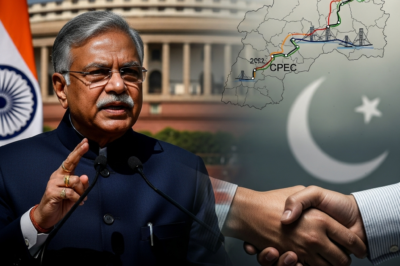
In a diplomatic maneuver that underscores the heightening tensions in South Asian geopolitics, the Government of India has issued a stern and unequivocal rejection of the recent joint statement released by Pakistan and China regarding the Union Territory of Jammu and Kashmir. This development follows a high-level meeting between Pakistani leadership and Chinese officials, where references were made to the long-standing Kashmir dispute and the progress of the China-Pakistan Economic Corridor (CPEC). The Ministry of External Affairs (MEA) in New Delhi wasted no time in hitting back, categorizing the references as interference in India’s internal affairs and a blatant violation of sovereignty. This escalating rhetorical exchange marks yet another chapter in the complex trilateral relationship between the nuclear-armed neighbors and the rising superpower, China. The core of India’s objection lies not just in the mention of Kashmir, which India considers its integral and inalienable territory, but also in the continued development of CPEC projects that traverse through Pakistan-occupied Kashmir (PoK).
Historical Context: The Longstanding Rivalry and the Role of China
The history of the Kashmir dispute dates back to the partition of India in 1947, and it has since been the primary flashpoint for multiple wars between India and Pakistan. However, the involvement of China has added a sophisticated layer of complexity to this bilateral issue. China occupies a significant portion of the Aksai Chin region and maintains a strategic partnership with Pakistan that both nations describe as ‘higher than the mountains and deeper than the oceans.’ This ‘all-weather friendship’ has historically aimed at balancing India’s influence in the region. Over the last decade, this partnership has moved from military cooperation to massive infrastructural integration under the banner of the Belt and Road Initiative (BRI). India has consistently boycotted BRI summits, citing that the flagship CPEC project violates its territorial integrity by passing through areas of Jammu and Kashmir currently under the illegal occupation of Pakistan. The recent joint statement is seen by New Delhi as a provocative attempt to internationalize a bilateral issue while simultaneously legitimizing illegal construction on Indian soil.
India’s Firm Rebuff: Sovereignty is Non-Negotiable
Responding to the communiqué, the MEA spokesperson Randhir Jaiswal stated that the Union Territory of Jammu and Kashmir and the Union Territory of Ladakh have been, are, and will always remain integral and inalienable parts of India. India’s position is grounded in the Instrument of Accession signed in 1947 and reinforced by constitutional changes in August 2019, which revoked the special status of the region under Article 370. From India’s perspective, no other country has the locus standi to comment on its internal matters. The Indian government has also repeatedly called upon Pakistan to vacate all areas under its illegal occupation. By slamming the joint statement, India is sending a clear message to Beijing: that any attempt to alter the status quo through third-party interference will be met with rigorous diplomatic pushback. This stance is part of a broader strategy where India has become increasingly vocal about its red lines, particularly as its economic and military stature grows on the global stage.
The CPEC Factor: Economic Ambition vs. Territorial Integrity
The China-Pakistan Economic Corridor (CPEC) is a multi-billion dollar collection of infrastructure projects that are currently under construction throughout Pakistan. While Pakistan and China frame it as a catalyst for regional connectivity and economic prosperity, India views it through a security and legal lens. The CPEC includes the development of highways, railways, and energy pipelines that connect China’s Xinjiang province to the Gwadar port in Balochistan. Crucially, major sections of these projects run through Gilgit-Baltistan, a region India claims as part of the erstwhile princely state of Jammu and Kashmir. India has argued at various international forums, including the United Nations, that such projects constitute a violation of international law. The MEA’s latest statement reiterated that any collaborative projects under the so-called CPEC within Indian territory are inherently illegal and unacceptable. The concern for New Delhi is not just the infrastructure itself, but the permanent Chinese presence in a sensitive border region, which could have significant military implications in the event of a future conflict.
Analyzing the China-Pakistan Partnership Dynamics
For China, Pakistan serves as a crucial gateway to the Arabian Sea, allowing it to bypass the strategic ‘Malacca Trap’ through which most of its energy imports pass. By supporting Pakistan’s stance on Kashmir, China secures a loyal ally on India’s western flank, effectively forcing India to maintain a two-front military posture. For Pakistan, China provides much-needed financial bailouts, advanced military hardware, and diplomatic cover at the UN Security Council. The joint statement mentioned the need for a ‘peaceful resolution’ of the Kashmir issue, a phrase India views as hypocritical coming from two nations that have historically sought to change borders through force or economic coercion. Political analysts suggest that China’s continued backing of Pakistan is a calculated move to keep India occupied with regional disputes, thereby slowing its emergence as a global rival to Chinese hegemony. However, this strategy has also pushed India closer to the West, particularly the Quad alliance (comprising the US, Japan, Australia, and India), which seeks a ‘free and open Indo-Pacific.’
The Shadow of Cross-Border Terrorism and Regional Stability
Another critical element of India’s rebuttal involves the issue of state-sponsored terrorism. India has long accused Pakistan of using cross-border terrorism as an instrument of state policy to destabilize Jammu and Kashmir. In its response to the joint statement, India often highlights that the real obstacle to regional peace is not the status of Kashmir, but the terror infrastructure operating from Pakistani soil. China’s role here is also scrutinized; Beijing has frequently used its technical hold at the UN to block the listing of Pakistan-based terrorists as global criminals. This ‘double standard’ on terrorism is a major point of contention in New Delhi. By siding with Pakistan in joint statements, China is perceived as validating a regime that harbors entities detrimental to regional stability. India asserts that until there is a complete cessation of terror activities, any talk of ‘peaceful resolution’ remains a hollow rhetoric designed to mislead the international community.
Global Implications and the Path Ahead
The global reaction to this latest spat is likely to be one of cautious observation. While the United States and several European nations have recognized Kashmir as a bilateral issue between India and Pakistan, they have also shown increasing sensitivity to India’s concerns regarding Chinese expansionism. As India prepares for a more assertive role in global governance, its refusal to back down on sovereignty issues like CPEC and Kashmir signals a shift in its foreign policy doctrine—one that prioritizes national integrity over diplomatic niceties. Looking ahead, the tension is unlikely to subside. China’s deepening investments in Pakistan and India’s firm defensive and diplomatic posture create a stalemate. However, India’s recent infrastructure push in Ladakh and Arunachal Pradesh demonstrates that it is ready to match China’s physical presence on the borders. The future of South Asian stability will depend largely on whether these three powers can find a way to manage their differences without spiraling into a hot conflict, although the current climate suggests that the war of words will only intensify.
Conclusion: A Non-Negotiable Stance
In conclusion, India’s sharp reaction to the Pakistan-China joint statement is a reaffirmation of its ‘zero tolerance’ policy toward interference in its internal affairs. By hitting back on both Kashmir and CPEC, New Delhi is addressing two different yet interconnected threats: the political challenge to its territorial claims and the physical challenge of foreign infrastructure on its land. As the geopolitical landscape of the Indo-Pacific continues to evolve, India’s willingness to call out the ‘collusive’ nature of the China-Pakistan axis will be pivotal in shaping the region’s future. The message from New Delhi is clear: sovereignty is not a commodity for trade, and regional cooperation cannot come at the cost of territorial integrity. As long as CPEC continues to ignore India’s borders and joint statements continue to misrepresent the status of Kashmir, the diplomatic freeze in the region is likely to persist, necessitating a robust and vigilant strategy from the Indian establishment.




































Leave a Reply