
Introduction
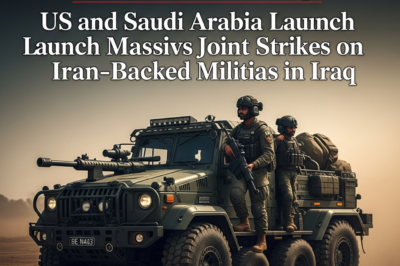
In a dramatic and unprecedented escalation of tensions in the Middle East, the United States and Saudi Arabia have reportedly conducted coordinated military strikes against Iran-backed militias operating within Iraq. This development marks a significant departure from previous rules of engagement and signals a new, more aggressive phase in the long-standing shadow war between the regional powerhouses and their Western allies against the Islamic Republic of Iran’s proxy network. The strikes target several logistical hubs and command centers belonging to groups under the umbrella of the Popular Mobilization Forces (PMF), or Hashd al-Shaabi, which the West has long accused of serving as Tehran’s vanguard in the Levant. As smoke rises over the Iraqi desert, the international community watches with bated breath, fearing that this direct intervention could be the spark that ignites a much broader regional conflagration. The involvement of Saudi Arabia—a nation that has typically preferred to act through financial support or within its own borders—alongside the US military represents a hardening of the Arab-Israeli-American coalition aimed at containing Iranian expansionism. This article provides a comprehensive analysis of the strikes, the historical underpinnings of the conflict, and the profound implications for global security.
The Strategic Context of the Joint Strikes
The decision to conduct joint strikes between the United States and Saudi Arabia is not a sudden whim but the culmination of months of heightened intelligence and increasing provocations. For several years, Iran-backed militias in Iraq have been using sophisticated drone technology and short-range ballistic missiles to target US bases, such as Al-Asad and Al-Tanf, as well as critical Saudi oil infrastructure. The logic behind these strikes from the US-Saudi perspective is one of active deterrence. By targeting the infrastructure of the militias, the coalition aims to degrade their operational capability while sending a clear message to Tehran that the gray zone warfare—where Iran operates through proxies to maintain plausible deniability—is no longer a safe harbor. This military cooperation is also a physical manifestation of the deepening security ties between Washington and Riyadh, which have been strained in recent years but have found common ground in the face of Iranian-made UAVs and the perceived threat to the Strait of Hormuz. The strikes specifically targeted warehouses, training camps, and drone assembly plants that were identified as key nodes in the Iranian supply chain moving from Tehran through Baghdad to Damascus and Beirut.
Detailed Breakdown of the Targets and Operational Tactics
According to military analysts, the operation involved a sophisticated mix of precision-guided munitions and electronic warfare capabilities. Sources suggest that US F-15E Strike Eagles, alongside Saudi Royal Air Force assets, were deployed to strike high-value targets in the Al-Anbar province and near the Al-Qaim border crossing. These areas are notorious for being controlled by Kata’ib Hezbollah and Harakat al-Nujaba, two of the most powerful and ideologically aligned militias with Iran’s Quds Force. The strikes were not merely punitive; they were designed to dismantle the specific capabilities that have allowed these groups to harass commercial shipping and military personnel. Reports indicate that at least six major installations were hit, including an underground storage facility believed to house advanced Iranian missile components. The use of Saudi airspace and potentially Saudi participation in the kinetic phase of the mission signifies a no-turning-back point in regional politics. It indicates that Riyadh is now willing to risk direct Iranian retaliation on its own soil in exchange for a more forceful containment policy. Furthermore, the timing of these strikes, coming shortly after a series of high-level diplomatic meetings, suggests that the military action is part of a broader maximum pressure campaign designed to force Iran back to the negotiating table under less favorable terms.
The Axis of Resistance and the Iranian Strategy
Tehran’s response to these strikes has been one of predictable defiance. The Iranian leadership, which oversees the so-called Axis of Resistance—a network including Hezbollah in Lebanon, the Houthis in Yemen, and various Iraqi militias—views these strikes as a violation of Iraqi sovereignty and an act of desperation by imperialist powers. From the perspective of the Islamic Revolutionary Guard Corps (IRGC), their presence in Iraq is a legitimate extension of their regional defense strategy, aimed at preventing the resurgence of extremist groups like ISIS while countering US influence. The strikes pose a significant challenge to the IRGC’s regional architecture. If the US and Saudi Arabia can consistently target these groups without sparking a full-scale war, the utility of the proxy model begins to diminish. However, history suggests that Iran is more likely to double down. In the wake of the strikes, we can expect an increase in asymmetric attacks, possibly targeting the logistical lines of the US military in eastern Syria or using Houthi allies to strike at shipping in the Red Sea. The Iranian strategy is built on endurance and the ability to absorb tactical losses while maintaining a long-term strategic presence. Tehran believes that the Western public’s appetite for another forever war in the Middle East is low, and they will likely use this incident to further mobilize anti-Western sentiment within Iraq’s political spheres.
Iraq’s Sovereignty at a Crossroads
For the Iraqi government in Baghdad, these strikes represent a diplomatic and political nightmare. Prime Minister Mohammed Shia al-Sudani finds himself caught in an impossible position, balancing the demands of the US, which provides essential security assistance and financial ties, and the powerful pro-Iran factions within his own government and the PMF. The Iraqi Foreign Ministry has condemned the strikes as a violation of sovereignty, a necessary rhetorical move to appease the domestic base. However, behind closed doors, there is a recognition that the presence of autonomous militias—who often act without the state’s permission—is what draws foreign fire in the first place. This incident highlights the dual-state nature of Iraq, where the official military exists alongside ideologically driven paramilitaries. The strikes could potentially lead to a renewed push in the Iraqi parliament to expel US forces, a move that Washington warns would lead to the total collapse of the security apparatus and potentially a resurgence of jihadist elements. The social fabric of Iraq is also at risk; as these strikes occur, the risk of sectarian tensions re-emerging between those who support the Iranian-aligned groups and those who wish for a sovereign Iraq free from foreign interference grows exponentially.
Regional and Global Economic Consequences
The geopolitical tremors from these strikes are felt far beyond the borders of Iraq. Global markets are sensitive to any instability in the Middle East, particularly when it involves the world’s largest oil exporter, Saudi Arabia, and the strategic corridor of Iraq. Immediately following the news of the strikes, Brent crude prices saw a spike, reflecting the war premium that traders place on oil when regional conflict looms. The potential for a wider war threatens the stability of the global energy supply chain. If Iran were to retaliate by attempting to close the Strait of Hormuz or by striking Saudi refineries as they did in 2019, the global economy could face a significant inflationary shock. Beyond oil, the strikes impact the Middle Corridor trade routes and China’s Belt and Road Initiative, which seeks stability in the region for its infrastructure projects. Investors are also reassessing the risk profiles of emerging markets in the Middle East. While the Abraham Accords have fostered a sense of growing economic cooperation between Israel and several Arab nations, this military escalation reminds the world that the region remains a tinderbox where decades of diplomatic progress can be undone by a single night of airstrikes.
Predictive Analysis: What Happens Next?
Looking ahead, the path forward is fraught with danger. We are likely to see a tit-for-tat cycle of violence in the short term. The militias will almost certainly launch retaliatory drone or rocket attacks against US positions in the region. The critical question is whether this escalation can be contained. There are three primary scenarios. First, the controlled escalation model, where both sides exchange blows but stop short of a direct state-on-state war, maintaining a high-tension status quo. Second, a diplomatic breakthrough triggered by the realization that the cost of war is too high, leading to a new regional security framework. This seems unlikely given the current ideological entrenchment. The third and most concerning scenario is total regional war, where a miscalculation—such as a strike that causes high civilian or high-ranking military casualties—leads to a direct clash between the US/Saudi coalition and Iran. The role of international mediators like Qatar, Oman, and the United Nations will be crucial in the coming weeks. They will need to provide a face-saving exit for both parties to de-escalate. Furthermore, the upcoming US presidential election adds another layer of complexity, as domestic political pressures may influence the White House’s willingness to either double down or seek a rapid resolution to the crisis.
Conclusion
The joint US-Saudi strikes on Iran-backed Iraqi militias mark a historic and perilous juncture in Middle Eastern history. It is a clear signal that the era of passive containment is ending, replaced by a strategy of direct confrontation against Iranian proxies. While the military objective of degrading militia capabilities may be achieved in the short term, the long-term political and humanitarian consequences remain deeply uncertain. As Iraq struggles to maintain its sovereignty and the world economy braces for potential shocks, the need for a sustainable diplomatic solution has never been more urgent. However, with both sides deeply committed to their respective regional visions, the smoke over Iraq may be a harbinger of a long and difficult road ahead. The international community must now navigate this crisis with extreme caution, lest the shadow war finally steps into the blinding light of a full-scale regional conflict.



































Leave a Reply