
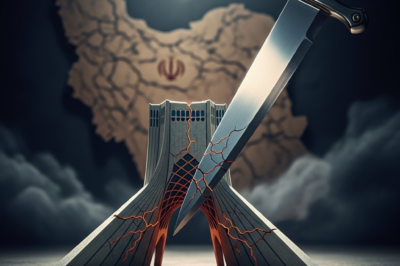
The Islamic Republic of Iran is currently navigating one of its most volatile domestic political periods in decades. The headline that has sent shockwaves through international diplomatic circles—”Us, Blade, Your Throat”—is not merely a provocative slogan but a chilling manifestation of a deepening schism within the Iranian establishment. As reported by NDTV and various regional outlets, hardline factions within the country have begun to turn their vitriol toward their own leadership, specifically targeting the administration of President Masoud Pezeshkian. This internal rebellion, characterized by slogans that imply violent retribution, suggests that the ideological monolithic image Tehran strives to project to the world is crumbling from within. For a regime that has long relied on the unity of its conservative base to suppress liberal dissent, this shift represents a profound existential threat. When the ‘true believers’ start threatening the state with the blade, the very foundations of the theocracy are put to the ultimate test.
The Genesis of the ‘Blade’ Slogan and the Hardline Revolt
The phrase “Us, Blade, Your Throat” did not emerge in a vacuum. It is the culmination of months of simmering resentment among Iran’s ultra-conservative factions, including elements of the Basij militia and hardline clerics who view any attempt at diplomatic rapprochement or social relaxation as a betrayal of the 1979 Revolution. Following the election of Masoud Pezeshkian, a figure seen by many as a relative reformist or at least a pragmatist, the hardliners have felt increasingly marginalized. They perceive his attempts to engage with the West regarding the nuclear deal (JCPOA) and his calls for a less stringent enforcement of the mandatory hijab laws as a ‘soft coup’ against the values of the Islamic Republic.
This slogan is a direct message to the executive branch: the hardliners consider themselves the ‘guardians’ of the revolution, and they are prepared to use the same tools of coercion they once used against student protesters and liberal activists against the government itself. The imagery of the ‘blade’ is particularly potent in Middle Eastern political discourse, symbolizing a final, bloody reckoning. It reflects a radicalized segment of society that feels the state is no longer ‘revolutionary’ enough, creating a paradox where the regime’s own enforcement arm is now its primary antagonist.
Coup Claims and the Shadow of the IRGC
Amidst these violent slogans are rising claims of a potential ‘soft coup.’ These allegations come from both sides of the aisle. Reformists claim that the deep state—primarily the Islamic Revolutionary Guard Corps (IRGC)—is orchestrating a campaign of intimidation to paralyze the Pezeshkian administration. Conversely, hardliners claim that the President and his cabinet are the ones conducting a coup by stealthily dismantling the ideological pillars of the state to please Western powers and secure sanctions relief. This atmosphere of mutual suspicion has led to a breakdown in governance, as every policy decision is viewed through the lens of betrayal or survival.
The role of the IRGC in this turmoil cannot be overstated. While the Guard is officially loyal to the Supreme Leader, Ayatollah Ali Khamenei, it is not a monolithic entity. There are younger, more radicalized officers within the IRGC who believe that the current leadership has grown soft and corrupt. These ‘neo-revolutionaries’ are often the ones backing the groups that chant the ‘blade’ slogans. They view the current economic malaise not as a result of sanctions, but as a result of a lack of revolutionary zeal. If these elements feel that the Supreme Leader is leaning too far toward Pezeshkian’s pragmatism, the threat of a more formal military intervention or a systemic purge becomes a terrifyingly real possibility.
Masoud Pezeshkian: A President Caught in the Crossfire
President Masoud Pezeshkian entered office with the impossible task of bridging the gap between an angry, disillusioned populace and a rigid, uncompromising clerical establishment. His rhetoric of ‘national unity’ has, so far, failed to appease either side. To the youth and the middle class, he has not moved fast enough to secure personal freedoms or economic stability. To the hardliners, every word he speaks is an affront to the memory of Ebrahim Raisi, the former hardline president whose death in a helicopter crash opened the door for Pezeshkian.
The ‘Blade at the Throat’ threat is specifically designed to neutralize Pezeshkian’s leverage. By creating a climate of fear, the hardliners hope to prevent him from making any concessions in international negotiations. They are effectively holding the government hostage, signaling to the world that even if the President signs an agreement, the ‘street’ (or at least their violent version of it) will not honor it. This creates a paralysis that benefits the hardliners’ agenda of continued isolationism and ‘resistance economy’ tactics, even as the Iranian rial continues its downward spiral and the cost of living becomes unbearable for the average citizen.
Economic Despair as a Catalyst for Extremism
One cannot analyze the political fracturing of Iran without looking at the economic backdrop. Decades of sanctions, combined with systemic corruption and mismanagement, have hollowed out the Iranian middle class. However, the economic pain is also felt by the regime’s traditional power base. The families of the Basij and the low-level IRGC members are also struggling with hyperinflation and the lack of basic goods. In the past, the regime could buy loyalty through subsidies and patronage. As the state’s coffers dwindle, that patronage is drying up.
When the ‘true believers’ lose their economic privileges, their ideological loyalty often morphs into radicalized anger. They blame the ‘technocrats’ and the ‘reformists’ for their suffering. The ‘blade’ slogan is a cry of the disenfranchised loyalist who feels that while they fought the regime’s wars in Syria and Iraq, the ‘elites’ in Tehran are now trying to sell out the revolution to the Americans for a few barrels of oil. This economic desperation provides the fuel for the fire of political insurrection, making the hardliners more dangerous than ever because they feel they have nothing left to lose but their ideological purity.
Regional Implications: The Proxy Network and Foreign Policy
The internal instability in Tehran has immediate and dire consequences for the rest of the Middle East. Iran’s ‘Axis of Resistance’—comprising Hezbollah in Lebanon, the Houthis in Yemen, and various militias in Iraq and Syria—depends on a stable and decisive leadership in Tehran. If the hardliners succeed in destabilizing Pezeshkian’s government, or if they seize more direct control, we can expect a significantly more aggressive Iranian foreign policy. The hardliners view regional escalation as a way to unite the country under a banner of national defense, distracting from the internal ‘blade’ threats.
Furthermore, the nuclear file remains the most sensitive point of contention. The hardliners have openly called for Iran to pivot toward the development of a nuclear deterrent, moving away from the ‘civilian’ program that Pezeshkian hopes to use as a bargaining chip. The threat of a coup or a hardline takeover could force Israel and the United States to reconsider their own ‘red lines.’ If the ‘blade’ is at the throat of the Iranian leadership, the leadership might decide that the only way to save itself is to provoke an external conflict that forces the domestic hardliners back into line.
The Final Arbiter: The Supreme Leader’s Dilemma
Ultimately, the fate of the Iranian state rests with Ayatollah Ali Khamenei. For years, he has mastered the art of balancing the different factions of the Islamic Republic, playing them against each other to ensure his own survival. However, the current level of vitriol suggests that this balancing act is reaching its breaking point. If Khamenei sides too strongly with Pezeshkian, he risks a mutiny within the IRGC and the hardline base. If he sides with the hardliners, he risks a total collapse of the economy and a potential mass uprising from a population that is already at its limit.
The claims of a coup and the violent rhetoric directed at the leadership indicate that the ‘old guard’ is losing its grip on the ‘younger radicals.’ Khamenei is in his 80s, and the looming question of succession adds another layer of instability. The factions are not just fighting for the soul of the revolution; they are fighting for the right to decide who comes next. In this high-stakes game of survival, the ‘blade’ is no longer just a metaphor—it is a political reality that threatens to carve a new and bloody path for the future of Iran. Whether the regime can reconcile these internal contradictions or if it will be consumed by them remains the most critical question for the stability of the entire region.































Leave a Reply