
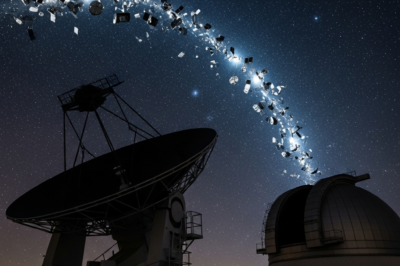
The night sky, once a pristine canvas for astronomical discovery, is rapidly transforming into a high-speed minefield of metallic shards and defunct machinery. Recent reports from major British observatories have highlighted an escalating sense of urgency, as researchers watch with growing anxiety the proliferation of orbital debris that threatens to paralyze global communication and scientific progress. This is not merely a concern for astronomers; it is a burgeoning crisis for a modern civilization that relies heavily on satellite infrastructure for everything from global positioning systems (GPS) to climate monitoring and financial transactions. As the UK Space Agency and various international bodies step up their monitoring efforts, the data suggests we are reaching a critical tipping point in Low Earth Orbit (LEO).
The Rising Tide of Orbital Debris: A Statistical Nightmare
For decades, humanity has launched objects into space with little regard for their eventual disposal. Today, the consequences of that negligence are becoming impossible to ignore. According to current estimates from the European Space Agency (ESA), there are more than 34,000 objects larger than 10 centimeters currently orbiting the Earth. While that number sounds manageable, the danger lies in the millions of smaller fragments that are virtually impossible to track with current technology. There are an estimated 1 million pieces of debris between 1 and 10 centimeters, and a staggering 130 million pieces smaller than 1 centimeter. At orbital velocities reaching 17,500 miles per hour, even a tiny fleck of paint can impact a satellite with the kinetic energy of a bowling ball traveling at 60 miles per hour, causing catastrophic damage or total destruction.
The British Perspective: Monitoring from the Ground Up
British scientists, particularly those utilizing the advanced tracking capabilities of the Science and Technology Facilities Council (STFC) and various university-led observatories, have become vocal advocates for space sustainability. The UK has long been a leader in space situational awareness (SSA), a field dedicated to tracking, identifying, and predicting the movement of objects in orbit. However, British astronomers are expressing ‘nervousness’ because the rate of satellite launches is outpacing our ability to monitor the resulting debris. The rise of mega-constellations, such as SpaceX’s Starlink and Amazon’s Project Kuiper, has added thousands of new satellites to an already crowded environment. While these projects aim to provide global internet coverage, they also increase the probability of close encounters and accidental collisions, which in turn generate even more debris.
The Kessler Syndrome: A Doomsday Scenario for the Space Age
At the heart of the anxiety felt by the British scientific community is the ‘Kessler Syndrome.’ Proposed by NASA scientist Donald Kessler in 1978, this theory suggests a scenario where the density of objects in LEO is high enough that collisions between objects could cause a cascade in which each collision generates more space debris, further increasing the likelihood of further collisions. If this chain reaction reaches a critical mass, certain orbital altitudes could become entirely unusable for generations. We have already seen glimpses of this phenomenon; the 2009 collision between the defunct Russian satellite Kosmos 2251 and the active Iridium 33 communication satellite created thousands of trackable fragments that still pose a threat to spacecraft today. For British observatories, the fear is that we are one major collision away from a permanent loss of space access.
Economic and Geopolitical Stakes of a Crowded Sky
The implications of the space junk crisis extend far beyond the laboratory. The global space economy is valued at nearly $500 billion, with a significant portion of that revenue generated by satellite-based services. A failure in the satellite grid would disrupt global logistics, military communications, and weather forecasting, leading to economic losses in the trillions. Furthermore, space debris is a geopolitical powderkeg. If a piece of debris from one nation’s defunct satellite destroys a multi-billion-dollar asset belonging to another nation, the resulting tension could escalate quickly. The UK, through its National Space Strategy, is attempting to lead the way in establishing international norms for ‘space traffic management,’ but consensus among major space-faring nations remains elusive.
Technical Challenges in Debris Detection and Mitigation
One of the primary reasons for the nervousness in British observatories is the technical limitation of our current tracking systems. Ground-based radars and optical telescopes can only see so much. Small, dark pieces of debris often go undetected until they are dangerously close to an active satellite. Researchers are currently working on integrating artificial intelligence into tracking systems to better predict orbital pathways and potential collisions. Additionally, the UK is a pioneer in ‘Active Debris Removal’ (ADR) technology. Companies like Astroscale, which has a significant presence in the UK, are testing ‘harpoon and net’ systems designed to capture and de-orbit large pieces of junk. However, these missions are expensive and technically complex, and they currently focus on large objects rather than the millions of small fragments that are just as lethal.
International Policy and the Future of Space Sustainability
The British government has consistently called for more robust international regulations regarding the disposal of satellites at the end of their operational lives. Currently, many satellites are left to drift for decades before atmospheric drag naturally pulls them down. New guidelines suggest a ‘five-year rule’ for de-orbiting, but these are often non-binding. The tension between the commercial drive to launch more satellites and the scientific need to preserve the orbital environment is at an all-time high. Without a legally binding international treaty that mandates debris mitigation and provides a framework for liability, British observatories warn that our window for intervention is closing. The ‘nervousness’ observed today is a rational response to a problem that has been ignored for too long, and the future of our technological civilization may depend on how we manage the void just above our heads.
As we look forward, the challenge remains clear: we must treat space as a finite resource. The efforts of British scientists to monitor this growing threat are vital, but they are only one part of the solution. A global, coordinated effort to clean up our orbital neighborhood and implement sustainable launch practices is no longer an option—it is a necessity for the survival of the space age.






































Leave a Reply