
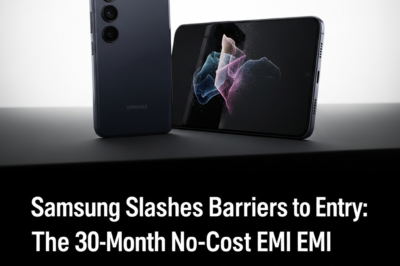
The landscape of the premium smartphone market is undergoing a seismic shift, driven not just by hardware innovation, but by creative financial engineering. Samsung, the undisputed leader in the foldable category, has recently announced a groundbreaking payment scheme that allows consumers to own their latest flagship devices—the Galaxy Z Fold6 and the Galaxy Z Flip6—through a 30-month no-cost Equated Monthly Installment (EMI) plan. This move is particularly significant because it addresses the primary hurdle for foldable adoption: the staggering price tag. Historically, foldable devices have been positioned as luxury items for the early adopter or the tech elite. By stretching the payment cycle to 30 months without touching the base price or adding interest, Samsung is democratizing access to the future of mobile computing. This strategy signifies a transition from the traditional transactional model to a long-term consumer relationship model, ensuring that the latest technology is no longer out of reach for the aspirational middle class. As the global economy experiences fluctuations and consumer spending habits become more cautious, such financial flexibility could be the deciding factor that maintains Samsung’s dominance in a niche yet rapidly growing market.
The Financial Strategy Behind 30-Month Installments
The core of Samsung’s new offer lies in the psychology of affordability. For most consumers, a lump-sum payment exceeding $1,000 or $1,800 is a significant deterrent. However, when that same cost is divided into thirty equal parts, the monthly commitment becomes comparable to a high-end gym membership or a premium streaming bundle. This ‘micro-payment’ approach significantly reduces the ‘pain of paying,’ making the decision to upgrade much easier. Samsung is collaborating with major financial institutions and its proprietary Samsung Finance+ platform to facilitate these transactions. By absorbing the interest costs that would typically be associated with a 2.5-year loan, Samsung is essentially subsidizing the consumer’s entry into the foldable ecosystem. This is a calculated risk. The goal is to increase the volume of sales to offset the cost of financing. Furthermore, by locking consumers into a 30-month payment plan, Samsung ensures a level of brand loyalty; a user is less likely to switch to a competitor if they are still paying off a high-quality device that continues to receive software updates and support.
Samsung Galaxy Z Fold6 and Z Flip6: The Hardware Justification
While the financing is attractive, the product itself must justify the commitment. The Galaxy Z Fold6 and Z Flip6 represent the pinnacle of Samsung’s engineering. The Z Fold6, with its book-like form factor, has been refined with a more durable ‘Armor Aluminum’ frame and a redesigned hinge that reduces the visible crease while offering better resistance to dust and debris. Its inner display is a canvas for productivity, powered by the Snapdragon 8 Gen 3 for Galaxy, ensuring that the device remains fast and relevant for the duration of the 30-month payment plan. On the other hand, the Z Flip6 has seen massive improvements in camera technology and battery life, addressing two of the most common complaints about previous generations. The addition of a 50MP main sensor brings it on par with the Galaxy S24 series, making it a viable flagship for photography enthusiasts. When a consumer looks at these specs, they see a device that isn’t just a gimmick but a long-term investment. The longevity of the hardware is crucial here; if the phone didn’t last three years, a 30-month plan would be a hard sell. Samsung’s promise of seven years of security and OS updates perfectly complements this long-term financing, assuring the buyer that their phone will be as secure and feature-rich in month 30 as it was on day one.
Challenging the Dominance of Traditional Flagships
For years, the ‘slab’ smartphone has reigned supreme. Devices like the iPhone Pro Max and the Galaxy S Ultra series have been the standard for premium excellence. However, the foldable form factor offers something these traditional devices cannot: a transformative user experience. By making the Fold6 and Flip6 more affordable through the 30-month plan, Samsung is directly challenging the market share of high-end slab phones. Why would a consumer buy a standard flagship when, for a similar monthly outlay, they could own a device that unfolds into a tablet or folds into a compact square? This move is particularly aggressive toward Apple, which has yet to release a foldable device. By the time an ‘iPhone Fold’ arrives, Samsung aims to have captured a significant portion of the premium audience through these accessible payment plans. The competition is not just about who has the best screen, but who has the best ownership model. Samsung is betting that once a user experiences the multitasking capabilities of a foldable, they will never want to go back to a single-screen device.
The Role of Galaxy AI and Ecosystem Lock-in
A significant part of the value proposition for the latest Z series is the integration of Galaxy AI. Features such as ‘Circle to Search,’ ‘Live Translate,’ and the ‘AI-powered Note Assist’ are not just parlor tricks; they are tools that fundamentally change how users interact with their mobile devices. These AI features require powerful hardware and a commitment to software evolution. By offering a 30-month payment plan, Samsung is inviting users into an AI-driven ecosystem. As users store more data in the Samsung Cloud, use Galaxy Buds that pair seamlessly with their Fold, and track health metrics on a Galaxy Watch, the cost of switching to another brand becomes prohibitively high. This is the ‘walled garden’ strategy, executed through financial accessibility. The 30-month window provides ample time for the user to become deeply integrated into the Samsung suite of products and services. By the time the plan ends, the consumer is likely to look at the Galaxy Z Fold8 or Fold9 as their next logical step, continuing the cycle of brand loyalty.
Impact on the Indian and Global Consumer Market
In markets like India, where the ‘EMI culture’ is a primary driver of the economy, this 30-month offer is a game-changer. Indian consumers are historically value-conscious but are increasingly willing to spend on premium experiences if the payment terms are favorable. Samsung has always had a strong foothold in India, but the foldable segment remained a tough nut to crack due to the high upfront cost. With the 30-month no-cost EMI, the Galaxy Z Flip6 becomes accessible to a much wider demographic, including young professionals and students who previously could only dream of owning a foldable. Globally, this move sets a precedent. It puts pressure on other manufacturers like Google, OnePlus, and Motorola to offer similar long-term financing options. If 30-month plans become the industry standard for foldables, it could accelerate the decline of the traditional flagship and usher in the ‘Foldable Era’ much faster than analysts originally predicted. Retailers are also expected to see a surge in footfall, as these plans are often easier to explain and sell in a physical store environment where the customer can touch and feel the device.
Conclusion: A New Era of Accessible Luxury
Samsung’s decision to stretch foldable payments to 30 months without increasing the price is more than a simple promotion; it is a visionary business move that recognizes the changing reality of consumer electronics. In a world where flagship phones are reaching price parity with laptops, the method of acquisition is just as important as the technology itself. This strategy effectively eliminates the ‘price shock’ associated with foldables and positions the Galaxy Z Fold6 and Z Flip6 as attainable tools for productivity and expression. By combining cutting-edge hardware, a robust AI ecosystem, and an unprecedented financing model, Samsung is not just selling a phone; it is selling a lifestyle. As we look toward the future, it is clear that the success of high-end tech will depend on these types of inclusive financial structures. Samsung has set the bar high, and the rest of the industry must now decide how to respond. For the consumer, the message is clear: the future is foldable, and it has never been more affordable to join the revolution.




































Leave a Reply