
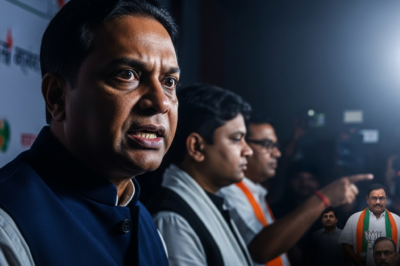
The political landscape of West Bengal, already a theater of high-octane drama and ideological warfare, has been further ignited by a series of explosive allegations from veteran Trinamool Congress (TMC) leader and Member of Parliament, Kalyan Banerjee. In a statement that has sent shockwaves through the corridors of power in Kolkata and New Delhi alike, Banerjee has claimed that a segment of his own party colleagues—specifically sitting Members of Parliament—are covertly collaborating with the Bharatiya Janata Party (BJP). This revelation is not merely a localized political spat; it represents a deep-seated fissure within the TMC that could have far-reaching implications for the upcoming electoral cycles and the stability of the Mamata Banerjee-led administration. As the veteran parliamentarian points his finger at internal betrayal, the narrative of ‘sleeper cells’ and ‘Trojan horses’ within the Trinamool Congress has returned to the forefront of national discourse. The timing of these comments is particularly critical, coming at a juncture when the TMC is attempting to consolidate its position as a primary challenger to the saffron surge in Eastern India. The fallout from these allegations is expected to redraw the battle lines, forcing the TMC leadership to confront the uncomfortable reality of internal dissent while warding off an aggressive BJP that is perpetually on the lookout for windows of opportunity.
The Core of the Allegations: Internal Betrayal and the ‘BJP Link’
Kalyan Banerjee, known for his fiery rhetoric and unwavering loyalty to the TMC top brass, did not mince words when he suggested that some party MPs have already mentally and strategically shifted their allegiances to the BJP. According to Banerjee, these individuals are functioning within the TMC only in name, while their actions and communications suggest a alignment with the opposition’s goals. This ‘dual-membership’ phenomenon is described as a calculated move by those who fear losing their seats or who seek political survival in a shifting landscape. The veteran leader hinted that these MPs are in constant contact with BJP leaders, providing internal intelligence and softening their stance against the central government’s policies to secure their own futures. This is not the first time such allegations have surfaced, but coming from a leader of Kalyan Banerjee’s stature, the claims carry significant weight. It suggests that the party’s internal surveillance and discipline mechanisms are being tested by a sophisticated infiltration or defection strategy orchestrated by the BJP. The implications are clear: the TMC is facing a two-front war—one against the external opposition and another against the ‘enemies within’ who threaten to erode the party’s foundations from the inside out.
Historical Context: The Legacy of Defections in West Bengal Politics
To understand the gravity of Kalyan Banerjee’s claims, one must look back at the history of political crossovers in West Bengal. Since 2019, the state has seen a significant number of high-profile leaders switching sides, most notably Suvendu Adhikari, whose departure from the TMC was a seminal moment in the state’s political history. Adhikari’s move to the BJP paved the way for others, creating a precedent where senior leaders could jump ship and find immediate prominence in the rival camp. The BJP has successfully marketed itself as a viable alternative for TMC leaders who feel sidelined by the rise of Abhishek Banerjee or who are dissatisfied with the party’s internal hierarchy. However, the tide has not been one-way; leaders like Mukul Roy and Babul Supriyo have also made headlines by returning to the TMC or switching from the BJP, respectively. This constant churn has created an atmosphere of mutual suspicion. Kalyan Banerjee’s latest outburst is a reflection of this systemic paranoia. The fear is that the ‘Adhikari Model’—where leaders remain in the party until the very last moment before a major election only to defect and take a chunk of the vote share with them—is being replicated by a new batch of MPs. This historical baggage makes the current allegations far more credible to the average voter and far more dangerous for the TMC leadership.
The Internal Power Struggle: Old Guard vs. The New Order
Underpinning the allegations of BJP-siding is an unspoken but palpable tension within the Trinamool Congress itself. There is a perceived rift between the ‘Old Guard,’ comprising veterans like Kalyan Banerjee who have been with Mamata Banerjee since the party’s inception in 1998, and the ‘New Order’ centered around Abhishek Banerjee, the party’s National General Secretary. The veterans often feel that their traditional methods of grassroots politics are being overshadowed by a more corporate, data-driven approach favored by the younger leadership. This internal friction creates fertile ground for the BJP to sow seeds of discord. When a senior leader like Kalyan Banerjee speaks out about ‘rebel MPs,’ he is often not just talking about ideological shifts, but also about the frustration of leaders who feel alienated by the party’s current direction. The BJP leverages this frustration, offering these ‘sidelined’ leaders a platform where their seniority might be respected—or at least where they can exact revenge on their former colleagues. The struggle for the soul of the TMC is thus inextricably linked to the external threat of the BJP, as internal dissatisfaction becomes the primary engine for external defection.
BJP’s Strategy: Operation Lotus and the Bengal Front
The BJP’s strategy in West Bengal, often referred to as a variant of ‘Operation Lotus,’ focuses on weakening regional giants by absorbing their most influential leaders. For the BJP, capturing West Bengal is the ‘Final Frontier’ in its mission to dominate Indian politics. By courting TMC MPs, the BJP aims to achieve several objectives: first, to create a sense of inevitability regarding the TMC’s decline; second, to gain ready-made organizational strength in constituencies where the BJP’s own grassroots presence might be thin; and third, to destabilize the state government by creating a perception of administrative and political collapse. Kalyan Banerjee’s comments validate the BJP’s narrative that the TMC is a ‘sinking ship.’ Even if the MPs do not officially defect immediately, their passive cooperation with the BJP can sabotage TMC’s campaign efforts, influence local policing and administration, and demoralize the party’s rank and file. The BJP’s tactical brilliance lies in its ability to wait; they do not necessarily need these MPs to resign and trigger by-elections. They simply need them to be ‘ineffective’ for the TMC and ‘cooperative’ for the BJP during crucial legislative votes or electoral cycles.
The Legal and Ethical Quandary: Anti-Defection Law and Voter Trust
The situation described by Kalyan Banerjee also highlights the limitations of the Tenth Schedule of the Indian Constitution, popularly known as the Anti-Defection Law. The law was designed to prevent ‘Aaya Ram, Gaya Ram’ politics by disqualifying legislators who voluntarily give up membership of their party or vote against the party whip. However, it does little to address ‘silent rebels’—those who remain in the party, enjoy the perks of office, but actively work for the opposition. These MPs can avoid disqualification by not formally resigning, while still dealing a lethal blow to their parent party’s prospects. This creates an ethical vacuum that erodes voter trust. When a citizen votes for a candidate based on a party’s symbol and ideology, and that representative later sides with the opposition in spirit, it constitutes a betrayal of the democratic mandate. Kalyan Banerjee’s public call-out is an attempt to shame these individuals and force the party’s disciplinary committee to take action, even if the legal path to disqualification is murky and time-consuming. It is a desperate plea for political integrity in an era where ideological loyalty is increasingly becoming a fluid concept.
Conclusion: The Future of West Bengal’s Political Landscape
As the Trinamool Congress moves toward the next major electoral challenge, the shadows cast by Kalyan Banerjee’s allegations will be hard to ignore. The party finds itself at a crossroads where it must decide whether to undergo a radical internal purge or to attempt a process of reconciliation with its disgruntled members. For Mamata Banerjee, the challenge is twofold: she must maintain her image as the undisputed ‘Didi’ of Bengal while managing the ambitious rise of the next generation and the predatory tactics of the BJP. If Kalyan Banerjee’s claims are true, and a segment of TMC MPs is indeed siding with the BJP, the political map of West Bengal could see a dramatic reconfiguration in the coming months. The BJP will undoubtedly use these allegations to further its narrative of a crumbling TMC, while the TMC must prove that its core remains unshakable. In the high-stakes game of Indian politics, West Bengal remains the most volatile and unpredictable board, and the moves made by these ‘rebel MPs’ could very well determine the winner of the next great battle for the East.






































Leave a Reply