
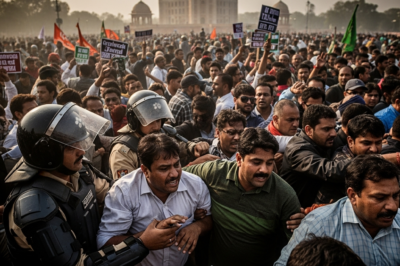
The political landscape of New Delhi witnessed a peculiar yet intense demonstration today as the Cockroach Janta Party (CJP) took to the streets of Jantar Mantar. What began as a symbolic gathering of activists and disgruntled citizens eventually culminated in a tense standoff with law enforcement, leading to the detention of six key members. This event, reported initially by major outlets like The Hindu, marks a significant moment in the ongoing narrative of grassroots activism in the capital. The protest, characterized by its unconventional branding and sharp critique of administrative inertia, underscores a growing trend of satirical yet serious political movements aiming to capture the public imagination. As the sun set over the historical observatory, the remnants of placards and the echoes of slogans served as a stark reminder of the underlying socio-economic grievances that fueled this assembly. Understanding the nuances of this protest requires a deep dive into the identity of the Cockroach Janta Party, the specific triggers that led to the Jantar Mantar mobilization, and the broader implications of the police response in an era where the right to assemble is under constant judicial and executive scrutiny.
The Genesis of the Cockroach Janta Party: Symbolism and Ideology
The Cockroach Janta Party is not your typical political entity. Named after the insect renowned for its extreme resilience and ability to survive even nuclear fallout, the party uses this metaphor to represent the common citizen—the ‘Aam Aadmi’ who survives despite systemic neglect, inflation, and administrative apathy. According to the group’s unofficial manifestos circulated via social media, the cockroach symbolizes the resilient spirit of the urban poor and the middle class who inhabit the shadows of the city’s glistening infrastructure. Their ideology is rooted in a form of ‘radical survivalism,’ where they demand that the government acknowledge the basic needs of those who are often invisible to the policy-making elite. Over the past few months, the CJP has been building a digital presence, using dark humor and stinging satire to highlight issues ranging from sanitation to the rising costs of essential commodities. This protest at Jantar Mantar was their most ambitious attempt to move from the digital sphere to the physical streets, testing their ability to mobilize and confront the state machinery directly.
Chronology of the Jantar Mantar Demonstration
The day began at approximately 10:00 AM when small groups of protesters started trickling into the designated protest zone at Jantar Mantar. Clad in brown and black attire to signify their ‘cockroach’ identity, they carried banners that read ‘We Survive Your Neglect’ and ‘The Unkillable Spirit of the Poor.’ By noon, the crowd had grown to several hundred, consisting primarily of students, social activists, and daily wage laborers who felt let down by recent municipal policies. The atmosphere was initially peaceful, with speakers taking turns on a makeshift podium to list grievances against the local administration. However, as the afternoon progressed and the humidity rose, the rhetoric became more pointed. The protesters attempted to move beyond the barricades set up by the Delhi Police, seeking to march toward Parliament House. This breach of the agreed-upon protest boundaries served as the catalyst for the subsequent confrontation. The police, citing Section 144 of the Code of Criminal Procedure, which prohibits the assembly of four or more people in certain areas, warned the crowd to remain within the designated limits. The refusal of a core group of leaders to comply led to a shift in the mood from a peaceful rally to a site of civil disobedience.
The Clash: Why Six Protesters Were Detained
The situation escalated around 3:30 PM when the Delhi Police moved in to disperse the crowd that had begun to block the main arterial roads leading away from Jantar Mantar. Amidst the chanting and the jostling, six individuals identified as the primary organizers were singled out by the security forces. According to official police statements, these detentions were necessary to prevent a total breakdown of law and order and to ensure that traffic flow in the high-security Lutyens’ zone was not permanently disrupted. The six detainees were whisked away in police vans to the Mandir Marg police station. Witnesses at the scene reported that the detentions were met with stiff resistance, with other protesters forming human chains to prevent the police from reaching the leaders. The Hindu reported that the police used ‘mild force’ to break these chains, leading to minor scuffles. The detention of these six individuals effectively decapitated the protest’s leadership for the day, leading to a gradual thinning of the crowd as remaining protesters feared further legal action. The legal basis for these detentions often rests on the fine line between ‘peaceful assembly’ and ‘unlawful gathering,’ a line that is frequently debated in the context of Delhi’s stringent security protocols.
Socio-Political Demands: Beyond the Satire
While the name ‘Cockroach Janta Party’ might seem lighthearted, their demands are anything but. The charter of demands presented during the protest focused on three main pillars: Urban Dignity, Economic Transparency, and Administrative Accountability. Specifically, the protesters demanded an immediate freeze on the hike in public transport fares, which they argue disproportionately affects the working class. They also highlighted the dire state of public sanitation in the outskirts of Delhi, contrasting it with the pristine conditions of the central diplomatic zones. Another major demand was the protection of street vendors’ rights, who often face harassment despite the existence of the Street Vendors Act. By using the ‘cockroach’ imagery, the party sought to bring attention to the ‘infestation’ of corruption that they claim has hollowed out municipal corporations. This blend of satire and serious policy critique has allowed the CJP to appeal to a younger demographic that is often disillusioned with traditional, jargon-heavy political discourse. The protest was a call for a more inclusive urban planning model that does not treat the poor as an eyesore to be hidden away but as an integral part of the city’s ecosystem.
The Role of Delhi Police and the Sec 144 Paradigm
The response of the Delhi Police to the CJP protest highlights the complex role of law enforcement in the national capital. Jantar Mantar has historically been the ‘Hyde Park’ of India, a space where dissent is not only tolerated but expected. However, in recent years, the area has seen increasing restrictions due to noise pollution complaints from residents and heightened security concerns. The frequent invocation of Section 144 has transformed Jantar Mantar from a free-speech zone into a highly regulated ‘protest box.’ During the Cockroach Janta Party demonstration, the police maintained that their actions were purely preventive. From an SEO and journalistic perspective, this raises questions about the shrinking space for democratic expression in urban centers. The use of detention as a tool to end a protest quickly is a strategy that has become increasingly common. Critics argue that such moves stifle legitimate grievances, while supporters of the administration argue that maintaining the functionality of the capital city must take precedence over the right to block roads. The detention of the six CJP members will likely be challenged in court, adding to the long list of legal battles regarding the limits of the right to protest in India.
Future Outlook: What This Means for Urban Activism
The conclusion of the Cockroach Janta Party protest does not signify the end of the movement; rather, it likely marks the beginning of a new phase of urban activism in Delhi. The fact that a relatively unknown group could garner enough attention to necessitate a significant police response and mainstream media coverage suggests that there is a vacuum in the current political representation of the urban underclass. Moving forward, the CJP is expected to leverage the ‘martyrdom’ of their six detained members to build further momentum on social media. We can expect to see more such ‘pop-up’ protests that use unconventional branding to cut through the noise of traditional news cycles. For the government and the police, the challenge will be to balance security with the democratic necessity of allowing people to voice their frustrations. If the underlying issues of inflation, housing, and dignity are not addressed, the ‘cockroaches’—as the party calls itself—will only continue to multiply in the political landscape. This event serves as a bellwether for the upcoming municipal and state-level discussions, where the issues raised by the CJP are likely to resonate with a significant portion of the electorate who feel left behind by the rapid pace of lopsided urban development.






































Leave a Reply