
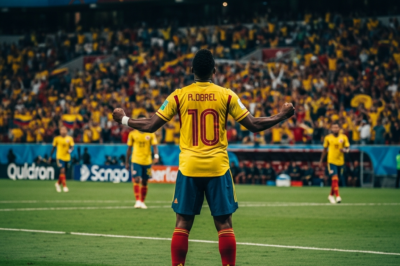
The Strategic Significance of the Colombia vs DR Congo Clash
In the high-stakes arena of the FIFA World Cup 2026, every pass, every goal, and every tactical substitution carries a weight that transcends the immediate ninety minutes on the pitch. The recent clash between Colombia and the Democratic Republic of Congo (DR Congo) was no exception. As the global football community focused its attention on this transcontinental battle, the narrative quickly shifted from a mere group-stage encounter to a significant mathematical event with far-reaching implications. For Colombia, known as Los Cafeteros, the match was a statement of intent, showcasing their evolution under a revitalized technical staff. For DR Congo, the Leopards, it was a test of their mettle against a perennial South American powerhouse. However, the most intriguing subplot of this encounter wasn’t found in the immediate box score, but rather in the ripple effects felt thousands of miles away in Lisbon. The performance of Colombia, characterized by high-pressing and clinical finishing, inadvertently created a favorable scenario for Portugal, as the FIFA ranking coefficients and potential knockout bracket permutations began to align in favor of the Seleção das Quinas. This match serves as a perfect case study for the complexities of the modern World Cup, where the expansion to 48 teams has turned every fixture into a critical data point for the world’s elite teams.
Tactical Breakdown: Colombia’s High-Octane Offense
Colombia entered the match with a clear tactical blueprint designed to exploit the spatial vulnerabilities in DR Congo’s defensive transition. Operating primarily in a fluid 4-3-3 formation that often shifted into a 3-4-3 during the attacking phase, Colombia utilized their fullbacks, such as Daniel Muñoz, as secondary wingers to overload the flanks. This tactical flexibility forced the Congolese wing-backs into deep defensive positions, effectively nullifying their counter-attacking threat. The central midfield trio, anchored by a disciplined holding player, allowed playmakers like James Rodríguez and Luis Díaz the freedom to roam between the lines. The dominance was not merely statistical but visual; Colombia maintained over 65% possession throughout the first half, completing passes with an efficiency that frustrated the Congolese press. The opening goal, a masterclass in one-touch football, illustrated the chemistry that this Colombian squad has developed over the qualification cycle. By utilizing a high-press system, Colombia won the ball back in the final third on twelve separate occasions in the first forty-five minutes, a metric that highlights their physical conditioning and tactical discipline. This level of dominance is a warning sign to other contenders in the tournament, suggesting that Colombia is no longer just a ‘dark horse’ but a genuine threat to the traditional hierarchy.
The Defensive Fortitude of DR Congo: A Brave Resistance
Despite the scoreline and Colombia’s overwhelming dominance in possession, the Democratic Republic of Congo displayed a level of resilience that earned the respect of neutrals. Under their current management, the Leopards have transitioned into a more organized, compact unit that relies on a ‘mid-block’ defensive strategy. Against Colombia, this meant absorbing immense pressure for long periods and relying on the shot-stopping abilities of their veteran goalkeeper. The DR Congo defense, led by stalwarts in the center-back positions, managed to block several goal-bound efforts and successfully navigated the aerial threats posed by Colombia’s set-pieces. While they struggled to maintain possession in the middle of the park, their quick-break transitions occasionally caught the Colombian high line off-guard, forcing the South American defenders into desperate recovery runs. The narrative of this match for DR Congo is one of growth; competing at this level requires more than just individual talent; it requires a collective tactical awareness that they are rapidly developing. The lessons learned in this high-pressure environment will be invaluable as they continue their journey in the 2026 finals, proving that the gap between the traditional giants and the emerging African nations is narrowing with every tournament cycle.
Why Portugal Benefits: The Mathematical Ripple Effect
The headline-grabbing aspect of this match was its impact on Portugal, a team not even on the same continent as the match participants. In the intricate web of FIFA rankings and the ‘Elo’ rating system used for tournament seeding, the results of high-coefficient matches like Colombia vs DR Congo have significant consequences. As Colombia dominated the encounter, they solidified their standing in the upper echelons of the global rankings. This stability in the rankings directly influences the ‘Pot’ assignments for subsequent phases and future tournament cycles. More importantly, the specific scoreline and the resulting group dynamics meant that certain higher-seeded teams, including Portugal, were shielded from potential ‘Groups of Death’ or unfavorable paths in the knockout stages. By Colombia asserting their dominance, it clarified the points distribution in a way that prevents a chaotic scramble in the middle of the ranking table. For Roberto Martínez and his Portuguese side, this result provides a degree of predictability. It allows their scouting and tactical departments to focus on a narrower range of potential opponents, optimizing their preparation for the later rounds. In professional football, information and predictability are as valuable as talent, and Colombia’s victory provided a wealth of both for the Portuguese technical staff.
Stars of the Match: Individual Brilliance on Display
Several individuals stood out during this pulsating encounter, cementing their status as world-class talents. Luis Díaz, the Liverpool winger, was a constant thorn in the side of the Congolese defense, his direct running and technical proficiency at pace creating numerous scoring opportunities. His ability to draw multiple defenders toward him opened up vital pockets of space for his teammates, a tactical advantage that Colombia exploited ruthlessly. On the other side, Chancel Mbemba for DR Congo showed why he is considered one of the most reliable defenders in European club football, making several goal-saving tackles and organizing a backline that was under siege. The resurgence of James Rodríguez also cannot be overlooked; his vision and delivery from dead-ball situations remain among the best in the world. Even as he enters the later stages of his career, his influence on the Colombian tempo is undeniable. The match also saw the emergence of younger talents, with substitute appearances from promising starlets who showed that the future of both nations is in capable hands. These individual performances are what make the World Cup the pinnacle of the sport, as players elevate their game to meet the expectations of millions of fans watching at home.
Historical Trajectories: From Qualification to the Global Stage
To understand the intensity of the Colombia vs DR Congo match, one must look at the historical paths these two nations took to reach the 2026 FIFA World Cup. Colombia’s journey involved a grueling CONMEBOL qualification process, arguably the most difficult in the world, where they had to face the likes of Brazil, Argentina, and Uruguay on a regular basis. Their qualification was a testament to their consistency and the depth of their talent pool. Conversely, DR Congo’s path through the CAF qualifiers was a story of overcoming adversity and building a cohesive unit from a diverse group of players based across various global leagues. The historical context of this match also includes the growing presence of African teams on the world stage since the 1990s and the South American desire to reclaim the trophy from European dominance. This clash was a collision of two distinct footballing cultures: the rhythmic, technical ‘Samba-adjacent’ style of Colombia and the physical, explosive, and increasingly disciplined style of DR Congo. By examining their past encounters and their respective evolutions, we see that this 2026 match was decades in the making, representing a milestone for both federations.
The 48-Team Format: Navigating the New World Cup Landscape
The 2026 World Cup is the first to feature 48 teams, a change that has fundamentally altered the tournament’s group stage dynamics. The Colombia vs DR Congo game highlighted how this expansion affects strategy. With more teams and more groups, the margin for error has changed, and the value of goal difference has skyrocketed. Teams like Colombia now know that a dominant win in the opening matches can almost guarantee a spot in the round of 32, allowing them to rotate their squad and manage player fatigue more effectively than in previous iterations of the tournament. For Portugal, observing from the sidelines, the 48-team format means they must be even more diligent in their analysis of ‘non-traditional’ footballing nations. The diversity of playing styles has increased, and the chance of an upset is higher than ever. This match proved that even when one team dominates, the tactical nuances required to break down a well-organized opponent are immense. The expansion has not diluted the quality but has instead introduced new tactical puzzles for coaches to solve, making the road to the final more arduous and mentally taxing than ever before.
Conclusion: A Tournament of Unpredictable Destiny
As the final whistle blew in the match between Colombia and DR Congo, the scoreboard reflected a dominant performance by the South Americans, but the true story was much broader. The 2026 World Cup continues to prove that football is a global ecosystem where a result in one group can ignite hope or cause concern in another. Colombia’s dominance solidified their status as a heavyweight, DR Congo showed the world their untapped potential, and Portugal found themselves in a strategically advantageous position without kicking a ball. This interconnectedness is the beauty of the World Cup. As we move forward into the knockout phases, the data gathered from matches like this will be analyzed by thousands of experts, but the magic remains in the unpredictability of the beautiful game. Whether it is the tactical genius of the managers, the individual brilliance of the players, or the mathematical coincidences of the FIFA rankings, the 2026 tournament is shaping up to be a historic chapter in sporting history. For fans of Colombia, DR Congo, and Portugal, the journey is just beginning, and the stakes have never been higher.







































Leave a Reply