
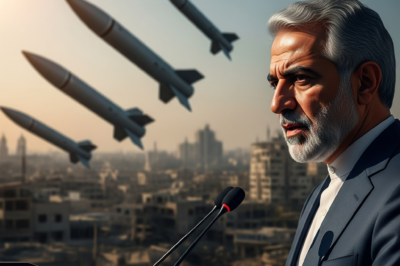
In a geopolitical landscape increasingly defined by shifting alliances and high-stakes brinkmanship, Iran has issued a stark and uncompromising message to the international community, particularly to the United States and its Western allies. The core of the message is simple yet profound: Iran’s ballistic missile program is non-negotiable. This stance was recently underscored by high-ranking Iranian officials who drew a direct, sobering parallel to the ongoing conflict in the Gaza Strip. The assertion that ‘without missiles, we would be like Gaza’ represents more than just a rhetorical flourish; it is a fundamental articulation of Tehran’s national security doctrine in an era of asymmetric warfare and regional instability. This development comes at a critical juncture as the international community attempts to revive diplomatic channels to address Iran’s nuclear ambitions and regional influence. However, the explicit linking of domestic missile capabilities to the survival of the state suggests that the window for a comprehensive ‘grand bargain’ involving weaponry curbs may be narrower than ever before.
The Iranian leadership’s refusal to entertain missile restrictions is rooted in a deep-seated belief that their missile arsenal serves as the ultimate deterrent against foreign intervention. By invoking the image of Gaza—an enclave that has faced devastating aerial bombardments with limited means to strike back effectively at the source of those attacks—Tehran is communicating to its own population and the world that disarmament is synonymous with vulnerability. For the Iranian establishment, the lesson of the last year in the Levant is clear: technical and military superiority in missile technology is the only shield that prevents a nation from being subjected to the kind of total kinetic warfare seen in the Palestinian territories. This narrative effectively bridges the gap between domestic defense policy and the broader struggles of the ‘Axis of Resistance,’ positioning Iran not just as a regional patron, but as a state that has learned the hard lessons of modern conflict.
The Gaza Parallel: Deterrence as an Existential Necessity
The comparison to Gaza is strategically calculated to resonate with both domestic audiences and the broader Islamic world. In the eyes of Tehran’s military planners, the lack of a sophisticated, long-range deterrent in the hands of Gaza’s governing bodies allowed for a sustained and intensive military campaign by Israel that could not be deterred by traditional means. By stating that Iran would suffer a similar fate without its missiles, officials are highlighting the perceived failure of international law and diplomacy to protect states or entities that do not possess the means to retaliate in kind. This logic is an extension of the ‘defensive deterrence’ theory that Iran has refined since the end of the Iran-Iraq War. During that conflict, specifically the ‘War of the Cities,’ Iran found itself unable to respond effectively to Iraqi missile strikes on its urban centers, a trauma that remains foundational to its military industrial complex. Today, the missile program is viewed as the only guaranteed way to ensure that any attack on Iranian soil would result in a reciprocal and unacceptable cost to the aggressor.
Furthermore, the Gaza analogy serves to silence domestic critics who might argue for economic relief in exchange for military concessions. By framing missiles as a life-or-death necessity, the government elevates the program above the fray of standard political negotiation. The imagery of Gaza’s leveled neighborhoods is used as a potent visual argument for why Iran must continue to invest in its ‘Emad,’ ‘Ghadr,’ and ‘Sejjil’ missile families. From a tactical perspective, the Iranian Revolutionary Guard Corps (IRGC) argues that their missiles provide ‘strategic depth,’ allowing Iran to project power far beyond its borders and keep potential conflicts away from the Iranian heartland. This doctrine of ‘forward defense’ is inextricably linked to the missile program, which provides the reach necessary to threaten enemy assets across the Middle East and parts of Europe.
Historical Context: From the 2015 JCPOA to the Present Deadlock
To understand the current impasse, one must look back at the history of the Joint Comprehensive Plan of Action (JCPOA), signed in 2015. While the JCPOA successfully limited Iran’s nuclear activities, it conspicuously left the missile program outside the scope of the formal agreement. This was a deliberate choice by the Obama administration and other P5+1 members to secure a deal on the most pressing issue—nuclear breakout capacity. However, this omission became a primary point of contention for critics in the United States and the Middle East, particularly Israel and Saudi Arabia, who argued that a deal that didn’t address the ‘delivery systems’ (the missiles) was fundamentally flawed. When the Trump administration unilaterally withdrew from the deal in 2018 and initiated a ‘maximum pressure’ campaign, one of the key demands was a new, broader treaty that would include strict limits on Iran’s ballistic missile development and regional activities.
The failure of the ‘maximum pressure’ campaign to bring Iran back to the negotiating table on Western terms has only emboldened the hardliners in Tehran. They argue that the US withdrawal proved that no agreement is permanent and that giving up military leverage is a fool’s errand. Since 2018, Iran has significantly accelerated its missile testing and development, showcasing increased precision, maneuverability, and range. The transition from liquid-fueled to solid-fueled missiles has also enhanced their readiness, making them harder to detect and destroy before launch. By the time the Biden administration took office with the intent of returning to the JCPOA, the regional context had shifted. Iran had already integrated its missile capabilities more deeply into its regional strategy, providing technology and training to proxies, which has created a ‘ring of fire’ around its primary regional rivals. This historical trajectory explains why Iran now views any attempt to curb its missiles as a non-starter; they see the program as the only leverage they have left in a world where diplomatic promises are seen as fragile.
Technical Sophistication and the IRGC’s Missile Doctrine
Iran’s missile arsenal is widely considered the largest and most diverse in the Middle East. It ranges from short-range tactical missiles used in localized battlefield scenarios to medium-range ballistic missiles (MRBMs) capable of reaching targets over 2,000 kilometers away. Key among these are the ‘Shahab’ series, which provided the early foundation for Iranian deterrence. However, it is the newer generations, such as the ‘Khorramshahr’ and the ‘Haj Qasem’ (named after the slain general Qasem Soleimani), that demonstrate the leap in Iranian engineering. These missiles are designed to bypass sophisticated missile defense systems like the Iron Dome or the Patriot batteries through high speeds and terminal-phase maneuvering. The recent unveiling of the ‘Fattah’ hypersonic missile, according to Iranian claims, represents an attempt to join the elite group of nations possessing technology that can travel at five times the speed of sound, making interception nearly impossible with current defensive technology.
The IRGC, which oversees the missile program, views these weapons as the centerpiece of their asymmetric warfare strategy. Because Iran’s conventional air force consists of aging airframes from the pre-1979 era, the missile force acts as a ‘virtual air force.’ Instead of relying on vulnerable fighter jets to deliver payloads, Iran uses its mobile missile launchers to create a threat that is difficult to neutralize. This doctrine also includes the development of ‘suicide’ drones or loitering munitions, which have been used with significant effect in recent regional conflicts. The integration of precision-guided kits into older unguided rockets has also turned relatively simple weapons into high-precision tools of war. For Iranian military planners, this technical evolution is a point of national pride and a critical component of their ‘Resistance Economy,’ where domestic innovation is used to overcome international sanctions.
The US Dilemma: Diplomacy vs. Containment in a Multi-Polar World
For Washington, the Iranian refusal to discuss missiles creates a profound diplomatic dilemma. On one hand, the Biden administration recognizes that a nuclear-armed Iran is a global security threat that must be prevented. On the other hand, a deal that only addresses nuclear concerns while ignoring the missile threat is politically untenable in the US Congress and deeply alarming to regional allies. The American policy has traditionally sought a ‘longer and stronger’ deal, but Iran’s latest rhetoric suggests that the ‘stronger’ part—referring to missiles and regional behavior—is effectively off the table. This leaves the US with few options: continue the current path of targeted sanctions and containment, engage in a limited nuclear-only deal that risks regional backlash, or escalate to more coercive measures that could lead to a broader conflict.
Furthermore, the global geopolitical shift, characterized by the rising influence of China and Russia’s war in Ukraine, has provided Iran with more diplomatic and economic breathing room. Tehran has strengthened its ties with Moscow, notably through the provision of drone technology, and has found in China a consistent buyer of its oil despite Western sanctions. This ‘Pivot to the East’ reduces the efficacy of US economic pressure as a tool to force military concessions. If Iran feels it can survive and even thrive economically without Western approval, its incentive to negotiate away its primary military deterrent—its missiles—evaporates. The US now finds itself in a position where it must manage a regional power that is increasingly integrated into an anti-Western bloc, making the missile issue a focal point of the broader competition between global powers.
Future Outlook: Is a Middle Ground Possible?
As we look toward the future, the probability of a formal agreement that includes significant curbs on Iran’s missile program appears extremely low. The ‘Gaza lesson’ has become a pillar of Iranian strategic thought, and no amount of economic incentive is likely to outweigh the perceived security risks of disarmament. However, there may be room for ‘informal understandings’ or ‘de-escalation measures’ that do not require a formal treaty. This could include unwritten agreements on range limits—keeping missiles under the 2,000km threshold to avoid threatening Western Europe—or transparency measures regarding certain tests. Yet, even these modest goals are hindered by the deep-seated mistrust between Washington and Tehran.
The ultimate implication of Iran’s stance is a Middle East that remains on a permanent war footing. As Iran continues to advance its missile technology, its neighbors will likely respond by increasing their own defensive and offensive capabilities, leading to a regional arms race. The comparison to Gaza serves as a reminder that in the absence of robust regional security architecture, nations will prioritize raw military power over diplomatic engagement. Until there is a fundamental shift in the security perceptions of both Iran and its adversaries, the missile program will remain the ‘impenetrable shield’ of the Islamic Republic, and the shadow of Gaza will continue to loom large over any diplomatic table.
Conclusion
The rejection of missile curbs by Iran, framed through the tragic lens of the Gaza conflict, marks a definitive moment in Middle Eastern diplomacy. It signals that for Tehran, the era of making concessions on core defense capabilities in exchange for economic integration is over. The ‘Gaza analogy’ is a powerful tool for the Iranian leadership to justify their military expenditures and to solidify their role as a defiant regional power. As the international community grapples with this reality, the focus must shift from unrealistic demands for total disarmament to more pragmatic approaches to conflict management and risk reduction. In a world where the ‘Gaza scenario’ is viewed as the alternative to a robust missile program, the path to peace will require more than just signatures on a page; it will require a fundamental reimagining of what security looks like in a multi-polar and increasingly volatile region.






































Leave a Reply