
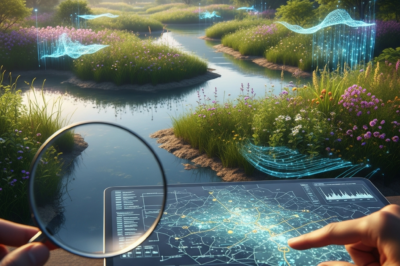
In an era where the dual crises of climate change and biodiversity loss threaten the very foundations of human civilization, The Energy and Resources Institute (TERI) has introduced a pioneering framework that places Artificial Intelligence (AI) at the heart of environmental recovery. Land degradation currently affects over 3.2 billion people worldwide, leading to food insecurity, increased poverty, and heightened vulnerability to extreme weather events. In India alone, roughly 29% of the total geographical area is undergoing degradation, a trend that poses a significant threat to the nation’s agricultural output and ecological stability. TERI’s recent initiative—’AI for Restoring Degraded Lands’—is not merely a technological upgrade; it is a fundamental shift in how we perceive, measure, and heal our planet. By integrating satellite imagery, machine learning, and advanced economic modeling, this framework provides a comprehensive toolkit for stakeholders to identify hotspots of degradation, simulate future climate impacts, and, crucially, assign a tangible value to the services provided by healthy ecosystems. This intersection of silicon and soil represents a new frontier in the battle for a sustainable future, offering a precision-guided approach to what was once a largely speculative field of conservation and land management.
The Technological Paradigm: Mapping Degradation with Unprecedented Precision
Historically, mapping land degradation was a labor-intensive process involving manual surveys and low-resolution satellite data that often missed the nuances of soil salinity, nutrient depletion, or subtle changes in vegetation cover. TERI’s AI-driven approach revolutionizes this by utilizing high-resolution multispectral and hyperspectral imagery provided by advanced satellite constellations. Machine learning algorithms, specifically Convolutional Neural Networks (CNNs) and Random Forest models, are trained to recognize specific ‘spectral signatures’ associated with different stages and types of degradation. For example, AI can differentiate between seasonal moisture fluctuations and permanent desertification, allowing for the creation of dynamic, real-time maps. These maps do more than just show where the land is ‘broken’; they categorize the type of degradation—whether it be water erosion, wind erosion, salinity, or vegetal degradation. This level of granularity is essential for developing site-specific restoration strategies. Furthermore, the integration of Geographic Information Systems (GIS) with AI allows for the layering of socio-economic data over ecological data, identifying regions where land restoration could have the highest impact on local livelihoods and food security, thus ensuring that interventions are both ecologically sound and socially just.
Predictive Analytics: Forecasting Climate Risk in an Uncertain World
Restoration is inherently a forward-looking endeavor, yet it is often hampered by the extreme unpredictability of a changing climate. A forest planted today must be able to survive the droughts, heatwaves, and shifting pest populations of 2050. TERI’s framework addresses this through predictive AI modeling. By analyzing decades of historical climate data alongside current environmental trends, AI models can simulate various future scenarios based on different Representative Concentration Pathways (RCPs) established by the IPCC. These models help scientists understand how shifting precipitation patterns, rising temperatures, and increased frequency of extreme events will impact degraded landscapes over the next several decades. For instance, an AI model might predict that a specific region currently being restored as a tropical forest will, in twenty years, transition into a dry deciduous zone due to reduced rainfall. This foresight allows for ‘adaptive restoration’—the selection of species and land management techniques that are resilient to future conditions rather than just past ones. By predicting risk, the TERI framework minimizes the chances of restoration failure, ensuring that financial and human resources are invested in projects with the highest long-term viability. This proactive stance moves us away from reactive conservation, providing a robust roadmap for ‘climate-proofing’ our natural assets and building landscape-level resilience.
Valuing Ecosystem Services: Translating Nature into the Language of Economics
One of the most significant barriers to large-scale land restoration is the lack of perceived economic value. To many policymakers and investors, a restored forest is merely a collection of trees rather than a vital infrastructure component. TERI’s framework seeks to bridge this gap by using AI to quantify and value ‘Ecosystem Services.’ These services include carbon sequestration, water purification, pollination, soil fertility maintenance, and flood regulation. Using complex algorithmic models, the framework can calculate the precise amount of carbon a specific plot of land can sequester or the volume of groundwater it can recharge annually. Once quantified, these services can be translated into economic terms using standardized valuation metrics, providing a clear Cost-Benefit Analysis (CBA) for restoration projects. This economic valuation is crucial for attracting private sector investment and for the development of ‘Payment for Ecosystem Services’ (PES) schemes. When a corporation or a government can see the literal monetary value of the services provided by a restored watershed—in terms of reduced water treatment costs or avoided flood damage—the argument for restoration becomes irrefutable. This ‘Natural Capital’ accounting is the key to mainstreaming ecology into global financial systems and ensuring that the preservation of nature is seen as a profitable, long-term investment rather than a charitable expense.
Strategic Implementation: Bridging the Gap Between Data and Dirt
Data is only as valuable as the action it inspires. The TERI framework emphasizes the translation of complex AI outputs into actionable insights for policymakers, community leaders, and conservationists. This involves the creation of decision-support systems that can be used at the grassroots level. For example, a district magistrate in a drought-prone region could use the TERI platform to identify which village commons are most suitable for silvopasture development based on AI-derived soil health and moisture data. Moreover, the framework encourages the participation of local communities by integrating traditional ecological knowledge with digital data. AI can validate traditional practices, such as indigenous water harvesting techniques or sacred grove management, by modeling their efficiency under current and future conditions. This synergy ensures that restoration is not a top-down technological imposition but a collaborative effort that respects local context and heritage. The implementation phase also focuses on rigorous monitoring and evaluation; AI-powered drones and satellite feeds provide a continuous feedback loop, allowing for the real-time adjustment of restoration activities. If a particular reforestation plot is not thriving according to the digital twin model, the AI can analyze environmental variables to determine why—whether it’s an unexpected soil pH shift or a localized pest outbreak—enabling rapid and effective intervention.
Global Implications and the Path Toward the 2030 Goals
The timing of TERI’s initiative is critical for the international community. We are currently in the midst of the UN Decade on Ecosystem Restoration (2021-2030), and nations are under immense pressure to meet ambitious targets set by the Bonn Challenge, the Paris Agreement, and the Kunming-Montreal Global Biodiversity Framework. India has committed to restoring 26 million hectares of degraded land by 2030. Achieving this monumental task without the aid of advanced technology is almost impossible. TERI’s AI-driven framework provides a scalable, replicable model that can be adapted by other Global South nations facing similar challenges of land degradation and resource scarcity. By democratizing access to high-end predictive tools and valuation models, this initiative helps level the playing field, allowing developing countries to make data-driven decisions regarding their natural resources. However, the path ahead is not without challenges. Issues such as data privacy, the high cost of high-resolution satellite imagery, and the need for significant computational power in remote areas must be addressed through international cooperation. Furthermore, there is the ‘human element’—the urgent need to train a new generation of ‘digital ecologists’ who are equally comfortable with Python code and soil samples. Despite these hurdles, the TERI framework stands as a beacon of hope, demonstrating that while technology may have contributed to our current environmental woes, it also holds the key to our collective recovery.
Conclusion: A New Covenant Between Humanity and the Environment
In conclusion, the ‘AI for Restoring Degraded Lands’ framework developed by TERI marks a significant milestone in environmental science and public policy. It moves beyond the descriptive—simply telling us that the land is degraded—to the prescriptive and the predictive. It provides the tools to map the damage with laser precision, the vision to see the long-term risks of a changing climate, and the language to communicate the immense value of restoration to a world driven by economic logic. As we stand at an ecological crossroads, the integration of Artificial Intelligence into land management offers a path toward a more resilient, biodiverse, and prosperous future. It is a powerful reminder that our greatest technological achievements are most meaningful when they are used to protect and restore the natural systems that sustain all life on Earth. The success of this framework will ultimately be measured not by the complexity of its algorithms, but by the health of the soil, the clarity of the water, and the vitality of the ecosystems it helps to bring back to life. As we look toward 2030 and beyond, the marriage of AI and ecology will undoubtedly be the most important partnership of the 21st century, securing the legacy of the planet for generations to come.







































Leave a Reply