
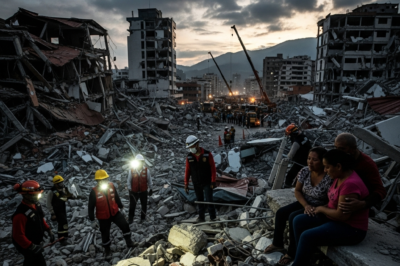
The Immediate Aftermath of the Venezuelan Seismic Crisis
The sudden and violent shifting of the Earth’s crust beneath Venezuela has plunged the nation into a state of profound mourning and logistical chaos. In what seismologists are describing as a rare and devastating doublet event, two massive earthquakes struck within hours of each other, claiming at least 32 lives and leaving hundreds more injured or missing. The tremors, which were felt as far away as neighboring Colombia and Trinidad and Tobago, have caused significant structural failures in several of Venezuela’s major urban centers. As the dust settles over the ruins of apartment complexes and historic landmarks, the sheer scale of the humanitarian challenge is beginning to emerge. This catastrophe comes at a time when the nation is already grappling with complex socio-economic issues, making the sudden influx of displaced citizens a primary concern for local and national authorities. The initial shock began in the early morning hours, catching many residents in their sleep and leading to high casualty rates in densely populated residential zones. Search and rescue teams, bolstered by volunteers and local fire departments, are currently working against the clock to locate survivors trapped beneath the weight of collapsed concrete and twisted metal. This event marks one of the deadliest seismic incidents in the region in recent decades, drawing immediate attention from the international community and prompting a swift mobilization of emergency resources.
The Timeline of Devastation: Mapping the Twin Tremors
According to data from the Venezuelan Foundation for Seismological Research (FUNVISIS) and the United States Geological Survey (USGS), the first quake registered a preliminary magnitude of 6.8, centered near the coastal town of Irapa. This initial shock occurred at a depth of approximately 10 kilometers, sending high-frequency waves through the soft soils of the coastal valleys. Less than three hours later, as emergency services were just beginning to assess the damage, a second tremor of magnitude 6.5 struck slightly to the west, closer to the city of Cumaná. This ‘twin’ phenomenon, while rare, is known to occur when the stress from an initial rupture triggers a secondary fault line that was already near its breaking point. The cumulative effect of these two events has been catastrophic for buildings that survived the first shake but were structurally compromised, only to collapse during the second. Residents in Caracas, located hundreds of miles from the epicenters, reported intense swaying of high-rise buildings, leading to the mass evacuation of the capital’s financial district. The psychological impact of the secondary quake cannot be overstated; it has created a pervasive sense of dread among the populace, with many refusing to return indoors despite falling temperatures. Technical analysis suggests that the rupture occurred along the San Andreas-like strike-slip system that defines the boundary between the Caribbean and South American tectonic plates, a region with a long and documented history of violent movement.
Human Toll and the Collapse of Urban Infrastructure
The confirmed death toll of 32 is expected to rise as recovery efforts reach more remote mountainous villages that have been cut off by landslides. In the port city of Guanta, a three-story medical clinic collapsed, leading to several fatalities among patients and staff. The distribution of casualties highlights a grim reality: the majority of deaths occurred in ‘barrios’ or informal settlements where building codes are non-existent and homes are constructed from heavy, unreinforced masonry. These structures lack the flexibility to withstand lateral seismic forces, essentially turning into traps during high-magnitude events. Beyond the loss of life, the displacement of thousands has created an immediate need for temporary shelter. Schools and community centers have been converted into makeshift dormitories, but resources are thin. The destruction of key arterial roads has hampered the delivery of medical supplies and heavy machinery needed to clear debris. In Caracas, several bridges have been closed pending safety inspections, causing massive traffic gridlock and slowing the movement of ambulances. The emotional weight of the tragedy is being felt in every corner of the country, as families wait for news of loved ones. Social media has become a vital tool for the missing, with hashtags like #VenezuelaRelief trending as citizens share photos and locations of those yet to be accounted for in the rubble.
Geopolitical Context and the Inflow of International Aid
In the wake of the disaster, the international community has moved with uncharacteristic speed to pledge assistance. Despite ongoing political tensions, nations from across the ideological spectrum have expressed their condolences and offered material support. The United Nations has announced the release of emergency funds to provide clean water, food, and medicine to the hardest-hit areas. Neighboring Colombia, despite strained diplomatic relations in the past, was one of the first to offer specialized urban search and rescue (USAR) teams and heavy-lift helicopters to assist in the remote Sucre state. The European Union has pledged a multimillion-euro package aimed at long-term reconstruction, while regional partners like Brazil and Argentina are readying shipments of non-perishable food and hygiene kits. For the Venezuelan government, the challenge lies in the logistics of distribution. Ensuring that aid reaches the most vulnerable without being diverted by bureaucratic hurdles is a priority that the international observers are watching closely. These promises of aid represent a rare moment of global solidarity, as the magnitude of the human suffering transcends political boundaries. However, the long-term sustainability of this aid is a concern, as the country will require years of financial and technical support to rebuild its shattered power grids and water treatment facilities, which were already in a state of disrepair prior to the earthquakes.
Scientific Analysis: Why the Cariaco-El Pilar Fault System Ruptured
Geologically, Venezuela sits at a high-risk junction where the South American plate is being subducted and bypassed by the Caribbean plate. The specific area of the recent quakes involves the Cariaco and El Pilar fault systems. These faults are capable of producing significant energy release because they are shallow and run through regions with varying soil densities. Seismologists explain that the ‘twin’ nature of this event is a result of stress transfer. When the first segment of the El Pilar fault ruptured, the energy was not entirely dissipated; instead, it moved down the line, putting immense pressure on an adjacent segment that had been ‘locked’ for decades. This explains why the second quake was nearly as powerful as the first. Historical records indicate that this region experienced similar ‘doublet’ events in the 19th century, though the population density was much lower then. Modern seismic monitoring equipment in the region had detected a slight increase in micro-seismic activity over the last six months, but predicting the exact timing of a major rupture remains beyond the reach of current science. This event serves as a stark reminder of the necessity for updated seismic hazard maps and the rigorous enforcement of building standards in earthquake-prone zones. The soil liquefaction reported near the coastline further complicated the situation, as the ground literally lost its strength, causing buildings to tilt and sink into the earth, a phenomenon often seen in high-magnitude coastal quakes.
The Long Road to Recovery and National Resilience
Rebuilding after a disaster of this magnitude is not merely a matter of masonry and mortar; it is a task of social and economic restoration. The Venezuelan government has declared a national period of mourning and has promised to fast-track the reconstruction of homes for those who lost everything. However, the economic implications are staggering. With the oil industry—the backbone of the economy—already facing challenges, the cost of rebuilding infrastructure like the damaged pipelines and refineries near the coast could run into the billions of dollars. There is also the matter of public health. Damaged sewage systems and a lack of clean water in the displacement camps increase the risk of waterborne diseases. Psychologically, the nation is reeling. Post-traumatic stress among survivors, especially children who witnessed the collapse of their schools and homes, will require long-term mental health interventions. Despite these daunting challenges, the spirit of the Venezuelan people remains unbroken. In every city, ‘solidarity chains’ have formed, where neighbors help neighbors clear rubble and share what little food they have. This grassroots resilience is the foundation upon which the country will rebuild. The focus must now shift from emergency rescue to sustainable recovery, ensuring that the new structures are built to withstand the inevitable future movements of the earth. As aid pours in from across the globe, the hope is that this tragedy will serve as a catalyst for improved disaster preparedness and a renewed focus on the safety of the nation’s infrastructure.
Conclusion: Lessons Learned from the Twin Quakes
The twin earthquakes in Venezuela are a tragic reminder of the volatile nature of our planet and the fragility of human structures. While the death toll of 32 is a profound loss, the disaster has also highlighted the incredible capacity for international cooperation in times of crisis. The road ahead will be long and fraught with difficulty, but the immediate outpouring of aid offers a glimmer of hope. Moving forward, the emphasis must be on science-based urban planning and the creation of a robust emergency response framework that can function even under the most extreme conditions. The lessons learned from this doublet event will likely be studied by seismologists and disaster management experts worldwide for years to come. For the people of Venezuela, the focus remains on the present: honoring the victims, tending to the injured, and beginning the slow, painful process of putting their lives and their country back together. The global community must remain committed to its promises of aid, ensuring that once the headlines fade, the support for Venezuela’s recovery does not fade with them. This is a moment for unity, resilience, and a commitment to building a safer, more prepared future for all residents of the Caribbean basin.


































Leave a Reply