
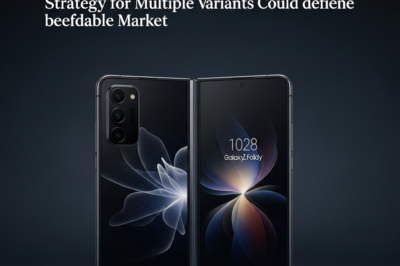
The Evolution of a Revolution: Samsung’s Strategic Pivot
For nearly half a decade, Samsung has been the undisputed king of the foldable smartphone market. From the experimental and somewhat fragile beginnings of the original Galaxy Fold to the polished, water-resistant refinement of the Galaxy Z Fold 6, the South Korean tech giant has dictated the pace of innovation. However, the landscape in 2024 and 2025 is drastically different from the one Samsung once dominated. Competitors, particularly from China, have released devices that are thinner, lighter, and in some cases, more technologically advanced in terms of battery chemistry and hinge mechanics. Recent reports, specifically those highlighted by PhoneArena, suggest that Samsung is no longer content with a single flagship foldable strategy. For the upcoming Galaxy Z Fold 8, Samsung is reportedly trying something entirely new: a multi-variant approach designed to segment the market and address the diverse needs of a maturing consumer base. This move marks a significant departure from the ‘one-size-fits-all’ philosophy that has guided the Fold line for six generations.
The significance of this shift cannot be overstated. By diversifying the Galaxy Z Fold 8 lineup, Samsung is acknowledging that the ‘Foldable’ category is no longer a niche hobbyist segment but a mainstream vertical with distinct sub-segments. Some users want the ultimate productivity machine with an integrated S-Pen, while others prioritize a device that feels like a standard smartphone in their pocket. This dual-track development strategy is Samsung’s answer to the encroaching pressure from brands like Huawei, Honor, and Xiaomi, who have recently stolen the spotlight with ultra-slim folding designs. As we dive into the details of what this ‘new approach’ entails, it becomes clear that the Galaxy Z Fold 8 will be more than just an annual refresh; it will be a reboot of Samsung’s entire mobile strategy.
The Dual-Variant Strategy: Standard vs. Slim vs. Ultra
The core of the recent news surrounding the Galaxy Z Fold 8 is the development of multiple hardware configurations. Traditionally, Samsung released one ‘Fold’ and one ‘Flip.’ For the Fold 8 cycle, we are seeing evidence of at least two distinct paths. The first is a continuation of the ‘Standard’ model—a device that balances durability, camera performance, and the S-Pen experience. The second variant, which has been the subject of intense speculation, is a ‘Slim’ or ‘Ultra’ variant. This model is expected to push the boundaries of industrial design, aiming for a thickness that rivals the thinnest devices on the market, such as the Honor Magic V3.
Engineering a thinner foldable is not merely a matter of shaving off millimeters. It requires a complete rethink of the internal architecture. Reports suggest that for the Galaxy Z Fold 8 variants, Samsung is experimenting with different materials for the backplate and internal support structures. The ‘Slim’ variant might sacrifice S-Pen digitization layers—a major contributor to screen thickness—in exchange for a profile that measures under 10mm when folded. This would be a massive leap for Samsung, whose current models still feel somewhat chunky compared to the sleekest competitors. By offering two variants, Samsung can cater to the ‘Power User’ who needs the stylus and the ‘Style Conscious’ user who wants the future of mobile tech without the bulk.
Competitive Pressure: Why Samsung Must Innovate Now
To understand why Samsung is making this move, one must look at the global market share data. While Samsung still holds a lead in many Western markets, its dominance in the foldable space has been eroded globally. In China, the world’s largest smartphone market, brands like Huawei and Honor have surged ahead by offering hardware that feels a generation ahead of the Z Fold 6. The Huawei Mate XT, a tri-fold device, and the Honor Magic V3, which is thinner than many slab phones, have set a new bar for what consumers expect from high-end foldables.
Samsung’s response has historically been cautious, prioritizing reliability and software polish (One UI) over radical hardware changes. However, the ‘slow and steady’ approach is reaching its limit. Consumers are beginning to notice that Samsung’s folding screens still feature a prominent crease and a narrower cover display compared to the competition. The Galaxy Z Fold 8 variants are a direct response to this ‘innovation gap.’ By splitting the line, Samsung can take bigger risks on one model (the Slim/Ultra) while maintaining the dependable, rugged reputation of the standard model. This allows them to compete on the ‘thinness’ front without alienating long-time fans who rely on the specific dimensions and features of the current Fold series.
Technical Breakthroughs: Hinges, Batteries, and Displays
A key part of the new strategy for the Galaxy Z Fold 8 involves the integration of next-generation components. For the thinner variant, Samsung is reportedly looking at high-energy-density silicon-carbon batteries. This technology allows for larger battery capacities in much thinner physical footprints compared to traditional lithium-ion batteries. This is crucial because a major complaint with thin foldables is their lack of endurance. If Samsung can deliver a 5,000mAh+ battery in a 9mm chassis, it would be a game-changer.
Furthermore, the hinge mechanism is undergoing a total redesign. The rumor mill suggests a ‘Titanium Hinge’ or a new friction-based system that reduces the number of moving parts. This not only makes the device lighter but also more durable against dust and debris. On the display side, we expect to see the debut of a more advanced ‘Ultra Thin Glass’ (UTG) version that is both more flexible and more resistant to impact. This new UTG, combined with a redesigned OLED panel layer, aims to finally eliminate the visible crease that has been a point of contention for years. For the premium Fold 8 variant, we might even see a ‘zero-gap’ design that looks seamless when closed, a feat Samsung has struggled to perfect in mass production compared to its peers.
Market Implications: Price Points and Global Reach
Introducing multiple variants poses a significant challenge: pricing. The Galaxy Z Fold 6 already sits at a premium $1,899 price point. If Samsung introduces a ‘Z Fold 8 Ultra’ or ‘Special Edition’ alongside a standard model, how will it be positioned? Industry analysts suggest that Samsung might use this opportunity to slightly lower the price of the ‘Standard’ model to make it more accessible (perhaps around $1,599), while the ‘Ultra’ or ‘Slim’ variant would take over the ultra-premium $1,999+ bracket.
This tiered pricing strategy would allow Samsung to capture a larger share of the foldable market. A more affordable ‘Standard’ Fold 8 could entice users who have been on the fence about the technology due to cost. Meanwhile, the cutting-edge ‘Slim’ model would serve as a halo product, showcasing Samsung’s engineering prowess and competing directly with the luxury offerings from Huawei and Honor. Moreover, global availability is a key factor. In the past, ‘Special Edition’ models were limited to specific regions like South Korea and China. With the Z Fold 8, there is a strong push to make both variants available globally, ensuring that Samsung remains the default choice for foldables in North America and Europe.
The Future Outlook: Is This the End of the ‘Boring’ Samsung?
The decision to diversify the Galaxy Z Fold 8 represents a cultural shift within Samsung. For years, the company has been criticized for being too conservative with its flagship designs. By embracing multiple variants, Samsung is showing a level of agility and willingness to experiment that we haven’t seen since the early days of the Galaxy Note series. This move is likely a precursor to even more radical form factors, such as rollable displays or tri-fold devices, which are currently in the R&D phase at Samsung Display.
In conclusion, the news that Samsung is trying something new for both Galaxy Z Fold 8 variants is a signal to the industry that the leader is ready to fight back. By addressing the specific demands for thinner profiles and more robust features through a multi-model lineup, Samsung is positioning itself to not just participate in the foldable market, but to redefine it once again. Whether this strategy succeeds will depend on the execution of the hardware and the ability of One UI to provide a seamless experience across different screen ratios. However, one thing is certain: the foldable wars are heating up, and Samsung is finally bringing its full weight to the battlefield. The Galaxy Z Fold 8 will likely be remembered as the moment Samsung’s foldable journey moved from a singular vision to a diverse ecosystem of cutting-edge devices.







































Leave a Reply