
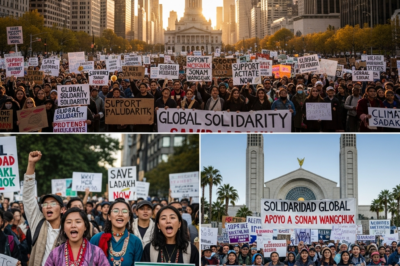
The echoes of a hunger strike in the high-altitude desert of Ladakh have reached the bustling streets of New York City and the tech-centric corridors of San Jose. In a remarkable display of global solidarity, members of the Indian diaspora, climate activists, and supporters of democratic rights gathered in these major American hubs to amplify the voice of Sonam Wangchuk. Wangchuk, an acclaimed engineer, innovator, and educator, has been at the forefront of a movement demanding constitutional safeguards for the Union Territory of Ladakh. These protests mark a significant turning point in the movement, as the local struggle for ecological preservation and political representation transcends national borders, transforming into an international narrative regarding indigenous rights and environmental justice. The demonstrations in the United States underscore a growing concern among the global community about the fate of the fragile Himalayan ecosystem and the democratic aspirations of its inhabitants. As the world watches, the movement spearheaded by Wangchuk and the people of Ladakh continues to gain momentum, challenging the status quo and demanding a future that prioritizes both people and the planet.
The Global Echo: Protests in New York and San Jose
In New York City, protesters gathered at iconic locations, including Times Square and near the Indian Consulate, brandishing placards that read ‘Save Ladakh’ and ‘Stand with Sonam Wangchuk.’ The atmosphere was one of determined urgency, as speakers addressed the crowd about the critical need for the Sixth Schedule status for Ladakh. Many in attendance were members of the Ladakhi and Tibetan diaspora, joined by Indian-Americans who believe that the preservation of Ladakh’s unique culture and environment is a matter of national and global importance. Similar scenes unfolded in San Jose, California, where the Silicon Valley community—many of whom are inspired by Wangchuk’s innovative contributions to sustainable engineering—came out in large numbers. The San Jose protests emphasized the intersection of technology, climate change, and human rights, arguing that the protection of the ‘Third Pole’ (the Himalayan glaciers) is essential for global climate stability. These overseas demonstrations were not merely symbolic; they aimed to bring international pressure on the Indian government to engage in meaningful dialogue with the representatives of Ladakh.
Understanding Sonam Wangchuk’s Crusade for Ladakh
To understand the intensity of these protests, one must look at the man at the center of the movement. Sonam Wangchuk, the inspiration behind the character Phunsukh Wangdu in the Bollywood blockbuster ‘3 Idiots,’ is far more than a public figure; he is a visionary who has dedicated his life to reforming the education system in Ladakh and creating sustainable solutions for high-altitude living. His ‘Climate Fast,’ a hunger strike conducted under the freezing skies of Leh, was a desperate plea to the central government to fulfill promises made during the reorganization of Jammu and Kashmir in 2019. Wangchuk’s activism is rooted in the belief that Ladakh’s fragile environment cannot survive unregulated industrialization or the influx of massive tourism without legal protections. He argues that the melting glaciers of the Himalayas, which provide water to millions across South Asia, are a ‘ticking time bomb’ that requires immediate constitutional intervention. His personal sacrifice has galvanized the youth of Ladakh and resonated with individuals globally who see him as a symbol of selfless advocacy for the Earth.
The Constitutional Context: The Demand for the Sixth Schedule
At the heart of the protests is the demand for the inclusion of Ladakh under the Sixth Schedule of the Indian Constitution. The Sixth Schedule provides for the administration of tribal areas in certain states through Autonomous District Councils (ADCs). These councils have the power to make laws on land, forest, water, agriculture, and village administration, effectively giving local communities a say in their own development. Since Ladakh was separated from Jammu and Kashmir and turned into a Union Territory without a legislature, the local population has felt disenfranchised. The Leh Apex Body (LAB) and the Kargil Democratic Alliance (KDA) argue that without the Sixth Schedule, Ladakh’s land and resources are vulnerable to exploitation by outside interests. The central government had previously signaled a willingness to consider these demands, but the lack of concrete action has led to a breakdown in trust. The protesters in New York and San Jose echoed these legal demands, calling for the restoration of statehood and the empowerment of local governance structures to protect Ladakh’s unique ethnic identity.
Ecological Stakes: Why the Himalayas Need Urgent Protection
The environmental argument for Ladakh’s protection is perhaps the most compelling for the international audience. Often referred to as the ‘Water Tower of Asia,’ the Himalayan range contains the largest volume of ice outside the polar regions. Ladakh, a trans-Himalayan cold desert, is particularly sensitive to temperature fluctuations. Scientific data indicates that glaciers in this region are retreating at an alarming rate, threatening the water security of the entire Indian subcontinent. Protesters in San Jose highlighted that any large-scale mining or industrial projects in Ladakh would lead to irreparable damage to the permafrost and the local biodiversity. The ‘Save Ladakh’ movement is essentially a climate movement. By demanding the Sixth Schedule, the people are seeking the right to veto projects that could exacerbate the climate crisis. The global diaspora’s involvement brings to light the fact that what happens in the remote valleys of Ladakh has direct implications for global carbon cycles and water cycles, making it a focal point for international climate diplomacy.
The Geopolitical Implications of a Destabilized Ladakh
Ladakh is not just an ecological hotspot; it is a strategically sensitive border region sharing boundaries with China and Pakistan. The stability of Ladakh is paramount for India’s national security. Analysts have pointed out that a dissatisfied and politically marginalized local population could lead to internal instability, which is undesirable in such a critical zone. The protests in the US touched upon the democratic health of India, suggesting that the fulfillment of the aspirations of Ladakh’s people would strengthen the nation’s democratic fabric. By ignoring the peaceful protests led by figures like Wangchuk, there is a risk of alienating a population that has historically been incredibly patriotic and vital to the defense of the borders. The international community, especially in the US, views the situation through the lens of human rights and democratic governance, urging for a resolution that respects the local will while maintaining regional security.
Future Outlook: Will the Government Respond to the Global Outcry?
As the movement continues to evolve, the question remains: how will the Indian government respond? The Ministry of Home Affairs has held several rounds of talks with Ladakhi leaders, but a consensus on the Sixth Schedule and statehood has yet to be reached. The global attention garnered by the protests in New York and San Jose adds a new layer of complexity for the administration. It is no longer a localized issue that can be managed within the borders of the Union Territory; it is now a topic of discussion in the international media and among influential diaspora groups. The persistence of Sonam Wangchuk and the unwavering support from the people suggest that the movement will not dissipate easily. The future of Ladakh depends on a delicate balance between development and conservation, and between central administration and local autonomy. The global outcry serves as a reminder that in the 21st century, the struggle for land and identity in even the remotest corners of the world can find a stage on the global platform, demanding justice and accountability.







































Leave a Reply