
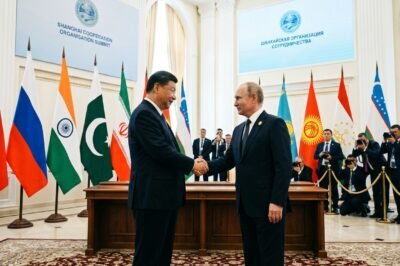
In the grand halls of international diplomacy, few gatherings command as much attention as the meeting between the leaders of Russia and China during the Shanghai Cooperation Organisation (SCO) summit. As Vladimir Putin and Xi Jinping prepare to convene, the world watches with bated breath, recognizing that this is not merely a routine diplomatic exchange but a seismic event in the ongoing reshuffling of the global order. The hook of this meeting lies in its timing and its subtext; against a backdrop of intensifying friction with the West, the ‘no limits’ partnership between Moscow and Beijing is being tested, refined, and projected as a viable alternative to the traditional US-led hegemony. For Russia, the summit represents a vital opportunity to demonstrate that it remains far from isolated despite the heavy sanctions imposed by Western powers. For China, it is a chance to consolidate its role as a stabilizing force in Eurasia while expanding its economic footprint through the Belt and Road Initiative. Together, these two giants are not just talking about regional security; they are outlining a blueprint for a multipolar world where the rules are no longer written exclusively in Washington or Brussels. This meeting serves as the definitive pulse check for an alliance that could define the 21st century. To understand the gravity of the current situation, one must look back at the formation of the Shanghai Cooperation Organisation itself. Established in 2001, the SCO was initially focused on regional security, specifically the ‘three evils’ of terrorism, separatism, and extremism in Central Asia. However, in the two decades since its inception, the organization has ballooned in both size and scope. With the inclusion of India, Pakistan, and most recently Iran, the SCO now represents nearly half of the world’s population and a significant chunk of global GDP. Within this framework, the bilateral relationship between Russia and China acts as the central pillar. The deep breakdown of their current agenda reveals a focus on strategic synergy. Russia, currently navigating the complexities of its special military operation in Ukraine, seeks continued diplomatic cover and economic lifelines from Beijing. Conversely, China, while cautious of secondary sanctions, views Russia as a critical partner in balancing against what it perceives as ‘encirclement’ by the AUKUS and Quad alliances in the Indo-Pacific. The meeting at the SCO summit is the physical manifestation of this mutual necessity, bridging the gap between historical rivalry and modern-day pragmatism. ## The SCO’s Rising Profile as a Counterweight to the West. The Shanghai Cooperation Organisation is no longer just a regional talking shop; it has evolved into a formidable counterweight to Western-led institutions like the G7 or NATO. As more countries in the Global South seek membership or observer status, the SCO provides a platform where sovereignty is prioritized over the liberal democratic values often championed by the West. This expansion reflects a growing dissatisfaction with the existing international financial and security architecture. By bringing together leaders from diverse political backgrounds, the SCO promotes a model of ‘non-interference’ that appeals to many emerging economies. During this summit, the emphasis on expanding the group’s influence will be palpable, as leaders discuss ways to integrate regional supply chains and create a collective security apparatus that does not rely on Western intervention. The sheer demographic and geographic scale of the SCO makes it an unavoidable player in any future global governance discussions. ## Russia-China Strategic Synergy and the ‘No Limits’ Doctrine. The relationship between Putin and Xi is perhaps the most consequential personal dynamic in modern politics. Their meeting at the SCO summit is expected to reinforce the ‘no limits’ partnership announced just before the conflict in Ukraine began. This synergy is built on a shared vision of a multipolar world. From Russia’s perspective, China provides a massive market for its energy exports, which have been redirected away from Europe. For China, Russia offers advanced military technology and a shared frontier that allows Beijing to focus its strategic attention on the South China Sea and Taiwan. Despite the outward appearance of total unity, there are nuances to this partnership. Beijing must carefully calibrate its support to avoid a total break with its primary trading partners in the European Union and the United States. The SCO summit serves as a controlled environment where these two leaders can synchronize their narratives without the direct pressure of Western oversight. ## Economic Cooperation, Energy, and the De-dollarization Movement. One of the most significant themes of the Putin-Xi meeting will be the continued push for economic independence from Western financial systems. The ‘de-dollarization’ movement has gained significant momentum within the SCO, as member states increasingly settle trades in their local currencies, such as the Ruble and the Yuan. This shift is not just a reaction to sanctions but a long-term strategic goal to insulate their economies from the reach of the US Treasury. Energy remains the backbone of this economic relationship. Russia is now China’s top oil supplier, and the Power of Siberia pipelines are symbols of a deepening energy integration. At the summit, discussions are expected to touch upon new infrastructure projects that will further link the Siberian resource base with the Chinese industrial heartland, creating a self-sustaining economic corridor that bypasses traditional maritime routes controlled by the US Navy. ## Security Architecture and the Stability of Central Asia. Central Asia has traditionally been viewed as Russia’s ‘backyard,’ but China’s economic influence in the region via the Belt and Road Initiative has created a complex web of overlapping interests. The SCO provides the necessary framework to manage these interests without direct conflict. At this summit, the leaders will likely address the security vacuum left in the wake of the US withdrawal from Afghanistan. Counter-terrorism remains a top priority, as both Moscow and Beijing are wary of radicalization spreading into their own borders. By coordinating their security efforts through the SCO’s Regional Anti-Terrorist Structure (RATS), they aim to create a ‘fortress Eurasia’ that is immune to the instabilities that have plagued the Middle East and parts of South Asia. This security architecture is increasingly being seen as a viable alternative to the US-led ‘hub and spoke’ alliance system. ## The Message to the West: Defiance and Sovereignty. The very occurrence of this meeting is a message of defiance to the West. It signals that despite the rhetoric coming from Washington, a significant portion of the world is not interested in isolating Russia or containing China. The SCO summit provides a stage for Putin and Xi to present a unified front, emphasizing the ‘Greater Eurasian Partnership.’ This narrative focuses on the idea that the Eurasian continent should be managed by Eurasian powers. By highlighting their shared commitment to the UN Charter—interpreted through their own lens of state sovereignty—they are challenging the ‘rules-based international order’ which they argue is merely a cover for Western interests. The optics of the summit, with numerous heads of state flanking the two leaders, are designed to project a world that is moving on from the unipolar moment of the 1990s. ## Conclusion: The Long-Term Trajectory of the SCO Alliance. As the SCO summit concludes, the meeting between Putin and Xi will likely be remembered as a milestone in the consolidation of a new geopolitical bloc. The implications are clear: the world is entering an era of heightened competition between two distinct visions of international order. While the West continues to emphasize democratic values and human rights, the SCO under Russian and Chinese leadership is doubling down on state-led development and collective security. This does not necessarily mean a return to a Cold War-style division, but it does mean that the era of uncontested Western influence has ended. The future of global trade, security, and diplomacy will increasingly be decided in cities like Samarkand, Astana, and Beijing. The Putin-Xi meeting is a clarion call that the Eurasian giant has awakened and is ready to lead a world that looks very different from the one we have known since the end of the 20th century.
Russia-China Alliance: Strategic Implications of the Putin-Xi Meeting at the SCO Summit
Posted by
Stories





-

Hunkkaar Teaser Analysis: Aneet Padda’s Gritty Transformation and the Evolving Landscape of Indian Thrillers
-

Mithila Palkar: The Relatable Queen of Indian Web Series and Her Meteoric Rise
-

Wamiqa Gabbi: The Meteoric Rise of Indian Web Series’ Most Versatile Leading Lady
-

Triptii Dimri Biography: The Evolution of India’s Newest Cinematic Sensation and Web Series Star
-

Wamiqa Gabbi: The Rise of India’s New Digital Icon and the Future of OTT Stardom
-

Mithila Palkar: The Unstoppable Evolution of India’s Digital Darling and Her Journey to the Silver Screen
-

Mithila Palkar: The Comprehensive Journey of India’s Web Series Sensation and Digital Pioneer
-

Mithila Palkar: The Relatable Queen of Indian Web Series and Her Inspiring Journey to Stardom
-

Sobhita Dhulipala Biography: The Meteoric Rise of India’s Most Versatile Web Series Star
-

Mithila Palkar: The Unstoppable Journey of India’s Digital Darling and Web Series Queen
-

Triptii Dimri: The Complete Biography of India’s Newest Cinematic Sensation and Web Series Icon
-

Wamiqa Gabbi: The Ethereal Rise of India’s Most Versatile Web Series Star
-

Sobhita Dhulipala: The Unstoppable Rise of India’s Most Versatile Web Series Icon
-

Wamiqa Gabbi: The Meteoric Rise of the New Queen of Indian Web Series and Her Unstoppable Journey to Stardom
-

Triptii Dimri: The Meteoric Rise of India’s New Cinema Sweetheart and Web Series Icon
-

Wamiqa Gabbi: The Versatile Queen of Indian OTT and Her Phenomenal Rise to Stardom
-

Tripti Dimri Biography: The Rise of India’s New National Crush and Her Journey from Laila Majnu to OTT Stardom
-

Wamiqa Gabbi Biography: The Meteoric Rise of India’s Newest OTT Sensation and Versatile Powerhouse
-

Wamiqa Gabbi Biography: The Meteoric Rise of the Digital Queen of Indian Web Series
-

The Rise of Wamiqa Gabbi: A Deep Dive into the Journey of India’s Most Versatile OTT Sensation
-

The Meteoric Rise of Triptii Dimri: Biography, Acting Prowess, and the Journey of India’s Newest Cinema Sensation

Launching Soon: The Future of News with Our E-Newspaper
In the ever-evolving landscape of media and technology, we are thrilled to announce the upcoming launch of our innovative e-newspaper, set to redefine the way news is consumed in the digital age. Embracing the convenience and accessibility that the digital world offers, our e-newspaper aims to deliver real-time news updates, insightful articles, and interactive features directly to your devices. With a commitment to journalistic integrity and a passion for storytelling, we are dedicated to keeping you informed, engaged, and connected, no matter where you are. Stay tuned for the launch of our e-newspaper, where the future of news awaits at your fingertips.
Recent News
- RBI Approves Record ₹2.11 Lakh Crore Surplus Transfer to Indian Government for FY24

- Calcutta High Court Strikes Down OBC Status of Several Classes in West Bengal: A Comprehensive Legal and Political Analysis
- At least six dead and dozens injured in massive boiler blast at Thane chemical factory

- Ireland, Norway, and Spain formally announce recognition of Palestinian statehood

- Nvidia stock market value eyes $2.5 trillion after blowout revenue forecast

- UK Prime Minister Rishi Sunak Calls for Snap General Election on July 4: A Strategic and High-Stakes Political Gamble

Politics
- Calcutta High Court Strikes Down OBC Status of Several Classes in West Bengal: A Comprehensive Legal and Political Analysis
- Ireland, Norway, and Spain formally announce recognition of Palestinian statehood
- UK Prime Minister Rishi Sunak Calls for Snap General Election on July 4: A Strategic and High-Stakes Political Gamble
- Putin’s Strategic Ultimatum: The Geopolitical Fallout of Warning South Korea Over Ukraine Aid
- Patna High Court Quashes Bihar Government’s Decision to Increase Reservation to 65%: A Landmark Judicial Intervention
- Education Ministry cancels UGC-NET exam following paper leak concerns; CBI probe ordered
Categories
- Art & Culture 106
- Auto 85
- Beauty 15
- Blog 307
- Books 7
- Business 374
- Celebrities 217
- Crime Files 139
- Democracy 308
- Education 84
- Entertainment 154
- Environment 133
- epaper 1
- Fashion 37
- Food 59
- Gadgets 89
- Guide 150
- Handicrafts 14
- Health 281
- Healthy Living 108
- History 5
- incidents 171
- Lifestyle 41
- Music 7
- Photography 15
- Politics 466
- Science & Technology 160
- Sports 283
- Tech 142
- Television 4
- Travel 68
- Travel & Tourism 30
- Trends 57
- Weather 9
- Web Series 97
- Workout 4
- World 665
Leave a Reply