
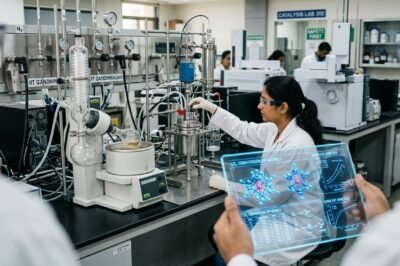
The global climate crisis has reached a critical tipping point where traditional methods of emission reduction are no longer sufficient to meet the ambitious targets set by international accords such as the Paris Agreement. In this high-stakes race against time, the role of carbon capture, utilization, and storage (CCUS) has emerged as a cornerstone of modern environmental strategy. However, the primary bottleneck has always been the discovery of efficient, cost-effective materials capable of not just capturing carbon dioxide, but transforming it into valuable chemical fuels. Researchers at the Indian Institute of Technology (IIT) Gandhinagar have recently made a groundbreaking stride in this field, utilizing the power of machine learning to sift through millions of potential materials to identify those most suited for the efficient reuse of CO2. This intersection of artificial intelligence and material science represents a paradigm shift in how we approach environmental remediation, moving away from slow, trial-and-error laboratory experiments toward a data-driven era of rapid discovery. By harnessing computational intelligence, the IIT Gandhinagar team is paving the way for a circular carbon economy where CO2 is no longer viewed as a waste product but as a feedstock for sustainable energy. The Global Imperative for Carbon Neutrality and the Role of CCUS. To understand the significance of the IIT Gandhinagar study, one must first appreciate the scale of the carbon problem. For decades, the burning of fossil fuels has released billions of tons of CO2 into the atmosphere, creating a warming effect that disrupts weather patterns and ecosystems. While renewable energy sources like solar and wind are growing, the transition is slow, and hard-to-abate sectors like cement and steel manufacturing continue to emit significant greenhouse gases. This is where CCUS becomes vital. The challenge, however, lies in the ‘utilization’ aspect. Converting CO2 into something like methanol or methane requires a catalyst—a material that facilitates the chemical reaction without being consumed itself. Historically, finding the right catalyst was like looking for a needle in a haystack, involving years of synthesizing materials and testing them under various pressures and temperatures. The traditional scientific method, while rigorous, is increasingly seen as a luxury we can no longer afford given the accelerating pace of climate change. Deciphering the Machine Learning Approach at IIT Gandhinagar. The researchers at IIT Gandhinagar have tackled this efficiency problem by integrating machine learning (ML) into the heart of their material discovery process. Machine learning algorithms are uniquely capable of recognizing patterns within massive datasets that would be impossible for a human researcher to discern. In this specific study, the team focused on identifying catalysts that can lower the energy barrier required to break the strong double bonds of the CO2 molecule. By feeding the algorithm data regarding the structural, electronic, and chemical properties of thousands of known materials, they trained the system to predict how theoretical, yet-to-be-synthesized materials would perform. This predictive modeling allows scientists to skip the laboratory phase for thousands of duds and focus their physical resources on only the most promising candidates. This computational filter significantly reduces the ‘time-to-discovery’ and ensures that experimental efforts are concentrated on materials with the highest probability of success, thereby optimizing funding and labor in the academic and industrial sectors. Accelerating Material Discovery through Computational Intelligence. One of the most profound aspects of this research is how it handles ‘descriptors’—the specific physical features that determine a material’s catalytic activity. The IIT Gandhinagar team utilized advanced algorithms to identify which specific descriptors, such as surface energy, atomic radius, or d-band center, correlate most strongly with CO2 conversion efficiency. By isolating these key variables, the researchers created a roadmap for designing new materials from the ground up. This is not just about finding existing materials; it is about providing the blueprints for creating entirely new ones. The use of machine learning also allows for the consideration of multi-component materials, such as metal-organic frameworks (MOFs) or complex alloys, where the possible combinations are nearly infinite. Without AI, exploring these combinations would take centuries; with the IIT Gandhinagar model, the most viable options can be identified in a matter of weeks or even days, fundamentally changing the velocity of environmental innovation. High-Performance Catalysts: The Key to Efficient CO2 Reutilization. The focus of the research was specifically on the selectivity and stability of the catalysts. In many CO2 reuse processes, a common problem is the production of unwanted side products or the rapid degradation of the catalyst. The IIT Gandhinagar researchers used their ML models to ensure that the identified materials were not only efficient but also highly selective, meaning they produce the desired fuel with minimal waste. Furthermore, the models predicted the thermal and chemical stability of these materials, ensuring they could withstand the harsh environments of industrial carbon capture units. This emphasis on ‘real-world’ performance metrics is what sets this study apart. It moves the conversation from theoretical chemistry to practical engineering. By identifying materials that remain active over long periods and under varying pressures, the team is addressing the economic feasibility of CO2 reuse, making it more attractive for private sector investment and large-scale industrial adoption. Scaling Sustainability: From the Laboratory to Industrial Application. While the computational results are impressive, the ultimate goal of the IIT Gandhinagar team is the industrial scaling of these discoveries. The transition from a machine learning prediction to a functioning factory-scale carbon conversion unit involves several layers of engineering challenges. However, by providing a list of ‘promising materials’ that have already been vetted for high efficiency, the researchers have removed the biggest hurdle in the pipeline. Industries can now look toward these specific material classes to design the next generation of scrubbers and converters. This has massive implications for the global carbon market. If CO2 can be efficiently turned into liquid fuels or chemical precursors, it creates a financial incentive for companies to capture their emissions. Instead of being a cost center, carbon capture becomes a revenue-generating activity. This economic shift is essential for widespread adoption, as it aligns environmental goals with corporate profitability, creating a sustainable model for long-term decarbonization. The Future Landscape of AI-Driven Environmental Science. The success of the IIT Gandhinagar researchers serves as a proof of concept for a broader movement in science: the ‘AI-driven laboratory.’ As we move forward, we can expect to see machine learning integrated into every facet of environmental science, from predicting climate patterns to optimizing the energy grids of entire cities. For carbon reuse, the next steps involve experimental validation of the AI-predicted materials and the optimization of the synthesis processes. The work at IIT Gandhinagar is a call to action for the global scientific community to embrace these digital tools. As the researchers continue to refine their models and explore even more complex material spaces, the dream of a carbon-neutral world becomes less of a distant hope and more of a technical certainty. The integration of AI into this field is not just a trend; it is the fundamental evolution of the scientific method in the 21st century. In conclusion, the efforts at IIT Gandhinagar represent a significant milestone in the journey toward global sustainability. By leveraging machine learning to identify promising materials for CO2 reuse, they have provided a powerful new tool in the fight against climate change. This research underscores the vital importance of interdisciplinary collaboration—combining the strengths of data science with the rigors of chemistry and engineering. As these technologies mature and move from the screen to the stack, they offer a viable path toward reclaiming our atmosphere and building a future where industrial progress and environmental health are no longer at odds. The breakthrough is a testament to the power of human ingenuity when bolstered by the processing speed of artificial intelligence, offering a beacon of hope in our collective effort to secure a cleaner, greener planet for generations to come.
Revolutionizing Carbon Capture: How IIT Gandhinagar is Leveraging AI to Turn CO₂ into Clean Energy
Posted by
Stories





-

Mithila Palkar: The Relatable Queen of Indian Web Series and Her Meteoric Rise
-

Wamiqa Gabbi: The Meteoric Rise of Indian Web Series’ Most Versatile Leading Lady
-

Triptii Dimri Biography: The Evolution of India’s Newest Cinematic Sensation and Web Series Star
-

Wamiqa Gabbi: The Rise of India’s New Digital Icon and the Future of OTT Stardom
-

Mithila Palkar: The Unstoppable Evolution of India’s Digital Darling and Her Journey to the Silver Screen
-

Mithila Palkar: The Comprehensive Journey of India’s Web Series Sensation and Digital Pioneer
-

Mithila Palkar: The Relatable Queen of Indian Web Series and Her Inspiring Journey to Stardom
-

Sobhita Dhulipala Biography: The Meteoric Rise of India’s Most Versatile Web Series Star
-

Mithila Palkar: The Unstoppable Journey of India’s Digital Darling and Web Series Queen
-

Triptii Dimri: The Complete Biography of India’s Newest Cinematic Sensation and Web Series Icon
-

Wamiqa Gabbi: The Ethereal Rise of India’s Most Versatile Web Series Star
-

Sobhita Dhulipala: The Unstoppable Rise of India’s Most Versatile Web Series Icon
-

Wamiqa Gabbi: The Meteoric Rise of the New Queen of Indian Web Series and Her Unstoppable Journey to Stardom
-

Triptii Dimri: The Meteoric Rise of India’s New Cinema Sweetheart and Web Series Icon
-

Wamiqa Gabbi: The Versatile Queen of Indian OTT and Her Phenomenal Rise to Stardom
-

Tripti Dimri Biography: The Rise of India’s New National Crush and Her Journey from Laila Majnu to OTT Stardom
-

Wamiqa Gabbi Biography: The Meteoric Rise of India’s Newest OTT Sensation and Versatile Powerhouse
-

Wamiqa Gabbi Biography: The Meteoric Rise of the Digital Queen of Indian Web Series
-

The Rise of Wamiqa Gabbi: A Deep Dive into the Journey of India’s Most Versatile OTT Sensation
-

The Meteoric Rise of Triptii Dimri: Biography, Acting Prowess, and the Journey of India’s Newest Cinema Sensation
-

Wamiqa Gabbi Biography: The Meteoric Rise of the Digital Queen and Her Unmatched Acting Prowess

Launching Soon: The Future of News with Our E-Newspaper
In the ever-evolving landscape of media and technology, we are thrilled to announce the upcoming launch of our innovative e-newspaper, set to redefine the way news is consumed in the digital age. Embracing the convenience and accessibility that the digital world offers, our e-newspaper aims to deliver real-time news updates, insightful articles, and interactive features directly to your devices. With a commitment to journalistic integrity and a passion for storytelling, we are dedicated to keeping you informed, engaged, and connected, no matter where you are. Stay tuned for the launch of our e-newspaper, where the future of news awaits at your fingertips.
Recent News
- Breakthrough in Pain Management: How Cancer Medications are Repurposing for Chronic Nerve Pain Relief

- Revolutionizing Carbon Capture: How IIT Gandhinagar is Leveraging AI to Turn CO₂ into Clean Energy
- India’s Economic Resurgence: A Comprehensive Analysis of the 7.8 Percent Q1 Growth Beat

- Redefining Dermatological Markers: The Surprising Link Between Cherry Angiomas and Neurofibromatosis Type 1

- 150 Years of the Grand Canyon: From John Wesley Powell’s 1869 Discovery to Modern Geological Revaluations

- The Oncologist’s Manifesto: A Comprehensive Breakdown of Prostate Cancer Awareness and Modern Treatment

Politics
- India’s Economic Resurgence: A Comprehensive Analysis of the 7.8 Percent Q1 Growth Beat
- Beyond the Ballot: An In-Depth Analysis of the RSS-BJP Power Dynamic and Mohan Bhagwat’s Evolving Rhetoric

- India and Uzbekistan Elevate Relations to Comprehensive Strategic Partnership: A New Era of Central Asian Diplomacy

- The Great Cleansing: Xi Jinping’s Purge Reaches the Commanders of Doklam and Galwan

- Fed Chair Kevin Warsh at Jackson Hole: ‘We have work to do’ on inflation – A Turning Point for Markets

- India’s Strategic Shift: Decoding Ex-CDS Chauhan’s Insights on Skardu vs Sargodha Airbases

Categories
- Art & Culture 100
- Auto 85
- Beauty 15
- Blog 251
- Books 7
- Business 359
- Celebrities 217
- Crime Files 139
- Democracy 308
- Education 84
- Entertainment 154
- Environment 133
- epaper 1
- Fashion 37
- Food 58
- Gadgets 86
- Guide 150
- Handicrafts 10
- Health 263
- Healthy Living 107
- History 5
- incidents 156
- Lifestyle 31
- Music 5
- Photography 15
- Politics 425
- Science & Technology 160
- Sports 228
- Tech 123
- Television 2
- Travel 68
- Travel & Tourism 30
- Trends 40
- Weather 6
- Web Series 96
- Workout 4
- World 651
Leave a Reply