
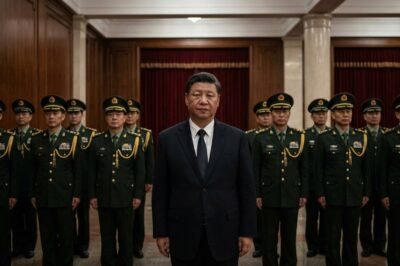
The corridors of power within the Zhongnanhai have never been more perilous for the top brass of the People’s Liberation Army (PLA). In a move that has sent shockwaves through the global intelligence community, Chinese President Xi Jinping has extended his relentless anti-corruption campaign—widely viewed as a political purge—to the very commanders who spearheaded China’s most aggressive military maneuvers against India in recent decades. The news that the ‘sword of Damocles’ has fallen on the generals associated with the Doklam standoff of 2017 and the brutal Galwan Valley clash of 2020 marks a significant pivot in China’s internal power dynamics. This is not merely a housekeeping exercise; it is a fundamental reordering of the Chinese military hierarchy that targets the prestigious Western Theater Command. The purge raises critical questions about the stability of the PLA’s leadership and whether the aggressive posturing on the Line of Actual Control (LAC) was driven by national interest or the personal ambitions of generals now deemed ‘politically unreliable.’ As the mist clears, it becomes evident that even those who shed blood for the ‘China Dream’ on the Himalayan heights are not immune to the President’s ruthless drive for absolute loyalty.
The Unfolding Crisis in the Central Military Commission
The current purge is part of a broader, systemic dismantling of what Xi Jinping perceives as entrenched interest groups within the military-industrial complex. For years, the Central Military Commission (CMC) has been the epicenter of Chinese power, but under Xi, it has become a revolving door of high-stakes investigations. This latest round of removals focuses on the Western Theater Command, which oversees the border with India. Statistics indicate that since 2023, over a dozen high-ranking generals, including the former Defense Minister Li Shangfu and key leaders of the Rocket Force, have been stripped of their titles. The removal of the general who commanded forces during the Doklam and Galwan incidents signifies that even ‘war heroes’ are being scrutinized for their political allegiance. The purge is not just about financial graft—though the military procurement system is notoriously corrupt—it is about ensuring that the PLA remains ‘The Party’s Gun.’ Experts suggest that these commanders may have been involved in the systemic corruption that has plagued the development of advanced weaponry, or perhaps more likely, they represented a factional threat to Xi’s centralized control. The optics of removing commanders who were once the face of China’s ‘wolf warrior’ diplomacy suggests a deep-seated insecurity at the top of the CCP.
From the Heights of Galwan to the Halls of Disgrace
To understand the gravity of this purge, one must revisit the events of 2017 and 2020. The Doklam standoff was a 73-day tense confrontation between the Indian Armed Forces and the PLA over Chinese construction of a road in territory claimed by Bhutan. This was followed by the 2020 Galwan Valley clash, the deadliest encounter between India and China in over four decades. The commanders in charge of these operations were lauded in state media as defenders of the motherland. However, the current investigation suggests that the operational conduct during these standoffs may have been influenced by internal factionalism. There are reports that the ‘purged’ general may have been part of a clique that prioritized theater-level glory over the strategic directives of the central leadership. The breakdown of trust between the Western Theater Command and Beijing is a stunning revelation. It suggests that while India was dealing with a unified military front, the internal structure of that front was already beginning to fracture under the weight of Xi’s expectations and the military’s own internal corruption.
The Institutional Anatomy of Xi Jinping’s Purge
Xi Jinping’s anti-corruption drive, known as the ‘Tigers and Flies’ campaign, has been the hallmark of his tenure since 2012. However, the focus on the military has intensified as China seeks to achieve a ‘world-class’ fighting force by 2049. The anatomy of this purge involves the Commission for Discipline Inspection of the CMC, which operates with near-total autonomy. The removal process typically begins with a ‘disappearance’ from public view, followed by a brief announcement of ‘serious violations of discipline.’ In the case of the Western Theater Command, the purge targets the logistical and procurement networks that supported the buildup of infrastructure along the LAC. It is estimated that billions of yuan have been poured into the border regions, and the potential for embezzlement in construction and high-altitude gear procurement is immense. By targeting these generals, Xi is sending a message to the entire PLA: no amount of battlefield success or tactical aggression against foreign adversaries can protect a commander from the party’s internal scrutiny. This creates a culture of fear that ensures compliance but may also stifle the initiative required in modern, fast-paced warfare.
Strategic Implications for the India-China Border Dispute
For India, the purging of the commanders who managed the LAC is a double-edged sword. On one hand, it confirms that the PLA is grappling with internal instability and a leadership crisis, which could temporarily hamper their operational efficiency. On the other hand, the removal of these figures might lead to their replacement by even more radical loyalists who are eager to prove their worth to Xi Jinping by initiating new provocations. The ‘purge’ suggests that the previous strategy on the border may have been viewed as a failure or, at the very least, misaligned with Xi’s current objectives. Indian security analysts are closely watching if the new leadership in the Western Theater Command will adopt a more conciliatory tone to allow the PLA to focus on internal restructuring, or if they will double down on aggression to distract from the internal chaos. Furthermore, the purge of the Rocket Force, which is crucial for any large-scale conflict with India, suggests that China’s missile capabilities might be hampered by technical or systemic issues caused by corruption, potentially giving India a brief strategic window of opportunity in defense preparedness.
The Modernization Paradox: Corruption vs. Combat Readiness
Xi Jinping has repeatedly stated that ‘the military must be able to fight and win.’ Yet, the constant purging of its top leadership suggests a paradox. Can a military achieve modernization if its top leaders are constantly being recycled due to corruption or political disloyalty? The purge of the Galwan-era commanders highlights a deep flaw in the PLA’s modernization effort: the human element. While China has made massive strides in stealth technology, naval expansion, and AI-driven warfare, the human leadership remains mired in the ‘old ways’ of patronage and graft. This ‘Modernization Paradox’ means that while the hardware looks formidable, the software—the leadership and command structure—is undergoing a violent and unpredictable reset. The statistics of the purge are telling; more generals have been removed under Xi than died in the entire history of the Chinese Communist Revolution. This level of turnover is unprecedented for a nation that is not currently engaged in a major hot war.
Conclusion: Future Implications and the Grip of the CCP
The targeting of the general who commanded the PLA during the Doklam and Galwan standoffs is a watershed moment in the history of the Chinese military. It signifies that the era of the ‘independent’ regional commander is over. Under Xi Jinping, the PLA is being transformed into a highly centralized, ideologically driven force where political reliability is the only metric of success. The future implications are profound. We can expect a more cautious PLA in the short term as new commanders settle into their roles under the watchful eye of the discipline inspectors. However, in the long term, a more ‘purified’ PLA could be even more dangerous, as it will be an instrument solely of Xi’s will, unburdened by the institutional memories or cautious tendencies of the older general officer corps. For the world, and particularly for India, this internal ‘cleansing’ is a reminder that China’s external aggression is often a mirror of its internal volatility. The ‘Great Purge’ is far from over, and its next victims may well be the very people currently carrying out the President’s orders.


































Leave a Reply