
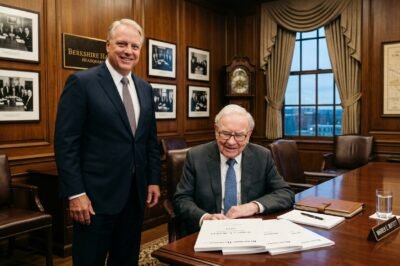
For more than half a century, the global financial landscape has been shaped, measured, and often anchored by the singular figure of Warren Buffett. His annual letters to shareholders were treated as scripture by value investors, and his Omaha-based conglomerate, Berkshire Hathaway, became the ultimate gold standard for long-term wealth creation. However, the announcement reported by Bloomberg regarding Howard G. Buffett replacing his father as the Chairman of Berkshire Hathaway marks the definitive conclusion of one of the most storied chapters in corporate history. This transition is not merely a change in leadership; it is the activation of a meticulously crafted, multi-decade succession plan designed to preserve the unique cultural DNA of a company that manages hundreds of billions of dollars in assets. The shift represents a move from a charismatic, centralized leadership model to a more institutionalized structure of governance, where Howard G. Buffett will serve as the non-executive chairman, acting as the ultimate guardian of the company’s deeply ingrained values. As the world watches this generational handoff, the implications for global markets, investor sentiment, and the future of value investing remain profound.
The Strategic Framework of the Succession Plan
The transition of Howard G. Buffett into the role of Chairman has long been a foundational pillar of Warren Buffett’s vision for Berkshire’s survival after his departure. Warren has frequently stated that the role of the chairman should be distinct from that of the CEO to ensure a system of checks and balances. While Greg Abel has been designated as the operational successor to lead the conglomerate’s sprawling portfolio of businesses—ranging from Geico and BNSF Railway to massive stakes in Apple and American Express—Howard’s role as Chairman is specifically designed to be non-operational. This separation of powers is intended to prevent any single individual from exercising the absolute authority that Warren held, ensuring that the company’s culture of integrity and autonomy remains intact even under new management.
Howard G. Buffett is not a typical corporate executive. A philanthropist, farmer, and former sheriff, his background is rooted in practical application and ethical stewardship rather than high-stakes wall street trading. This is precisely why he was chosen. The board of directors and Warren himself believe that Howard possesses the ‘Berkshire DNA’ necessary to protect the firm from activist investors or internal cultural drift. His primary responsibility will not be picking stocks or negotiating acquisitions, but rather overseeing the board, ensuring the CEO is performing correctly, and most importantly, stepping in if the company’s ethical standards or decentralized operating model are ever threatened. This unique governance structure is a rare experiment in corporate America, prioritizing cultural continuity over traditional executive hierarchy.
Protecting the Berkshire Hathaway Culture and Identity
At the heart of Berkshire Hathaway is a culture that Warren Buffett spent seventy years building: a decentralized system where individual business leaders are given nearly total autonomy as long as they provide consistent returns and maintain high ethical standards. Howard Buffett’s appointment is a signal to these leaders that the rules of the game have not changed. By installing a family member who is deeply committed to the patriarch’s philosophy, Berkshire aims to mitigate the ‘key man risk’ that has long haunted the stock. Investors are not just buying a cash-flow machine; they are buying into a philosophy of trust and long-term thinking that is increasingly rare in the era of quarterly-driven performance metrics.
Howard’s ascent also serves as a defensive maneuver against the threat of corporate raiders or short-term activists who might wish to break up Berkshire Hathaway into its constituent parts. Because the conglomerate is so massive, its ‘sum of the parts’ valuation often differs from its market cap, making it a potential target for those looking for a quick liquidation profit. Howard’s presence as Chairman, backed by the significant voting power held by the Buffett estate, ensures that the company remains a cohesive unit dedicated to the compounding of capital over decades, not months. This ‘Guardian’ role is essential for maintaining the confidence of long-term shareholders who have held the stock for forty or fifty years.
Market Reactions and Institutional Investor Confidence
The immediate reaction from Wall Street has been one of measured stability, a testament to how well Warren Buffett communicated this plan over the last ten years. Analysts note that Howard Buffett has served on the Berkshire board since 1993, giving him over three decades of direct exposure to the company’s inner workings. Institutional investors, including massive pension funds and sovereign wealth funds, have generally expressed support for the move, seeing it as the most stable path forward during a period of inevitable volatility. However, some skeptics point to the lack of Warren’s ‘magic touch’ as a potential long-term headwind for the stock’s premium valuation.
Key statistics regarding the transition include:
- Board Tenure: Howard G. Buffett has 30+ years of experience on the Berkshire Hathaway Board of Directors.
- Capital Allocation: While Howard chairs, Greg Abel will oversee a cash pile that has recently exceeded $180 billion.
- Stock Performance: Berkshire Class A shares have historically outperformed the S&P 500, and markets will be looking for a ‘Buffett Discount’ or ‘Premium’ in the coming months.
- Philanthropic Ties: Howard’s role also aligns with the eventual distribution of Warren’s wealth to the Gates Foundation and other Buffett family foundations.
The Operational Leadership Under Greg Abel
While Howard Buffett will hold the gavel at board meetings, the heavy lifting of running the world’s most complex conglomerate falls to Greg Abel. Abel, who formerly headed Berkshire Hathaway Energy, has already taken on significant responsibilities in recent years, overseeing all non-insurance operations. The relationship between Howard as Chairman and Greg as CEO will be the defining partnership of the post-Warren era. They must demonstrate that the ‘institutional imperative’—the tendency for large organizations to become inefficient and bureaucratic—can be resisted through their combined vigilance.
Abel faces the daunting task of deploying Berkshire’s massive cash reserves in an environment where high interest rates and inflated private equity valuations make ‘elephant hunting’ (large-scale acquisitions) increasingly difficult. Howard’s role will be to provide the psychological and structural support Abel needs to stick to the Buffett playbook: wait for the fat pitch, don’t overpay, and buy wonderful businesses at fair prices. The synergy between Howard’s oversight and Greg’s operational excellence will be the true test of whether Berkshire can remain a market leader without Warren at the helm.
Governance Challenges in a Post-Warren World
Transitioning from a legendary founder is a challenge few companies survive unscathed. The risks are many: internal power struggles, changes in investment philosophy, and the loss of the ‘halo effect’ that Warren provided. Howard Buffett must navigate a board that will eventually lose other long-standing members who were close to his father. He will be responsible for recruiting new directors who share the same ascetic and disciplined approach to capital management. Furthermore, the company faces growing pressure regarding ESG (Environmental, Social, and Governance) disclosures, an area where Warren was often resistant but where modern institutional investors are increasingly demanding.
As Chairman, Howard will likely be the face of the company at the annual ‘Woodstock for Capitalists’ in Omaha. While he lacks his father’s penchant for folksy aphorisms and witty rebuttals, his authenticity and commitment to his father’s legacy will be critical in calming the nerves of the tens of thousands of shareholders who attend. The challenge will be maintaining the transparency that Warren was known for while adapting to a digital age where information moves faster than ever before. Howard’s ability to manage the narrative and protect the brand will be as important as any financial decision made by the firm.
Conclusion: The Future Implications for Berkshire Hathaway
The appointment of Howard G. Buffett as Chairman of Berkshire Hathaway is the final piece of a legacy-defining puzzle. It ensures that the transition is not a sudden shock but a graceful evolution. For the global economy, a stable Berkshire Hathaway acts as a shock absorber; its massive insurance float and diversified holdings provide liquidity and stability during market downturns. By choosing his son to guard the gates, Warren Buffett has prioritized the longevity of his life’s work over traditional corporate norms. The coming years will reveal if this unique structure can sustain the outsized returns and impeccable reputation that defined the Buffett era. While the ‘Oracle’ may be stepping back, the foundation he built—now under the watchful eye of Howard G. Buffett and the operational hand of Greg Abel—appears designed to withstand the tests of time, inflation, and economic transformation. The world of finance has lost its most prominent voice, but it has gained a fascinating case study in how to pass the torch of a multi-billion dollar empire without losing its soul.






































Leave a Reply