
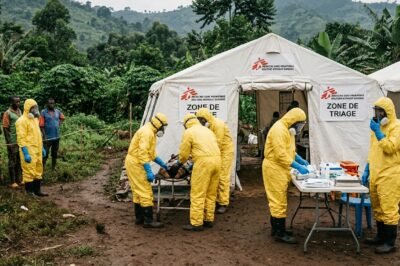
The quiet rustle of the dense vegetation in the North Kivu province of the Democratic Republic of Congo (DRC) is frequently broken by the sirens of ambulances and the heavy footsteps of health workers clad in yellow protective suits. This week, a somber milestone was reached that many had feared but few wanted to acknowledge: the official death toll from the current Ebola outbreak has surpassed 3,000. For a nation already weary from decades of civil unrest, economic instability, and various infectious diseases, this figure represents more than just a number; it is a profound human tragedy that highlights the systemic vulnerabilities of one of the world’s most fragile health landscapes. As the official data from the Ministry of Health confirms this grim reality, the international community is forced to reckon with the efficacy of current intervention strategies and the persistent barriers that prevent the complete eradication of the virus. The outbreak, which began in August 2018, remains the second-deadliest in history, second only to the West African epidemic of 2014-2016. Despite the availability of experimental vaccines and advanced therapeutic treatments, the virus continues to find a foothold in the complex social and political terrain of eastern Congo. This milestone serves as a wake-up call that the fight against Ebola is far from over, requiring a renewed commitment to both medical science and social trust.
## Historical Context: A Brief Overview of Ebola in the DRC
To understand the current crisis, one must look back at the history of the Ebola Virus Disease (EVD) within the borders of the DRC. The virus was first identified in 1976 near the Ebola River, which gave it its name. Since then, the country has faced more than ten separate outbreaks. However, most previous occurrences were confined to remote, sparsely populated rural areas, allowing for relatively quick containment. The current outbreak is fundamentally different. It is centered in North Kivu and Ituri, regions that are not only densely populated but also characterized by high mobility and a significant presence of armed rebel groups. This historical precedent created a sense of familiarity among some health officials, yet the unique variables of the current location have rendered traditional containment methods insufficient. In previous years, the mortality rate of Ebola often hovered around 50% to 90%, depending on the strain and the speed of response. The current outbreak has maintained a high case-fatality rate, exacerbated by the fact that many victims are never reaching treatment centers, dying instead in their communities where they further spread the virus during traditional burial practices.
## The Geography of an Epidemic: Why North Kivu and Ituri are Vulnerable
The geographical layout of eastern DRC is a significant factor in why this specific outbreak has been so difficult to quell. North Kivu and Ituri are bustling hubs of trade and migration. They share borders with Uganda and Rwanda, making the threat of cross-border transmission a constant anxiety for the World Health Organization (WHO). Unlike the deep jungle outbreaks of the past, this epidemic is occurring in a ‘red zone’—an area of active conflict. There are over 100 armed groups operating in the region, including the Allied Democratic Forces (ADF), which frequently launch attacks on civilians and government forces alike. This insecurity makes it incredibly dangerous for ‘contact tracers’ to do their jobs. When a new case is identified, health workers must find everyone that person interacted with, but in a war zone, those contacts might be displaced by violence or hidden in inaccessible forests. The rugged terrain, combined with poor infrastructure, means that transporting medical supplies and samples for testing can take days instead of hours, giving the virus more time to spread undetected through the population.
## Statistical Breakdown: Analyzing the Official Data from the Ministry of Health
According to the latest figures released by the DRC Ministry of Health and verified by international partners, the total number of cases has reached nearly 4,500, with confirmed deaths exceeding the 3,000 mark. The data suggests a disproportionate impact on women and children. Women are often the primary caregivers in Congolese society, meaning they are the ones nursing the sick and preparing bodies for burial—two of the highest-risk activities for contracting the virus. Furthermore, a significant percentage of the deceased are children under the age of five, whose immune systems are less equipped to handle the systemic inflammatory response triggered by the virus. Statistics also reveal a concerning trend of ‘community deaths.’ Roughly one-third of the victims are dying outside of Ebola Treatment Centers (ETCs). This indicates a lack of trust in the formal medical system or an inability to access care in time. When a death occurs in the community, the viral load in the body is at its highest, and the risk to mourners is extreme. The official data also shows that while the rate of infection has slowed in some hotspots, new ‘clusters’ continue to emerge in areas previously thought to be cleared, indicating that the virus is moving silently through undetected transmission chains.
## Sociopolitical Barriers: Conflict, Distrust, and Resistance
Perhaps the greatest obstacle to ending the Ebola outbreak is not biological, but social. Decades of conflict and perceived neglect by both the central government and the international community have fostered a deep-seated distrust among the local population. When health workers arrive in expensive SUVs and full-body hazmat suits, they are often met with suspicion. Rumors and conspiracy theories have flourished, with some residents believing that Ebola is a political invention designed to destabilize the region or a business venture for foreign NGOs. This distrust has manifested in physical violence. Dozens of health facilities have been attacked, and several health workers have been killed while performing their duties. This ‘resistance’ makes it impossible to maintain a consistent presence in many villages. Furthermore, the political climate has played a role; the exclusion of certain regions from national elections due to the Ebola risk led to protests and further alienated the community from the response efforts. Without the ‘social license’ to operate, even the most advanced medical interventions are rendered ineffective. Bridging the gap between scientific necessity and community perception remains the most difficult challenge for the DRC government and the WHO.
## The Role of the International Community and Vaccination Efforts
Despite the harrowing death toll, there have been significant scientific milestones during this outbreak. The deployment of the rVSV-ZEBOV vaccine, manufactured by Merck, has been a game-changer. Over 250,000 people have been vaccinated in a ‘ring vaccination’ strategy, where the contacts of an infected person, and the contacts of those contacts, receive the shot. Studies suggest the vaccine is highly effective, potentially preventing thousands of additional deaths. In addition to vaccination, the use of experimental therapeutics like REGN-EB3 and mAb114 has shown that Ebola is no longer an automatic death sentence if caught early. These treatments are part of a massive international effort involving the UN, Médecins Sans Frontières (MSF), and various governmental aid agencies. However, funding remains a constant struggle. The WHO has frequently warned that the response is ‘underfunded and overstretched.’ The logistical cost of maintaining a high-level medical presence in a conflict zone is astronomical. While the international community has provided billions in aid, the sheer duration of the outbreak—now spanning over two years—is draining resources that are also needed for other crises, such as measles and malaria, which actually kill more people in the DRC annually than Ebola.
## Conclusion: Future Implications and the Need for Resilient Systems
The passing of the 3,000-death threshold is a tragedy that will leave a permanent scar on the Democratic Republic of Congo. However, it also provides critical lessons for the future of global health. First, it is clear that medical interventions cannot exist in a vacuum; they must be integrated with local social and cultural norms to be successful. Second, the outbreak proves that health security is inextricably linked to regional stability. As long as there is conflict in the eastern DRC, the world will remain at risk from the pathogens that thrive in such chaos. Moving forward, the focus must shift from emergency response to the building of resilient local health systems. This means training local doctors and nurses, improving laboratory capacity, and investing in basic infrastructure like roads and clean water. The 3,000 lives lost should serve as a testament to the urgency of this mission. Ebola may eventually be contained this time, but the underlying conditions that allowed it to flourish remain. Only by addressing the root causes of vulnerability—poverty, conflict, and distrust—can we hope to prevent the next milestone from ever being reached. The world must not look away now; the cost of indifference is simply too high.



































Leave a Reply