
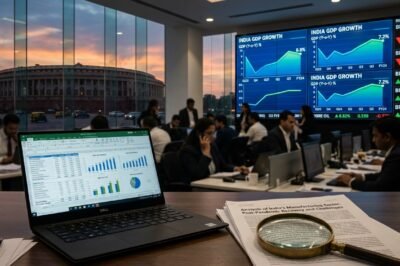
India’s economic narrative is currently characterized by a striking paradox that has captured the attention of global financial institutions and internal critics alike. On one hand, the nation continues to project an image of an indomitable giant, clocking growth rates that consistently outpace other major economies, seemingly immune to the volatile shocks of the global oil market. On the other hand, a growing chorus of statisticians and economists are raising red flags about the methodology behind these stellar numbers. For a country that imports nearly 80 percent of its crude oil requirements, the ability to maintain a 7 percent-plus growth rate in a high-interest, high-cost environment is nothing short of a fiscal miracle—if the numbers are to be believed. However, the BBC’s recent spotlight on the credibility of this data has reignited a fierce debate: Is India truly the world’s bright spot, or is the statistical machinery of the state being leveraged to paint a picture of prosperity that masks underlying structural weaknesses? This analysis explores the complex intersection of geopolitical strategy, energy security, and the controversial science of national accounting in modern India. In an era where global supply chains are brittle and inflation is a persistent threat, India’s reported GDP figures serve as a beacon for foreign direct investment. Yet, the shadows cast by data discrepancies threaten to undermine the very confidence the government seeks to build. This detailed breakdown examines how India manages its energy needs, why its statistical methods are under fire, and what the future holds for the world’s most populous nation. ## The Resilience of the Indian Economy Against Crude Oil Volatility To understand India’s growth, one must first understand its relationship with energy. As one of the world’s largest importers of crude oil, India’s macro-stability is historically tied to international barrel prices. Typically, an oil shock—defined by a sudden, sustained spike in prices—acts as a massive tax on the Indian economy, widening the current account deficit and stoking domestic inflation. Yet, in the post-pandemic recovery phase, India has reported robust GDP growth even as global energy prices fluctuated wildly due to the conflict in Ukraine. The government attributes this to prudent fiscal management and a massive push in capital expenditure on infrastructure. By pouring trillions of rupees into roads, railways, and ports, the state has attempted to create a multiplier effect that drives domestic demand even when external factors are unfavorable. This infrastructure-led growth model is designed to make the economy more efficient over the long term, reducing logistics costs that have traditionally hampered Indian manufacturing. However, the resilience is not merely a result of physical construction; it is also a byproduct of a strategic pivot in trade. The ability to decouple domestic fuel prices from global benchmarks, at least partially, has provided a cushion for the Indian consumer. But as the BBC report suggests, the official narrative of seamless growth may be overlooking the micro-economic stresses that higher energy costs still impose on the informal sector, which accounts for nearly half of India’s economic output. ## Navigating the Geopolitical Maze: The Russian Oil Factor A significant, though often downplayed, reason for India’s ability to defy the traditional oil shock is its tactical engagement with Russia. Following the sanctions imposed by Western nations on Russian energy exports, India stepped in as a major buyer, securing crude at significantly discounted rates. This ‘cheap’ oil has been a lifesaver for Indian refiners and the treasury, effectively mitigating the inflationary pressure that would have otherwise crippled growth. While the United States and Europe initially looked at this arrangement with skepticism, India maintained that its primary responsibility was to its own energy security and its billion-plus population. This influx of discounted crude allowed the government to maintain relatively stable retail fuel prices, which in turn kept transportation costs in check and prevented a total runaway of the Consumer Price Index (CPI). But critics argue that this is a temporary geopolitical arbitrage rather than a structural economic triumph. If the discounts were to disappear or if shipping routes were further compromised by Red Sea tensions, the ‘oil shock’ that India has so far ‘defied’ could return with a vengeance. Furthermore, the reliance on a single, sanctioned source for discounted energy creates long-term strategic vulnerabilities that aren’t necessarily captured in current GDP growth percentages. ## The Deflator Dilemma: Why Economists are Skeptical The core of the BBC’s investigation and the subsequent academic debate lies in the technicalities of how India calculates its Gross Domestic Product. The most contentious issue is the ‘GDP deflator.’ In simple terms, to get from nominal growth (current prices) to real growth (inflation-adjusted), economists use a deflator. Several prominent economists, including former Chief Economic Advisor Arvind Subramanian, have argued that India’s choice of deflators might be understating inflation in certain sectors, thereby overstating real growth. Specifically, there is a mismatch between the Wholesale Price Index (WPI) and the Consumer Price Index (CPI) used in these calculations. When manufacturing input costs (WPI) fall significantly—as they did recently—while retail prices remain high, the mathematical outcome can artificially inflate the ‘real’ GDP growth figure. Critics point to the discrepancy between the high reported GDP and the much lower Gross Value Added (GVA) in specific sectors like manufacturing and agriculture. If the economy were truly growing at 7-8 percent, one would expect to see a corresponding surge in private sector investment and robust growth in rural consumption. Instead, private investment remains sluggish, and rural demand has shown signs of distress. This gap between the headline number and the ground reality is where the ‘credibility questions’ become most pointed. ## Measuring the ‘K-Shaped’ Reality: Consumption vs. Statistics Another pillar of the data credibility argument is the divergence in consumption patterns. India is often described as experiencing a ‘K-shaped’ recovery, where the affluent top 10 percent of the population sees rapid income growth and spends on luxury goods, while the bottom 50 percent struggles with stagnant wages and high food inflation. Official data often aggregates these trends, resulting in a healthy-looking average that masks deep structural inequality. For instance, while passenger vehicle sales (mostly high-end SUVs) have hit record highs, the sale of two-wheelers—a proxy for rural and lower-middle-class economic health—has been much slower to recover to pre-pandemic levels. Similarly, the demand for work under the MGNREGA rural employment guarantee scheme remains high, indicating that the rural economy is not generating enough private-sector jobs to sustain the population. When the BBC highlights skepticism, it refers to this disconnect. If the economy is growing at a world-beating pace, why are the most basic indicators of mass-market health lagging? The government argues that these are lag effects and that the benefits of high growth will eventually ‘trickle down,’ but many analysts fear that the statistical framework is simply not capturing the true extent of the distress in the informal economy. ## The Politics of Data and Global Institutional Confidence The credibility of national statistics is not just an academic exercise; it has massive implications for global finance. For years, India was praised for having one of the most robust and independent statistical systems in the developing world. However, in recent years, controversies over suppressed employment surveys and the delay of the decadal census (originally due in 2021) have tarnished this reputation. The Ministry of Statistics and Programme Implementation (MOSPI) has faced criticism for methodology changes that conveniently seem to boost growth figures. While the IMF and World Bank still use official Indian data for their projections, they have occasionally added caveats regarding data quality. If international investors begin to lose faith in the accuracy of India’s economic reporting, the ‘India Premium’ could quickly turn into a ‘Transparency Discount.’ This would mean higher borrowing costs for Indian companies and a potential slowdown in the foreign direct investment (FDI) that is crucial for the government’s ‘Make in India’ initiative. The government has pushed back strongly against these claims, labeling them as ‘Western bias’ or politically motivated attacks, but the sheer volume of internal academic criticism suggests that a more transparent approach is needed. ## Institutional Reform: The Path to Transparency and Trust For India to solidify its position as a global economic leader, it must address the skepticism surrounding its data. This requires more than just defensive press releases; it requires institutional reform. Restoring the independence of the National Statistical Commission (NSC) and ensuring the timely release of all economic surveys—regardless of whether the findings are favorable—is essential. Transparency acts as a safeguard against economic shocks; it allows policymakers to see problems before they become crises. Moreover, modernizing the data collection process to better capture the informal sector and digital economy would yield more accurate results. As India aims to become a $5 trillion economy, the quality of its data must match the scale of its ambitions. Investors are generally willing to navigate risks if they are well-defined, but they are wary of uncertainty. By providing clear, verifiable, and consistent economic indicators, India can prove that its defiance of the oil shock is based on genuine structural strength rather than statistical maneuvering. ## Conclusion and Future Implications India stands at a crossroads. Its ability to maintain high growth while the rest of the world slows down is an achievement that cannot be entirely dismissed as a statistical fluke. The strategic energy deals and the infrastructure push are real, tangible factors driving the economy. However, the ‘credibility questions’ raised by the BBC and other experts cannot be ignored. The future of India’s growth story depends on reconciling the headline numbers with the lived experience of its citizens. If the government can address the ‘K-shaped’ inequality and restore the sanctity of its statistical institutions, India will indeed be the world’s growth engine for decades to come. If the data gap continues to widen, however, the country risks a crisis of confidence that could derail its economic momentum. Ultimately, the true test of India’s resilience will not be found in a GDP spreadsheet, but in the creation of sustainable, high-quality jobs and the broad-based prosperity of its vast population. As global oil markets remain volatile and geopolitical tensions simmer, the need for honest, transparent economic accounting has never been more critical for the world’s fastest-growing major economy.





-

Hunkkaar Teaser Analysis: Aneet Padda’s Gritty Transformation and the Evolving Landscape of Indian Thrillers
-

Mithila Palkar: The Relatable Queen of Indian Web Series and Her Meteoric Rise
-

Wamiqa Gabbi: The Meteoric Rise of Indian Web Series’ Most Versatile Leading Lady
-

Triptii Dimri Biography: The Evolution of India’s Newest Cinematic Sensation and Web Series Star
-

Wamiqa Gabbi: The Rise of India’s New Digital Icon and the Future of OTT Stardom
-

Mithila Palkar: The Unstoppable Evolution of India’s Digital Darling and Her Journey to the Silver Screen
-

Mithila Palkar: The Comprehensive Journey of India’s Web Series Sensation and Digital Pioneer
-

Mithila Palkar: The Relatable Queen of Indian Web Series and Her Inspiring Journey to Stardom
-

Sobhita Dhulipala Biography: The Meteoric Rise of India’s Most Versatile Web Series Star
-

Mithila Palkar: The Unstoppable Journey of India’s Digital Darling and Web Series Queen
-

Triptii Dimri: The Complete Biography of India’s Newest Cinematic Sensation and Web Series Icon
-

Wamiqa Gabbi: The Ethereal Rise of India’s Most Versatile Web Series Star
-

Sobhita Dhulipala: The Unstoppable Rise of India’s Most Versatile Web Series Icon
-

Wamiqa Gabbi: The Meteoric Rise of the New Queen of Indian Web Series and Her Unstoppable Journey to Stardom
-

Triptii Dimri: The Meteoric Rise of India’s New Cinema Sweetheart and Web Series Icon
-

Wamiqa Gabbi: The Versatile Queen of Indian OTT and Her Phenomenal Rise to Stardom
-

Tripti Dimri Biography: The Rise of India’s New National Crush and Her Journey from Laila Majnu to OTT Stardom
-

Wamiqa Gabbi Biography: The Meteoric Rise of India’s Newest OTT Sensation and Versatile Powerhouse
-

Wamiqa Gabbi Biography: The Meteoric Rise of the Digital Queen of Indian Web Series
-

The Rise of Wamiqa Gabbi: A Deep Dive into the Journey of India’s Most Versatile OTT Sensation
-

The Meteoric Rise of Triptii Dimri: Biography, Acting Prowess, and the Journey of India’s Newest Cinema Sensation

Launching Soon: The Future of News with Our E-Newspaper
In the ever-evolving landscape of media and technology, we are thrilled to announce the upcoming launch of our innovative e-newspaper, set to redefine the way news is consumed in the digital age. Embracing the convenience and accessibility that the digital world offers, our e-newspaper aims to deliver real-time news updates, insightful articles, and interactive features directly to your devices. With a commitment to journalistic integrity and a passion for storytelling, we are dedicated to keeping you informed, engaged, and connected, no matter where you are. Stay tuned for the launch of our e-newspaper, where the future of news awaits at your fingertips.
Recent News
- RBI to transfer record ₹2.11 lakh crore surplus to Indian government for FY24

- UK Prime Minister Rishi Sunak Calls for Surprise General Election on July 4: A Comprehensive Strategic Analysis

- Four Suspected ISIS Terrorists of Sri Lankan Nationality Arrested at Ahmedabad Airport: A Deep Dive into Regional Security Threats

- Nvidia Shares Skyrocket as Quarterly Revenue Triples Amid Insatiable Global Demand for AI Infrastructure

- Calcutta High Court Strikes Down OBC Status for 77 Communities in West Bengal: A Comprehensive Legal and Political Analysis

- Ireland, Spain and Norway announce formal recognition of Palestinian state

Politics
- UK Prime Minister Rishi Sunak Calls for Surprise General Election on July 4: A Comprehensive Strategic Analysis
- Calcutta High Court Strikes Down OBC Status for 77 Communities in West Bengal: A Comprehensive Legal and Political Analysis
- Ireland, Spain and Norway announce formal recognition of Palestinian state
- Calcutta High Court Strikes Down OBC Status of Several Classes in West Bengal: A Comprehensive Legal and Political Analysis

- Ireland, Norway, and Spain formally announce recognition of Palestinian statehood

- UK Prime Minister Rishi Sunak Calls for Snap General Election on July 4: A Strategic and High-Stakes Political Gamble

Categories
- Art & Culture 106
- Auto 85
- Beauty 15
- Blog 307
- Books 7
- Business 376
- Celebrities 217
- Crime Files 139
- Democracy 308
- Education 84
- Entertainment 154
- Environment 133
- epaper 1
- Fashion 37
- Food 59
- Gadgets 89
- Guide 150
- Handicrafts 14
- Health 281
- Healthy Living 108
- History 5
- incidents 172
- Lifestyle 41
- Music 7
- Photography 15
- Politics 469
- Science & Technology 160
- Sports 283
- Tech 142
- Television 4
- Travel 68
- Travel & Tourism 30
- Trends 57
- Weather 9
- Web Series 97
- Workout 4
- World 665
Leave a Reply