
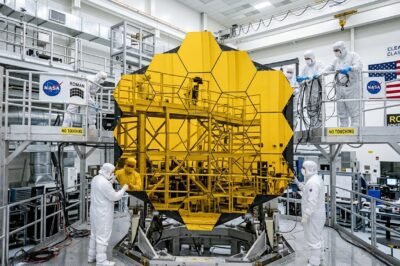
In the clandestine world of aerospace intelligence, some of the most sophisticated technology ever engineered remains hidden from the public eye, orbiting the Earth in silent, classified vigil. However, a remarkable shift in 2012 changed the course of astrophysics forever when the National Reconnaissance Office (NRO) unexpectedly donated two spare telescope mirrors to NASA. These were not just any optics; they were 2.4-meter mirrors, identical in size to the primary mirror of the legendary Hubble Space Telescope, but designed for a far more expansive purpose. One of these mirrors has now become the heart of the Nancy Grace Roman Space Telescope, a mission poised to revolutionize our understanding of the universe. This transition from a tool of terrestrial surveillance to a sentinel of the cosmos represents one of the most significant swords to plowshares moments in the history of science. By repurposing high-precision hardware originally intended for national security, NASA has leapfrogged years of development and saved millions in manufacturing costs, all while gaining a capability that will allow us to see the infrared universe with unprecedented clarity. This article explores the intricate journey of the Roman Telescopes mirror, the engineering hurdles of its adaptation, and the profound scientific questions it is destined to answer as it prepares for its journey to the second Lagrange point. H2: The Classified Legacy of the NRO Donation. The story of the Nancy Grace Roman Space Telescope begins not in a laboratory at NASA, but within the secure facilities of the National Reconnaissance Office, the agency responsible for the United States spy satellites. In the mid-2000s, the NRO had two primary mirror assemblies that were surplus to their requirements. These mirrors were part of the KH-11 Kennen reconnaissance program, which had long shared optical similarities with the Hubble Space Telescope. For years, these mirrors sat in climate-controlled storage, their existence a closely guarded secret. When the donation was announced in 2012, the astronomical community was stunned. The mirrors were of exceptional quality, featuring a 2.4-meter aperture but with a much shorter focal length than Hubbles mirror. This shorter focal length allows for a wider field of view, making them ideal for surveying vast swaths of the sky. While Hubble is like a magnifying glass, the NRO mirrors offered the potential for a wide-angle lens into the deep past of the universe. The donation effectively provided NASA with hundreds of millions of dollars worth of flight-qualified hardware, essentially giving the then-named WFIRST (Wide Field Infrared Survey Telescope) project a massive head start. H2: Engineering the Transition from Surveillance to Science. Repurposing a spy mirror for deep space observation was far from a simple task. While the primary mirror was an engineering masterpiece, it was designed to look down at the Earth from low Earth orbit, where thermal conditions and gravitational stresses are vastly different from the deep space environment of the L2 Lagrange point. Engineers at NASAs Goddard Space Flight Center and contractors at Harris Corporation had to meticulously evaluate the mirrors structural integrity and optical performance. The mirrors had to be stripped of their classified coatings and re-processed for infrared astronomy. One of the primary challenges was the thermal stability. In the vacuum of space, temperatures can fluctuate wildly, and the mirror must maintain its precise shape to within nanometers. The Roman telescope uses a specialized composite structure to support the mirror, ensuring that as the spacecraft pivots to look at different parts of the sky, the optics remain perfectly aligned. Furthermore, the optical assembly had to be integrated with two brand-new, cutting-edge instruments: the Wide Field Instrument (WFI) and the Coronagraph Instrument (CGI). This required a complete redesign of the secondary mirror and the optical bench to accommodate the wider light path that defines the Roman missions capabilities. H2: The Wide Field Instrument: A Panoramic View of the Cosmos. The true power of the Nancy Grace Roman Space Telescope lies in its ability to capture a field of view that is 100 times larger than that of the Hubble Space Telescope while maintaining the same exquisite resolution. This is made possible by the 18 state-of-the-art H4RG infrared detectors that form the focal plane of the Wide Field Instrument. Together, these detectors create a 300-megapixel camera that can survey the sky 1000 times faster than Hubble. This capability is revolutionary for statistical astronomy. Instead of focusing on individual galaxies or stars, Roman will perform massive surveys that capture millions of galaxies in a single image. This high-cadence, wide-area mapping will allow scientists to create the most detailed 3D maps of the universe ever attempted. The statistics gathered from these surveys are crucial for understanding the large-scale structure of the cosmos. By observing how light from distant galaxies is slightly distorted by the gravity of intervening dark matter, a phenomenon known as weak gravitational lensing, Roman will provide new insights into the invisible scaffolding that holds the universe together. H2: Probing the Mysteries of Dark Energy and Dark Matter. Perhaps the most ambitious goal of the Roman mission is to solve the mystery of dark energy. In the late 1990s, astronomers discovered that the expansion of the universe is not slowing down, as previously thought, but is actually accelerating. This acceleration is attributed to a mysterious force called dark energy, which makes up about 68 percent of the universe. Roman will use multiple methods to measure the expansion history of the universe with unprecedented precision. It will observe thousands of Type Ia supernovae, which act as standard candles to measure cosmic distances. Additionally, it will study Baryon Acoustic Oscillations (BAO), which are remnants of sound waves from the early universe that serve as a standard ruler for measuring the growth of cosmic structures. By combining these measurements, Roman will help determine if dark energy is a constant property of space (the cosmological constant) or a dynamic field that changes over time. Simultaneously, the telescope will map the distribution of dark matter, the invisible substance that accounts for most of the mass in the universe, by observing its gravitational effects on visible light. H2: Exoplanet Hunting and the Coronagraph Technology. Beyond cosmology, the Roman Space Telescope is a formidable exoplanet hunter. It will utilize a technique called gravitational microlensing to find planets that are otherwise invisible to modern telescopes. Microlensing occurs when the gravity of a foreground star acts as a lens, magnifying the light of a more distant background star. If the foreground star has a planet, that planet creates a tiny additional blip in the light curve. Roman is expected to find thousands of new worlds, including many that are similar to Earth in mass and distance from their parent stars. Furthermore, the telescope carries the Coronagraph Instrument, a technology demonstration that will pave the way for future missions to image Earth-like planets directly. The CGI uses a complex system of masks and deformable mirrors to block out the overwhelming glare of a star, allowing the much fainter light of an orbiting planet to be seen. This is like trying to see a firefly hovering next to a searchlight from miles away. The CGI will test advanced techniques for high-contrast imaging that will be essential for the next generation of Great Observatories designed to find signs of life on other worlds. H2: Conclusion: A New Era of Infrared Astronomy. The Nancy Grace Roman Space Telescope, scheduled for launch no later than May 2027, stands as a testament to the power of innovation and the benefits of inter-agency cooperation. By taking a mirror once intended for the shadows of national security and turning it toward the light of the stars, NASA has created a mission that is greater than the sum of its parts. Roman will not replace the James Webb Space Telescope or Hubble; rather, it will complete the trifecta of space-based observatories. While Webb peers deep into small patches of the sky to see the first stars, and Hubble provides high-resolution ultraviolet and visible light data, Roman will provide the broad, panoramic context that connects the dots of the cosmic narrative. Its data will be entirely public, fostering a global collaborative effort to decode the secrets of dark energy, dark matter, and the millions of worlds that inhabit our galaxy. As we look toward the launch, the Roman telescope reminds us that the tools we use to watch over our world can also be the windows through which we discover our place in the infinite expanse of the universe.
Recycling the Stars: How a Cold War Surplus Mirror from the NRO Transformed into the Nancy Grace Roman Space Telescope
Posted by
Stories





-

Hunkkaar Teaser Analysis: Aneet Padda’s Gritty Transformation and the Evolving Landscape of Indian Thrillers
-

Mithila Palkar: The Relatable Queen of Indian Web Series and Her Meteoric Rise
-

Wamiqa Gabbi: The Meteoric Rise of Indian Web Series’ Most Versatile Leading Lady
-

Triptii Dimri Biography: The Evolution of India’s Newest Cinematic Sensation and Web Series Star
-

Wamiqa Gabbi: The Rise of India’s New Digital Icon and the Future of OTT Stardom
-

Mithila Palkar: The Unstoppable Evolution of India’s Digital Darling and Her Journey to the Silver Screen
-

Mithila Palkar: The Comprehensive Journey of India’s Web Series Sensation and Digital Pioneer
-

Mithila Palkar: The Relatable Queen of Indian Web Series and Her Inspiring Journey to Stardom
-

Sobhita Dhulipala Biography: The Meteoric Rise of India’s Most Versatile Web Series Star
-

Mithila Palkar: The Unstoppable Journey of India’s Digital Darling and Web Series Queen
-

Triptii Dimri: The Complete Biography of India’s Newest Cinematic Sensation and Web Series Icon
-

Wamiqa Gabbi: The Ethereal Rise of India’s Most Versatile Web Series Star
-

Sobhita Dhulipala: The Unstoppable Rise of India’s Most Versatile Web Series Icon
-

Wamiqa Gabbi: The Meteoric Rise of the New Queen of Indian Web Series and Her Unstoppable Journey to Stardom
-

Triptii Dimri: The Meteoric Rise of India’s New Cinema Sweetheart and Web Series Icon
-

Wamiqa Gabbi: The Versatile Queen of Indian OTT and Her Phenomenal Rise to Stardom
-

Tripti Dimri Biography: The Rise of India’s New National Crush and Her Journey from Laila Majnu to OTT Stardom
-

Wamiqa Gabbi Biography: The Meteoric Rise of India’s Newest OTT Sensation and Versatile Powerhouse
-

Wamiqa Gabbi Biography: The Meteoric Rise of the Digital Queen of Indian Web Series
-

The Rise of Wamiqa Gabbi: A Deep Dive into the Journey of India’s Most Versatile OTT Sensation
-

The Meteoric Rise of Triptii Dimri: Biography, Acting Prowess, and the Journey of India’s Newest Cinema Sensation

Launching Soon: The Future of News with Our E-Newspaper
In the ever-evolving landscape of media and technology, we are thrilled to announce the upcoming launch of our innovative e-newspaper, set to redefine the way news is consumed in the digital age. Embracing the convenience and accessibility that the digital world offers, our e-newspaper aims to deliver real-time news updates, insightful articles, and interactive features directly to your devices. With a commitment to journalistic integrity and a passion for storytelling, we are dedicated to keeping you informed, engaged, and connected, no matter where you are. Stay tuned for the launch of our e-newspaper, where the future of news awaits at your fingertips.
Recent News
- India vs Malaysia LIVE score, Asian Games 2026 men’s hockey final: Harmanpreet Singh’s Early Lead and Tactical Masterclass

- Comprehensive Analysis: Asian Games 2026 Wrestling – India’s Schedule, Medal Prospects, and Global Standings

- Jr. NTR Takes Stand Against AI Misuse: A Comprehensive Analysis of the ‘Chuttamalle’ Deepfake Controversy

- Stroke Care Delays Increased Globally During COVID-19 Pandemic – European Medical Journal Analysis

- Deep Analysis: Nayara Energy Hikes Petrol and Diesel Prices Amid 2026 Global Energy Shifts

- Asian Games 2026 Wrestling Day 3 Live: Susaki, Sujeet, Zare in Action – United World Wrestling

Politics
- Deep Analysis: Nayara Energy Hikes Petrol and Diesel Prices Amid 2026 Global Energy Shifts
- Mamata Banerjee Allegations: A Deep Dive into the ‘Hijacking’ of the Electoral Process

- Trump to Host Zuckerberg and AI Titans: A Seismic Shift in Tech Governance and Global Strategy

- 9 Pak Soldiers Killed After First Woman Unit Of Baloch Rebels Attack Convoy: A Deep Dive Analysis

- Donald Trump At UN General Assembly: Make Deal Or Drive Iran Into Hell? – A Comprehensive Geopolitical Analysis

- Supreme Court Critiques ‘Machine-Generated’ Delhi SIR Notices: A Deep Dive into Judicial Concerns over Automated Governance

Categories
- Art & Culture 103
- Auto 85
- Beauty 15
- Blog 292
- Books 7
- Business 359
- Celebrities 217
- Crime Files 139
- Democracy 308
- Education 84
- Entertainment 154
- Environment 133
- epaper 1
- Fashion 37
- Food 59
- Gadgets 87
- Guide 150
- Handicrafts 11
- Health 278
- Healthy Living 107
- History 5
- incidents 163
- Lifestyle 41
- Music 7
- Photography 15
- Politics 441
- Science & Technology 160
- Sports 264
- Tech 133
- Television 2
- Travel 68
- Travel & Tourism 30
- Trends 50
- Weather 8
- Web Series 97
- Workout 4
- World 661
Leave a Reply