
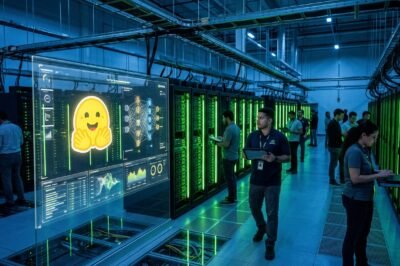
The landscape of artificial intelligence is currently undergoing a seismic shift, moving away from the tightly guarded silos of proprietary code toward a more collaborative, open-access future. At the center of this revolution is Nvidia, a company that has transitioned from a specialized graphics card manufacturer to the undisputed sovereign of the AI hardware era. The recent headlines regarding Nvidia’s multi-billion dollar engagement with Hugging Face, the preeminent platform for open-source AI models, represent more than just a financial transaction; it is a calculated $13 billion gamble on the democratization of intelligence. By funneling massive resources into the open-source ecosystem, Nvidia is not merely supporting the community; it is ensuring that its hardware remains the indispensable foundation upon which all future AI is built. This strategic alliance signals a departure from the dominance of closed-wall systems, suggesting that the next generation of breakthroughs will not come from a single laboratory, but from the collective genius of millions of developers worldwide. As we stand at this technological crossroads, the implications for enterprise computing, geopolitical power, and the very nature of software development are profound and far-reaching. The core of this $13 billion commitment lies in the integration of Nvidia’s DGX Cloud with the Hugging Face platform. This synergy allows developers to jump from discovering a model to training and deploying it on the world’s most powerful AI infrastructure with a single click. For years, the barrier to entry for high-level AI development was the sheer cost of compute and the complexity of environment setup. By bridging the gap between the repository and the supercomputer, Nvidia is effectively lowering the drawbridge to the castle of high-performance computing. This move is particularly significant as Hugging Face has become the ‘GitHub of AI,’ hosting hundreds of thousands of pre-trained models and datasets. When Nvidia invests at this scale, it is betting that the diversity of open models will eventually outpace the utility of specialized closed models. This strategy also serves as a hedge against the growing influence of massive cloud providers like Microsoft and Google, who are increasingly developing their own silicon to compete with Nvidia’s H100 and Blackwell chips. By empowering the independent developer and the enterprise that prefers on-premise or hybrid cloud solutions, Nvidia maintains its market lead regardless of which specific AI model wins the popularity contest. From a technical perspective, the integration focuses on optimizing the software stack. Nvidia’s CUDA platform has long been the industry standard for GPU acceleration, but the rise of diverse AI architectures requires a more flexible approach. Through the Hugging Face partnership, Nvidia is ensuring that every major open-source model—from Llama 3 to Mistral and beyond—is ‘Nvidia-native’ from day one. This means that these models are pre-optimized to run with maximum efficiency on Nvidia hardware, utilizing specialized features like Tensor Cores and NVLink. For the end-user, this translates to faster inference times and lower operational costs. As enterprises move from the experimentation phase of Generative AI to full-scale production, efficiency becomes the primary metric of success. Nvidia’s investment is a preemptive strike to ensure that as the world moves toward open models, those models run best on green silicon. The economic ripple effects of this deal are already being felt across the Silicon Valley ecosystem. A $13 billion valuation or investment commitment sets a new floor for the ‘Middleware’ layer of the AI stack. It validates the idea that the platform connecting hardware to software is just as valuable as the chips themselves. This has sparked a gold rush among venture capitalists seeking the next infrastructure play. However, Nvidia’s move is also a defensive maneuver. By anchoring Hugging Face to its ecosystem, Nvidia prevents competitors like AMD or Intel from gaining a foothold in the open-source community’s preferred workflow. It creates a ‘sticky’ environment where switching hardware would require re-tooling the entire development pipeline—a cost most companies are unwilling to bear. Furthermore, this partnership addresses the growing demand for ‘Sovereign AI.’ Many nations and large corporations are wary of sending their sensitive data to the black boxes of Big Tech’s proprietary models. They want to own their intelligence. Open-source models offer the transparency and control required for these high-stakes applications. By providing the hardware and the optimized platform for these open models, Nvidia is positioning itself as the trusted partner for national AI initiatives and highly regulated industries like finance and healthcare. The goal is to create a world where every company can have its own ‘mini-OpenAI’ tailored to its specific data and needs, all powered by Nvidia. Looking toward the future, the implications of this deal suggest a hybridization of AI development. We are likely to see a ‘hub-and-spoke’ model where a few massive, closed-source foundation models handle general-purpose tasks, while a vast galaxy of specialized, open-source models handle industry-specific applications. Nvidia’s $13 billion bet ensures they own the tracks upon which all these trains run. As AI moves toward edge computing and local execution, the importance of efficient, open models will only grow. Nvidia is not just buying a seat at the table; they are building the room where the table sits. This long-term vision encompasses everything from autonomous vehicles to humanoid robotics, all of which will rely on the open-source breakthroughs facilitated by the Hugging Face and Nvidia collaboration. Ultimately, the success of this $13 billion gamble will be measured by the vibrancy of the open-source community. If the next ‘GPT-4 moment’ comes from an open model developed on Hugging Face using Nvidia’s DGX Cloud, the transition of power in the tech world will be complete. Nvidia will have successfully pivoted from a hardware vendor to the primary curator of global intelligence. In conclusion, Nvidia’s massive commitment to open AI models via Hugging Face is a landmark event in the history of technology. it represents a transition from a world of digital secrets to one of shared innovation, underpinned by the most powerful hardware ever created. As this partnership matures, we can expect a rapid acceleration in the deployment of AI across all sectors of society, fundamentally changing how we interact with machines and how we solve the world’s most complex problems.
Stories





-

Hunkkaar Teaser Analysis: Aneet Padda’s Gritty Transformation and the Evolving Landscape of Indian Thrillers
-

Mithila Palkar: The Relatable Queen of Indian Web Series and Her Meteoric Rise
-

Wamiqa Gabbi: The Meteoric Rise of Indian Web Series’ Most Versatile Leading Lady
-

Triptii Dimri Biography: The Evolution of India’s Newest Cinematic Sensation and Web Series Star
-

Wamiqa Gabbi: The Rise of India’s New Digital Icon and the Future of OTT Stardom
-

Mithila Palkar: The Unstoppable Evolution of India’s Digital Darling and Her Journey to the Silver Screen
-

Mithila Palkar: The Comprehensive Journey of India’s Web Series Sensation and Digital Pioneer
-

Mithila Palkar: The Relatable Queen of Indian Web Series and Her Inspiring Journey to Stardom
-

Sobhita Dhulipala Biography: The Meteoric Rise of India’s Most Versatile Web Series Star
-

Mithila Palkar: The Unstoppable Journey of India’s Digital Darling and Web Series Queen
-

Triptii Dimri: The Complete Biography of India’s Newest Cinematic Sensation and Web Series Icon
-

Wamiqa Gabbi: The Ethereal Rise of India’s Most Versatile Web Series Star
-

Sobhita Dhulipala: The Unstoppable Rise of India’s Most Versatile Web Series Icon
-

Wamiqa Gabbi: The Meteoric Rise of the New Queen of Indian Web Series and Her Unstoppable Journey to Stardom
-

Triptii Dimri: The Meteoric Rise of India’s New Cinema Sweetheart and Web Series Icon
-

Wamiqa Gabbi: The Versatile Queen of Indian OTT and Her Phenomenal Rise to Stardom
-

Tripti Dimri Biography: The Rise of India’s New National Crush and Her Journey from Laila Majnu to OTT Stardom
-

Wamiqa Gabbi Biography: The Meteoric Rise of India’s Newest OTT Sensation and Versatile Powerhouse
-

Wamiqa Gabbi Biography: The Meteoric Rise of the Digital Queen of Indian Web Series
-

The Rise of Wamiqa Gabbi: A Deep Dive into the Journey of India’s Most Versatile OTT Sensation
-

The Meteoric Rise of Triptii Dimri: Biography, Acting Prowess, and the Journey of India’s Newest Cinema Sensation

Launching Soon: The Future of News with Our E-Newspaper
In the ever-evolving landscape of media and technology, we are thrilled to announce the upcoming launch of our innovative e-newspaper, set to redefine the way news is consumed in the digital age. Embracing the convenience and accessibility that the digital world offers, our e-newspaper aims to deliver real-time news updates, insightful articles, and interactive features directly to your devices. With a commitment to journalistic integrity and a passion for storytelling, we are dedicated to keeping you informed, engaged, and connected, no matter where you are. Stay tuned for the launch of our e-newspaper, where the future of news awaits at your fingertips.
Recent News
- India vs Malaysia LIVE score, Asian Games 2026 men’s hockey final: Harmanpreet Singh’s Early Lead and Tactical Masterclass

- Comprehensive Analysis: Asian Games 2026 Wrestling – India’s Schedule, Medal Prospects, and Global Standings

- Jr. NTR Takes Stand Against AI Misuse: A Comprehensive Analysis of the ‘Chuttamalle’ Deepfake Controversy

- Stroke Care Delays Increased Globally During COVID-19 Pandemic – European Medical Journal Analysis

- Deep Analysis: Nayara Energy Hikes Petrol and Diesel Prices Amid 2026 Global Energy Shifts

- Asian Games 2026 Wrestling Day 3 Live: Susaki, Sujeet, Zare in Action – United World Wrestling

Politics
- Deep Analysis: Nayara Energy Hikes Petrol and Diesel Prices Amid 2026 Global Energy Shifts
- Mamata Banerjee Allegations: A Deep Dive into the ‘Hijacking’ of the Electoral Process

- Trump to Host Zuckerberg and AI Titans: A Seismic Shift in Tech Governance and Global Strategy

- 9 Pak Soldiers Killed After First Woman Unit Of Baloch Rebels Attack Convoy: A Deep Dive Analysis

- Donald Trump At UN General Assembly: Make Deal Or Drive Iran Into Hell? – A Comprehensive Geopolitical Analysis

- Supreme Court Critiques ‘Machine-Generated’ Delhi SIR Notices: A Deep Dive into Judicial Concerns over Automated Governance

Categories
- Art & Culture 103
- Auto 85
- Beauty 15
- Blog 292
- Books 7
- Business 359
- Celebrities 217
- Crime Files 139
- Democracy 308
- Education 84
- Entertainment 154
- Environment 133
- epaper 1
- Fashion 37
- Food 59
- Gadgets 87
- Guide 150
- Handicrafts 11
- Health 278
- Healthy Living 107
- History 5
- incidents 163
- Lifestyle 41
- Music 7
- Photography 15
- Politics 441
- Science & Technology 160
- Sports 264
- Tech 133
- Television 2
- Travel 68
- Travel & Tourism 30
- Trends 50
- Weather 8
- Web Series 97
- Workout 4
- World 661
Leave a Reply