
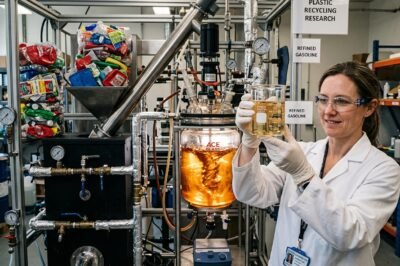
The global plastic crisis has reached a tipping point that demands more than just incremental changes in consumer behavior; it requires a fundamental shift in how we perceive and process synthetic waste. For decades, the narrative surrounding plastic has been one of inescapable permanence, with billions of tons of non-biodegradable material clogging our oceans and landfills. However, a groundbreaking discovery recently highlighted by ScienceDaily suggests that we are on the precipice of a molecular revolution. Researchers have developed an innovative chemical conversion process that effectively turns polyolefin waste—the most common form of plastic—into high-quality gasoline, diesel, and other liquid fuels. This breakthrough does not merely offer a way to dispose of waste; it provides a pathway to transform a global pollutant into a valuable commodity, potentially reshaping the entire energy landscape and the economics of the circular economy. By leveraging advanced catalytic techniques, scientists have found a way to break the stubborn carbon-carbon bonds of polymers, unlocking the energy stored within them in a form that is compatible with our existing transportation infrastructure. This development represents a significant leap forward in the quest for sustainable fuel sources and the mitigation of environmental degradation caused by the petroleum industry.
The Global Plastic Dilemma: A Crisis of Scale and Persistence
To understand the magnitude of this breakthrough, one must first grasp the sheer scale of the plastic problem. Since the mid-20th century, humanity has produced more than 8.3 billion metric tons of plastic. Of that staggering amount, approximately 6.3 billion tons have become waste, and a dismal 9 percent has been recycled. The majority of this waste is comprised of polyolefins, such as polyethylene and polypropylene, which are found in everything from grocery bags and milk jugs to automotive parts and medical devices. These materials are prized for their durability, but that very trait makes them an environmental nightmare, as they can persist in the environment for hundreds, if not thousands, of years.
Current mechanical recycling methods are often inefficient and result in lower-quality plastics, a process known as “downcycling.” Eventually, even these recycled materials reach a state where they can no longer be repurposed and are relegated to landfills. Moreover, the presence of contaminants and the variety of plastic types make traditional sorting and processing both labor-intensive and expensive. The new process addresses these limitations by looking at plastic not as a physical object to be reshaped, but as a chemical feedstock to be deconstructed. By returning the plastic to its molecular components, scientists can create products that are indistinguishable from virgin petroleum-based fuels, effectively closing the loop on the plastic life cycle.
Understanding the Science: From Polymers to Petroleum
The core of this new technology lies in a process called catalytic hydrothermal liquefaction. Unlike traditional pyrolysis, which involves heating plastic to extreme temperatures in the absence of oxygen to create a low-quality oil, this new method utilizes water at subcritical or supercritical states. Under these conditions, water acts as both a solvent and a reactant, facilitating the breakdown of long-chain polymers into shorter-chain hydrocarbons. The addition of specific catalysts—often involving noble metals or specialized zeolites—allows for a more controlled reaction, ensuring that the resulting liquid is high in the specific hydrocarbons needed for gasoline and diesel.
The chemical transformation is a delicate dance of temperature, pressure, and timing. By adjusting these variables, researchers can fine-tune the output of the reaction. For instance, higher temperatures might favor the production of gaseous hydrocarbons, while specific pressures can maximize the yield of liquid fuels. This level of control is revolutionary because it allows for a consistent output even when the input (the plastic waste) is heterogeneous. In a world where plastic waste is often a messy mix of different polymers and residues, the ability to produce a clean, standardized fuel is a game-changer for industrial scalability.
The Role of Catalytic Hydrothermal Liquefaction
One of the most significant advantages of this hydrothermal approach is its ability to handle wet or contaminated waste. Mechanical recycling requires pristine, dry plastic, but the real world is rarely so clean. Plastic pulled from the ocean or recovered from municipal waste is often caked with organic matter or moisture. Because this new process uses water as a primary medium, the need for intensive pre-drying and cleaning is significantly reduced. This not only saves energy but also reduces the overall cost of the recycling operation, making it more competitive with traditional oil extraction.
Efficiency and Yield Comparison
- Mechanical Recycling: Limited to specific types (PET, HDPE), loses quality each cycle, high energy cost for sorting.
- Traditional Pyrolysis: Produces heavy oils requiring extensive refining, high carbon byproduct (char).
- Catalytic Hydrothermal Liquefaction: Converts up to 90% of plastic mass into usable fuel, handles mixed streams, produces refined-grade gasoline.
Furthermore, the energy balance of the process is remarkably favorable. Preliminary studies indicate that the energy contained in the resulting fuel is significantly higher than the energy required to run the conversion process. When combined with the fact that this prevents the extraction of new crude oil, the net environmental benefit becomes clear. We are essentially mining our own waste to fuel our future, creating a carbon-offsetting mechanism that the world desperately needs.
Energy Efficiency and the Carbon Footprint Balance
Critically, the conversion of plastic to fuel must be evaluated through the lens of carbon accounting. Critics often argue that burning plastic-derived fuel still releases CO2 into the atmosphere. While true, this perspective overlooks the broader lifecycle analysis. If we do not convert waste plastic into fuel, we instead extract virgin crude oil from the earth, refine it, and burn it, while the plastic waste continues to pollute the environment or release methane in a landfill. By using plastic as a fuel source, we displace the need for new oil extraction, effectively using the carbon that has already been pulled from the ground once before.
Moreover, the process itself is being designed to be powered by renewable energy sources. Imagine a conversion facility powered by solar or wind energy that takes in plastic pollution and outputs diesel. This would create a near-closed-loop system for the carbon already present in our industrial cycle. Researchers are also investigating ways to capture the small amount of CO2 produced during the conversion process to further minimize the environmental footprint. When compared to the alternative—allowing plastic to degrade into microplastics that enter the food chain—the chemical conversion to fuel is an overwhelmingly superior environmental strategy.
The Road to Commercialization and Global Impact
Despite the scientific success of this process in laboratory settings, the transition to large-scale commercial application faces several hurdles. The primary challenge is the infrastructure required to collect and transport plastic waste to centralized conversion facilities. While the technology is sound, the logistics of waste management remain a bottleneck in many parts of the world. For this process to truly change the world, it must be integrated into existing municipal waste streams and supported by government policies that incentivize chemical recycling over landfilling.
However, the economic incentives are becoming hard to ignore. As the price of crude oil fluctuates and the global demand for energy continues to rise, a steady supply of fuel derived from “free” waste becomes increasingly attractive to investors. Companies are already beginning to explore the construction of pilot plants that can process several tons of plastic per day. If these pilot programs succeed, we could see a new industry emerge—one where waste management companies evolve into energy producers. This shift would provide a powerful financial motive for cleaning up the world’s most polluted regions, as plastic would no longer be seen as trash, but as “blue gold.”
Conclusion: A Future Fueled by Sustainability
The transformation of plastic waste into gasoline and diesel is more than just a clever bit of chemistry; it is a fundamental shift in our relationship with the materials we create. For the first time, we have the technological means to address the legacy of the plastic age by turning our past mistakes into the fuel for our future. While this technology is not a silver bullet that absolves us of the need to reduce plastic consumption, it provides a vital tool for managing the billions of tons of waste already in existence. As we move toward a more sustainable future, the ability to close the carbon loop and extract value from the discarded will be the hallmark of a truly advanced civilization. The research from groups like those featured on ScienceDaily is lighting the way toward an era where the term “waste” becomes obsolete, and the circular economy becomes a tangible, fueled reality.






































Leave a Reply