
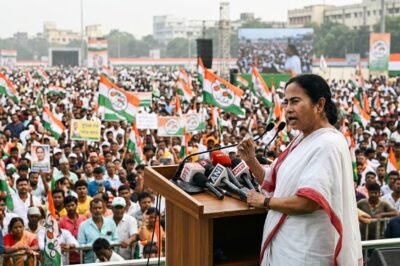
In the high-stakes theater of Indian democracy, the lines between administrative oversight and political maneuvering often blur, creating a friction that resonates far beyond the polling booths. The recent explosive allegations by West Bengal Chief Minister Mamata Banerjee regarding the alleged ‘hijacking’ of the electoral process by Election Commissioners Seema Khanna and Gyanesh Kumar have sent shockwaves through the national political landscape. As the 2024 General Elections progress through their grueling phases, this development marks a significant escalation in the ongoing conflict between the Trinamool Congress (TMC) and the Election Commission of India (ECI). Banerjee, a leader known for her street-fighter instincts and uncompromising stance against central intervention, has centered her critique on the integrity of the constitutional body tasked with ensuring free and fair elections. This situation is not merely a regional spat but a fundamental challenge to the institutional frameworks that uphold the world’s largest democracy. The rhetoric used—terms like ‘hijacked’ and ‘biased’—suggests a profound breakdown in trust, necessitating a detailed analysis of the underlying causes, the legal ramifications, and the potential impact on the democratic fabric of India.
The Core of the Controversy: Detailed Breakdown of Allegations
The crux of Mamata Banerjee’s grievance lies in the perceived partiality of the newly appointed Election Commissioners, Seema Khanna and Gyanesh Kumar. During a series of high-decibel rallies, the Chief Minister explicitly named these officials, accusing them of operating under the direct influence of the ruling Bharatiya Janata Party (BJP). Her narrative suggests that the administrative decisions made by the ECI, ranging from the scheduling of election phases to the deployment of central paramilitary forces, are designed to disadvantage the TMC and provide an unfair edge to its primary rival. The term ‘hijacking’ in this context refers to a systematic appropriation of the electoral machinery, where institutional processes are allegedly repurposed as political tools. This is a heavy accusation that challenges the very neutrality of the ECI, an institution that has historically been lauded for its independence.
Furthermore, Banerjee’s allegations extend to the specific conduct of the commissioners in handling complaints from the West Bengal government. She asserts that while the ECI is quick to take action against TMC leaders or state officials, it remains selectively silent or lethargic when dealing with alleged violations by the BJP. This perceived double standard is at the heart of the ‘hijacking’ claim. The Chief Minister argues that by controlling the flow of information and the enforcement of the Model Code of Conduct (MCC), the commissioners are effectively steering the election towards a predetermined outcome. Such claims are unprecedented in their directness and targeting of individual officials, signaling a new era of institutional confrontation in Indian politics.
Historical Context: West Bengal and the Election Commission
To understand the intensity of the current standoff, one must look at the long and often turbulent relationship between the state of West Bengal and the Election Commission of India. For decades, elections in West Bengal have been marred by reports of political violence, booth capturing, and allegations of state-sponsored intimidation. Consequently, the ECI has traditionally adopted a more interventionist approach in the state compared to others. This includes the deployment of massive numbers of Central Armed Police Forces (CAPF) and the staggering of elections into numerous phases. While the ECI views these measures as necessary for voter safety, Mamata Banerjee and the TMC view them as an affront to state sovereignty and a tactic to facilitate the movement of central BJP leadership across the state.
In previous election cycles, specifically in 2019 and 2021, the TMC had expressed similar concerns, though perhaps not with the current level of personal targeting against individual commissioners. The state has often been a laboratory for electoral innovation and administrative oversight, which frequently clashes with the local political culture. The current allegations against Seema Khanna and Gyanesh Kumar are therefore the latest chapter in a long-standing saga of mutual suspicion. The TMC believes that the ECI’s administrative rigor is specifically calibrated to curb their grassroots mobilization, whereas the ECI maintains its mandate is to ensure every voter can cast their ballot without fear. This fundamental disagreement on the ECI’s role creates a permanent state of tension during election seasons.
The Legal and Constitutional Framework of ECI Appointments
A significant portion of the current friction stems from the recent changes in the appointment process of Election Commissioners. Following the Supreme Court’s landmark judgment in 2023, which sought to create a more independent selection committee, the Union Government enacted the Chief Election Commissioner and other Election Commissioners (Appointment, Conditions of Service and Term of Office) Act, 2023. This new law replaced the Chief Justice of India in the selection panel with a Union Cabinet Minister, thereby giving the executive a significant majority in the appointment process. This change has been a major point of contention for opposition parties, including the TMC, who argue that it compromises the independence of the ECI from its very inception.
When Seema Khanna and Gyanesh Kumar were appointed under this new framework, it immediately invited scrutiny. Mamata Banerjee’s allegations of ‘hijacking’ are inextricably linked to this legislative shift. From her perspective, an ECI appointed through a process dominated by the central government cannot be expected to act neutrally when that same government is a contestant in the elections. The legal arguments here are complex; while the government maintains its right to legislate the appointment process as per the Constitution, the opposition views it as an erosion of checks and balances. This constitutional debate forms the backdrop against which the current accusations are being hurled, providing a legalistic veneer to what is essentially a fierce political battle.
Impact on Institutional Integrity and Public Perception
The repeated and direct targeting of Election Commissioners by a sitting Chief Minister has profound implications for the institutional integrity of the ECI. When a high-ranking official labels the electoral process as ‘hijacked,’ it sows seeds of doubt among the electorate. The credibility of the ECI rests on public trust; if voters begin to believe that the referees of the democratic contest are biased, the legitimacy of the entire democratic exercise is called into question. Statistics from various perception surveys have shown that while the ECI remains one of India’s most trusted institutions, that trust is not immune to the corrosive effects of constant political delegitimization. This trend of attacking the umpire, rather than just the opponent, marks a dangerous shift in political discourse.
Moreover, these allegations create an environment of extreme pressure for the administrative staff and security personnel on the ground. When the leadership of a state is in open conflict with the national election authority, it complicates the coordination required for peaceful polling. The personnel involved in election duties find themselves caught between their constitutional obligations and the local political pressures. This tension can lead to administrative paralysis or, conversely, over-correction by officials eager to prove their neutrality, both of which are detrimental to the smooth conduct of elections. The long-term impact could be a demoralized bureaucracy that is hesitant to take firm decisions for fear of political retribution or public shaming.
The Broader Political Strategy of the I.N.D.I.A. Bloc
Mamata Banerjee’s stance is not isolated but resonates with the broader strategy of the I.N.D.I.A. opposition bloc. Several other regional and national leaders have voiced similar concerns regarding the ECI’s functioning, alleging that the commission has been ‘tamed’ or ‘pressured’ by the central government. By making these explosive allegations, Banerjee is effectively positioning the TMC as the vanguard of the opposition’s fight for democratic fairness. This strategy serves two purposes: first, it prepares a narrative to explain potential electoral setbacks as the result of a rigged system; and second, it mobilizes the party’s base by painting the TMC as a victim of a powerful, unfair central apparatus.
The coordination among opposition parties on this issue suggests a concerted effort to put the ECI on the defensive. They have collectively raised issues such as the transparency of Electronic Voting Machines (EVMs), the integrity of VVPAT audits, and the handling of hate speech complaints against top leaders. However, Banerjee’s specific targeting of Seema Khanna and Gyanesh Kumar takes this a step further by personalizing the grievance. This escalation forces the ECI to either respond formally, which could be interpreted as entering the political fray, or remain silent, which could be seen as an admission of guilt by the public. This strategic dilemma is precisely what the opposition intends to exploit as the election reaches its climax.
Conclusion: Future Implications for Indian Democracy
The allegations of ‘hijacking’ the election process by Mamata Banerjee against Seema Khanna and Gyanesh Kumar represent more than just campaign rhetoric; they are a symptom of a deeper crisis in institutional trust. As the 2024 elections conclude, the primary task for the next government and the judiciary will be to restore the perceived neutrality of the Election Commission. Whether through further legislative amendments or a more transparent operational style by the ECI itself, the goal must be to insulate the commission from the vagaries of partisan politics. If these allegations continue to go unaddressed or if the appointment process remains a point of bitter contention, the very foundation of Indian democracy—the peaceful transfer of power based on undisputed results—could be at risk.
In the coming months, we may see more legal challenges in the Supreme Court regarding the ECI’s functioning and the conduct of the current commissioners. The court’s role as the ultimate arbiter will be crucial in determining the boundaries of political criticism and the standards for institutional independence. Ultimately, for a democracy as diverse and complex as India, the fairness of the election process must not only be a reality but also a visible and undeniable fact for all participants. The ‘hijacking’ narrative serves as a stark warning that the health of our democratic institutions requires constant vigilance and a commitment to transparency that transcends the immediate gains of any political party.




































Leave a Reply