
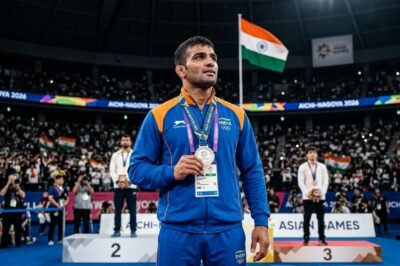
The atmosphere inside the Aichi-Nagoya gymnasium was thick with the scent of mats and the palpable tension of a nation standing on the precipice of history. As Nitesh Siwach stepped onto the circle for the 67kg Greco-Roman final, the weight of a sixty-four-year-old drought hung heavy in the air. Not since the 1962 Jakarta Games has an Indian wrestler climbed the top step of the podium in the Greco-Roman discipline, a style that emphasizes upper-body strength and forbids holds below the waist. The crowd, a mix of local Japanese enthusiasts and a vocal contingent of Indian supporters, watched with bated breath as Siwach engaged in a tactical battle of attrition against his formidable opponent from Kazakhstan. For six grueling minutes, the Indian grappler showcased remarkable resilience, defying the odds and the traditional dominance of Central Asian powerhouses. However, as the final whistle echoed through the arena, the scoreboard reflected a narrow margin that left India with a silver medal—a result that is both a cause for celebration and a poignant reminder of the work that remains to be done. The silver lining is bright, but the golden sun remains obscured for Indian Greco-Roman wrestling.
The Final Stand: A Tactical Chess Match on the Mat
The gold medal bout was nothing short of a technical masterclass, albeit one that favored the defensive solidity of the Kazakh opponent. From the opening whistle, Nitesh Siwach attempted to establish a dominant underhook, looking to push the pace and force a passivity warning against his rival. In Greco-Roman wrestling, the par terre position is often the deciding factor, and Siwach knew that he needed to score early to avoid being put on the defensive. The first period saw a flurry of hand-fighting, with both wrestlers jockeying for position near the edge of the mat. Despite Siwach’s aggressive posturing, the referees were hesitant to award points, leading to a 1-0 lead for the Kazakh wrestler due to a passivity call against the Indian in the final minute of the first half.
The second period intensified as Siwach realized the clock was his greatest enemy. He increased his intensity, successfully executing a snap-down that nearly put his opponent on the defensive. However, the Kazakh’s balance was impeccable, a testament to the rigorous training regimens typical of the former Soviet republics. Every time Siwach seemed to find an opening, a swift counter-movement neutralized the threat. The Indian coaching staff, led by international consultants brought in to bridge the technical gap, gestured wildly from the sidelines, urging Siwach to take more risks. In the final thirty seconds, Siwach went for a desperate throw, a high-amplitude move that could have secured the gold. It was a gamble that ultimately resulted in a counter-exposure, ending the match at 4-1 in favor of Kazakhstan. While the silver is a massive achievement, the tactical nuances of the final minutes will be studied for years to come.
Historical Context: The Long Road Since 1962
To understand the significance of Nitesh Siwach’s silver, one must look back at the history of the sport in India. While freestyle wrestling has seen a renaissance in the country—thanks to icons like Sushil Kumar, Yogeshwar Dutt, and Bajrang Punia—Greco-Roman has largely remained in the shadows. The last time India tasted gold in this specific style was at the 1962 Asian Games, where Ganpat Andalkar and Malwa clinched titles. Since then, the discipline has struggled for funding, visibility, and talent. For decades, the best Indian wrestlers gravitated toward freestyle, lured by the greater likelihood of Olympic success and professional opportunities in domestic leagues. Greco-Roman was often seen as an afterthought, a category filled by those who couldn’t make the cut in the freestyle squads.
However, the tide has slowly begun to turn. Over the last two Olympic cycles, the Wrestling Federation of India (WFI) has made a conscious effort to revitalize the Greco-Roman program. Specialized camps in Europe and the hiring of coaches from the Balkan region have started to pay dividends. Siwach’s silver in 2026 is the culmination of nearly a decade of targeted investment. It surpasses the bronze medals won in recent editions and signals that India is no longer just a participant but a genuine contender in the Greco-Roman arena. Yet, the gap between silver and gold remains the hardest to bridge, requiring not just physical strength but a cultural shift in how the sport is taught at the grassroots level in India’s traditional akharas.
Technical Breakdown: The Par Terre Deficiency
Wrestling analysts point to one specific area where India consistently falls short compared to the global elite: the par terre, or ground wrestling, phase. In Greco-Roman, when a wrestler is penalized for passivity, they are forced to lie flat on the mat while their opponent is given a chance to execute a lift or a gut-wrench. It is in these moments that gold medals are won and lost. In the 2026 final, Siwach was unable to turn his opponent during his one opportunity in the top position. Conversely, when Siwach was on the bottom, he showed incredible grit to avoid being lifted, but the energy expended in defense left him drained for the standing phase of the match.
Improving the par terre technique requires a level of core strength and specialized flexibility that is different from freestyle requirements. Indian wrestlers have historically relied on their stamina and leg-based defense, which are useless in Greco-Roman. To reach the next level, Siwach and his peers must spend more time training with partners from Iran and Russia, who are the undisputed masters of the gut-wrench and the suplex. The technical disparity is narrowing, but as the 2026 final showed, the elite wrestlers of the continent still possess a level of technical finesse on the mat that allows them to defend a lead with surgical precision.
Nitesh Siwach: The Profile of a Champion in the Making
Despite the heartbreak of the final, Nitesh Siwach has emerged as the new face of Indian wrestling. Hailing from a small village in Haryana, Siwach’s journey to the Asian Games podium is a story of immense sacrifice. He transitioned to Greco-Roman early in his career, a move that was criticized by many who believed he should stick to freestyle. His decision was fueled by a desire to bring glory to a neglected discipline. Siwach is known for his incredible work ethic, often training three sessions a day and spending hours analyzing video footage of his opponents. His performance in the earlier rounds of the 2026 Games was a testament to his evolution; he defeated a former world champion from Iran in the semi-finals, a feat that sent shockwaves through the wrestling community.
Siwach’s strength lies in his upper-body clinches and his ability to maintain a high pace throughout the match. He does not tire easily, a trait that allowed him to outlast his opponents in the preliminary rounds. However, the final revealed that at the very highest level, work rate alone is not enough. You need the technical guile to manufacture points out of nothing. Siwach is still young, and his silver medal should be viewed as a stepping stone rather than a ceiling. With the right support and continued exposure to international competition, he has the potential to be the one who finally breaks the gold medal jinx at the 2030 Games or even the upcoming Olympics.
The Road Ahead: Implications for Los Angeles 2028
The performance of the Indian Greco-Roman contingent in Aichi-Nagoya has significant implications for the Los Angeles 2028 Olympic cycle. For the first time, there is a legitimate belief that India can qualify multiple Greco-Roman wrestlers for the Olympics. Siwach’s silver will likely result in increased funding from the Ministry of Youth Affairs and Sports under the Target Olympic Podium Scheme (TOPS). This means better access to sports science, mental conditioning coaches, and high-performance training centers in Europe. The goal is no longer just to win at the Asian level but to challenge for medals on the global stage.
Furthermore, this result will likely inspire a new generation of wrestlers to take up Greco-Roman. When young athletes see a contemporary like Siwach standing on the podium, it validates the discipline as a viable path to fame and success. The WFI must capitalize on this momentum by organizing more Greco-Roman specific tournaments at the junior and sub-junior levels. The path to a Greco-Roman gold is now clearly mapped out; it requires a combination of traditional Indian grit and modern international technique. Siwach has shown that the distance to the top is shorter than ever before.
Conclusion: A Silver That Values More Than Gold
In the grand tapestry of Indian sports, a silver medal at the Asian Games is a prestigious achievement, but for Nitesh Siwach, it will always be the one that got away. Yet, in his defeat, he has provided a blueprint for the future. The drought for a Greco-Roman gold continues, but it no longer feels like an impossible dream. Siwach has bridged the gap between being a participant and being a finalist. His journey from the akharas of Haryana to the podium in Japan is a testament to the changing landscape of Indian wrestling. As the Indian contingent leaves Nagoya, they do so with the knowledge that they are close. The wait for a champion continues, but with Nitesh Siwach leading the charge, the golden era of Indian Greco-Roman wrestling might finally be within reach. The lessons learned in the heat of the 2026 finals will be the foundation upon which future champions are built, ensuring that the next time an Indian stands in the final, the anthem that plays will be the Jana Gana Mana.





































Leave a Reply