
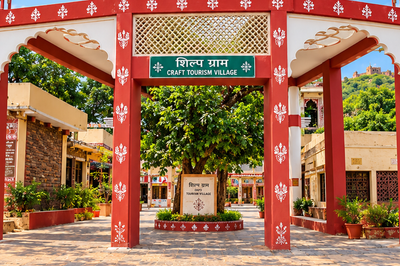
JAIPUR: Rajasthan’s rich craft traditions have long been an integral part of the state’s cultural identity and tourism economy. From textiles and traditional decorative arts to jewellery, woodcraft and other indigenous practices, the state’s artisans contribute significantly to India’s creative economy. In this landscape, Kunda in Amer, Jaipur, has the potential to emerge as a significant craft-tourism destination. But for that potential to be realised, the focus now needs to move beyond infrastructure creation towards professional management, tourism activation, market development and sustainable business generation.
The Office of the Development Commissioner (Handicrafts), Ministry of Textiles, Government of India, has introduced the concept of Craft Villages to create a meaningful convergence between handicrafts, tourism and sustainable livelihoods. A Craft Village is envisioned not simply as a marketplace, but as a living destination where artisans can produce, demonstrate, display and sell their traditional crafts. Visitors, in turn, get an opportunity to experience craftsmanship at close quarters, interact with artisans, understand traditional techniques and purchase authentic products directly from their creators.
Kunda: A Significant Public Investment
Recognising Rajasthan’s enormous handicraft and tourism potential, the Government of India sanctioned a Craft Tourism Village at Kunda, Amer, Jaipur, under the Office of the Development Commissioner (Handicrafts). Sanctioned during 2020–21, the project has a total estimated cost of approximately ₹5.37 crore, comprising a Government of India share of around ₹4.12 crore and an implementing-agency share of approximately ₹1.25 crore. The project has been implemented by the Jaipur Development Authority and presently covers around 40 houses. The infrastructure created under the initiative is intended to support artisan livelihoods through facilities such as artisan houses and worksheds, roads, water supply, sewerage, street lighting, footpaths, shops and display areas. Such infrastructure provides the physical foundation for a craft-tourism ecosystem. But infrastructure, by itself, cannot guarantee a successful destination. The larger question is: How can Kunda be transformed from an infrastructure project into a commercially vibrant craft-tourism destination?
From Buildings to a Living Craft Destination
Kunda has several inherent advantages. Visitors can potentially witness artisans working in real time, participate in workshops, interact with craftspeople, understand traditional techniques and purchase products directly from the source. This direct interaction can create a more meaningful tourism experience while improving artisan earnings and reducing dependence on intermediaries. The village could become a destination where craft is not merely displayed but experienced. However, this requires continuous programming and professional destination management. A Craft Tourism Village that remains open without regular events, visitors, marketing and commercial activity risks becoming an underutilised public asset. The next phase of Kunda should therefore focus on creating a comprehensive Craft Tourism Business and Operational Plan.
Jaipur Provides a Ready-Made Tourism Market
One of Kunda’s greatest advantages is its location. Jaipur is already among India’s most important tourism destinations, attracting large numbers of domestic and international visitors. The city’s established heritage tourism circuit provides an enormous potential audience for a professionally positioned craft village. Instead of attempting to create an entirely independent tourism market, Kunda could be strategically integrated into Jaipur’s existing tourism ecosystem. Hotels, tour operators, travel agencies, heritage properties, museums, cultural institutions and local tourism stakeholders could become important partners in directing visitors towards the village. A structured tourism route could potentially position Kunda alongside other established attractions in and around Jaipur and Amer. The objective should be to make “Kunda Craft Tourism Village” a recognisable destination brand rather than allowing it to remain simply a government-created infrastructure facility.
A Calendar of Events Can Create Destination Value
One of the most effective ways to keep a craft destination active is through a consistent annual calendar.
Kunda could develop a programme featuring:
- Annual craft festivals
- Weekend artisan demonstrations
- Live craft workshops
- Curated exhibitions
- Cultural performances
- School and college visits
- Design showcases
- Seasonal craft bazaars
- Buyer-seller meets
- International buyer programmes
- Artisan interaction sessions
- Craft documentation and storytelling programmes
A flagship annual event could eventually become a permanent fixture on Jaipur’s tourism calendar.
Such programming would create recurring reasons for tourists, students, designers, buyers and cultural enthusiasts to visit the village.
Digital Storytelling Can Take Kunda Beyond Jaipur
Tourism today is increasingly influenced by digital discovery. Kunda therefore needs a strong digital identity. A dedicated website and professional social-media presence could showcase artisans, products, craft processes, stories and upcoming events. High-quality photography, short films, documentaries, reels and interactive content could present each craft not merely as a product but as a story of heritage, community and craftsmanship. Collaborations with travel creators, influencers, photographers, bloggers and documentary filmmakers could further introduce Kunda to national and international audiences.
The digital strategy should also connect the physical destination with online commerce. QR-enabled product information, digital payments, online catalogues and e-commerce linkages can allow visitors to continue purchasing from artisans even after leaving Jaipur. Platforms such as IndiaHandmade, along with other appropriate digital marketplaces, could provide additional market opportunities.
Connecting Artisans to Global Markets
Kunda’s potential extends beyond tourism. Jaipur already has a strong commercial ecosystem in gems and jewellery, textiles and handicrafts, with established networks of manufacturers, exporters, traders, designers and international buyers. This ecosystem can be strategically connected with the Craft Tourism Village.
The village could host:
- International buyer programmes
- Exporter-artisan interaction sessions
- B2B exhibitions
- Design development programmes
- Product showcases
- Buyer-seller meets
- E-commerce onboarding programmes
- Packaging and branding workshops
- Quality improvement initiatives
Such interventions can help artisans move beyond local retail markets and access wider domestic and international opportunities.
From Traditional Craft to Sustainable Enterprise
A successful Craft Tourism Village should not only preserve traditional skills; it should also help artisans build sustainable enterprises. Kunda could become a centre for skill development, design innovation, product diversification, branding, packaging, quality improvement and entrepreneurship. Designers, design institutions, management experts, exporters and industry partners could work with artisans to develop products that retain their cultural identity while responding to contemporary consumer preferences. The objective should not be to commercialise crafts at the cost of authenticity. Instead, innovation should be used to make traditional craftsmanship economically viable for the next generation.
Rajasthan’s Large Artisan Ecosystem
The scale of opportunity becomes clearer when viewed against Rajasthan’s wider artisan ecosystem. More than 1.85 lakh artisans are enrolled under PEHCHAN initiatives of the Office of the Development Commissioner (Handicrafts), reflecting the significant artisan base across the state. Jaipur, meanwhile, functions as a major commercial and export centre with strong linkages to handicrafts, textiles and gems and jewellery. The city and its surrounding regions therefore provide Kunda with access to an ecosystem that already includes artisans, manufacturers, exporters, retailers, designers, tourism businesses and buyers. The challenge is to connect these existing strengths through a structured model.
From Infrastructure Creation to Business Creation
The central issue is not whether Kunda has infrastructure. The more important question is whether that infrastructure can be continuously activated and converted into economic opportunities for artisans. A dedicated management mechanism could be considered for the village, supported by clearly defined annual targets.
These could include:
- Visitor targets
- Artisan participation targets
- Sales and revenue targets
- Number of events conducted
- Buyer-seller programmes
- Digital reach and engagement
- Number of products developed
- E-commerce onboarding
- Hotel and tour-operator partnerships
- Domestic and international buyer linkages
Such measurable indicators would help assess whether the facility is delivering the economic and social outcomes for which it was established.
Jaipur’s Export Ecosystem Offers Another Opportunity
Kunda can also benefit from Jaipur’s wider commercial and export ecosystem. Jaipur has emerged as a major economic centre of Rajasthan, with significant activity in gems and jewellery, textiles, handicrafts and other sectors. The city is supported by a large base of MSMEs and established networks connecting local producers with national and international markets. At the wider state level, Rajasthan’s export economy also provides a substantial platform for integrating traditional crafts into global trade. Kunda could therefore function as a bridge between artisan production, tourism and the export market. Instead of limiting the village’s role to tourist retail, it could become a sourcing and discovery platform where buyers, designers, exporters and international visitors identify products and artisans for larger market opportunities.
The Risk of Underutilised Infrastructure
Public investment in cultural and artisan infrastructure creates long-term value only when the facilities are continuously utilised. If infrastructure remains underutilised for extended periods, there is a risk of deterioration, loss of commercial relevance and, potentially, the space becoming an unproductive public asset. This makes timely activation particularly important. The issue is not unique to Kunda. Across the country, several craft-related facilities have been created with the objective of supporting artisans and promoting tourism. The next policy challenge is to ensure that these assets remain active, productive and financially sustainable.
The Office of the Development Commissioner (Handicrafts) could consider undertaking a comprehensive review of existing craft-related infrastructure and preparing location-specific business and operational plans. Each facility could be evaluated based on its tourism potential, artisan base, location, market access, infrastructure, visitor potential and commercial opportunities.
Making Every Infrastructure Asset Work for the Artisan
The future of Kunda should ultimately be measured not by the number of buildings constructed, but by the number of artisans whose livelihoods are strengthened.
A successful Craft Tourism Village should generate a virtuous cycle:
Tourists visit → artisans demonstrate → visitors engage → products are purchased → artisans earn → crafts gain visibility → buyers discover products → markets expand → new opportunities emerge.
With professional management, continuous programming, strategic tourism partnerships, digital promotion and strong market linkages, Kunda can potentially become much more than a collection of artisan houses and shops.
It can become a living laboratory of Rajasthan’s craftsmanship—a place where heritage is preserved through economic opportunity rather than merely through documentation.
A Vision for Kunda
“Kunda Craft Tourism Village — Where Heritage Meets Livelihood, Craft Meets Tourism, and Rajasthan’s Artisans Connect with the World.” The next chapter of Kunda should therefore be about moving from infrastructure creation to business creation. The priority should not only be to build craft infrastructure, but to ensure that every asset is continuously utilised, every artisan has an opportunity to earn, every visitor has a reason to return, and every traditional craft has a pathway to the wider market. The ultimate measure of success should be simple: make every infrastructure asset work for the artisan.




































Leave a Reply