
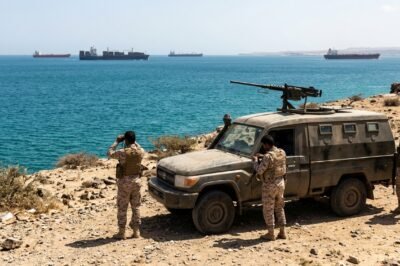
The recent reclamation of Dhubab by Yemeni pro-government forces represents more than just a tactical victory on the battlefield; it is a profound shift in the architectural security of one of the world’s most critical maritime chokepoints. Nestled near the Bab al-Mandeb strait—aptly named the ‘Gate of Tears’—this coastal district has long been a flashpoint in the devastating conflict that has gripped Yemen for years. As Al Jazeera and other major international outlets report, the sudden and decisive push by government troops, backed by regional allies, has successfully dislodged Houthi rebels from positions they had fortified to exert pressure on global shipping lanes. This development comes at a time when the international community is hyper-focused on the safety of Red Sea transit, making the liberation of Dhubab a headline of global economic and political significance. For the Yemeni government, it is a morale-boosting triumph that demonstrates a renewed capacity for coordinated offensive operations, while for the Houthis, it represents a stinging loss of leverage over the maritime traffic that fuels the global economy. This analysis dives deep into the military maneuvers, the regional power dynamics, and the long-term implications of this strategic recapture, which serves as a pivot point in the ongoing civil war.
The Strategic Weight of the Bab al-Mandeb Strait
To understand the importance of Dhubab, one must first look at its proximity to the Bab al-Mandeb strait. This narrow waterway, situated between the Arabian Peninsula and the Horn of Africa, is the southern gateway to the Red Sea and, consequently, the Suez Canal. It is estimated that nearly 10 percent of global seaborne-traded petroleum and roughly 12 to 15 percent of global trade passes through this corridor annually. Control over the coastal districts like Dhubab effectively means control over the safety and security of these massive commercial interests. By reclaiming this territory, the Yemeni government forces have effectively pushed back the Houthi presence from a location that allowed them to deploy land-to-sea missiles and launch drone attacks against merchant vessels.
Furthermore, the geographic terrain of Dhubab is uniquely suited for military oversight. The surrounding hills and coastal ridges provide an unobstructed view of the shipping lanes. For years, the Houthis utilized these heights to monitor naval movements and coordinate their maritime operations. The loss of these vantage points significantly hampers their ability to disrupt international shipping without relying on more distant and less accurate launch sites. This strategic denial is a key objective for the Saudi-led coalition, which has prioritized the security of the Red Sea as a matter of both regional and international security policy. The restoration of government control here serves as a buffer zone, protecting the flow of oil from the Gulf to European and American markets.
Military Mechanics of the Offensive
The operation to retake Dhubab was a multi-pronged assault that combined land-based maneuvers with significant logistical support from the Saudi-led coalition. Reports indicate that Yemeni national army units, alongside local resistance fighters, launched a coordinated strike from multiple directions, catching the Houthi defenders off guard. The Houthis had spent months fortifying the area with extensive minefields and improvised explosive devices (IEDs), making the advance both slow and dangerous. However, the use of advanced demining equipment and air cover provided the necessary momentum for the pro-government forces to break through the initial lines of defense.
The offensive was characterized by a high degree of coordination between infantry, light armor, and reconnaissance units. According to military sources, the breakthrough occurred after a series of targeted strikes on Houthi command and control centers within the district. By disrupting the rebels’ communication lines, the Yemeni forces were able to isolate Houthi units into small pockets, making them easier to neutralize or force into retreat. The speed of the final collapse of Houthi positions in Dhubab suggests a possible degradation in their supply lines or a strategic decision to withdraw to more defensible positions further inland. Regardless, the battlefield success underscores a growing efficiency within the Yemeni army’s southern commands, which have benefited from years of training and equipment upgrades provided by regional partners.
Geopolitical Ripples and Coalition Dynamics
The liberation of Dhubab is not merely a domestic Yemeni affair; it is a significant event in the broader geopolitical struggle between regional powers. For the Saudi-led coalition, this victory validates their long-term commitment to restoring the internationally recognized government. It also sends a clear message to Iran, which is frequently accused of providing the Houthis with the advanced missile and drone technology used to threaten maritime traffic. By securing the Bab al-Mandeb, the coalition is effectively shrinking the operational footprint of Iranian-aligned forces in a region that is vital to Western interests. This success may lead to increased diplomatic pressure on the Houthis to return to the negotiating table from a position of relative weakness.
Moreover, the success in Dhubab highlights the role of the Southern Transitional Council (STC) and other local factions that have been instrumental in the fight against the Houthis. While internal friction has occasionally plagued the anti-Houthi alliance, the coordinated effort in this coastal offensive suggests a renewed sense of purpose and unity. This internal cohesion is vital for any long-term stability in Yemen. If the various factions can maintain this level of cooperation, it could pave the way for further gains in the northern provinces. However, the international community remains cautious, as the history of the Yemeni conflict is filled with temporary gains that are later reversed by counter-offensives or political fracturing within the coalition.
Economic Safeguards and Global Shipping Security
From an economic perspective, the security of the Bab al-Mandeb is a non-negotiable priority for the global market. The recent spike in insurance premiums for ships traversing the Red Sea has been a direct result of Houthi aggression in the area. By moving the front lines further away from the coast, the Yemeni government forces are helping to lower the risk profile of the region. This could eventually lead to a stabilization of shipping costs and a more predictable flow of goods. Global trade organizations have been watching the developments in Dhubab with keen interest, as any disruption in this corridor has a ripple effect on everything from gas prices in Europe to the availability of consumer electronics in North America.
Furthermore, the reclamation of the port facilities in and around Dhubab provides an opportunity for the Yemeni government to increase its own economic footprint. While these ports are currently geared toward military and humanitarian use, their potential for commercial development in a post-conflict scenario is immense. Restoring the rule of law and official customs procedures in these coastal areas is a critical step toward rebuilding Yemen’s shattered economy. The ability to collect maritime revenues and manage port logistics would provide the government with much-needed capital to fund public services and reconstruction efforts in liberated territories, creating a positive feedback loop of stability and growth.
Humanitarian Dimension and Local Governance
Amidst the military and strategic calculations, the humanitarian impact on the residents of Dhubab cannot be overlooked. The district has suffered immensely under years of conflict, with critical infrastructure destroyed and much of the population displaced. The retreat of Houthi forces and the entry of government troops bring both hope and significant challenges. The immediate priority is the clearance of landmines, which remain a lethal threat to returning civilians. Humanitarian organizations are now calling for rapid intervention to restore water, electricity, and healthcare services to the area. The success of the reclamation will be judged not just by military control, but by the government’s ability to provide a





































Leave a Reply