
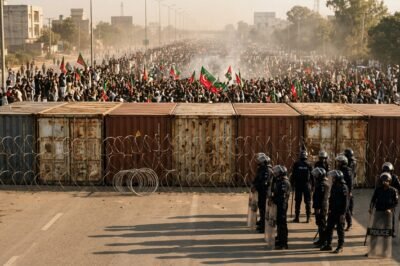
The air in Islamabad is thick with more than just the winter smog; it is heavy with the palpable tension of a nation at a crossroads. As thousands of supporters of the incarcerated former Prime Minister Imran Khan begin their defiant march toward the capital, the city has transformed into a literal fortress. This is not merely a political demonstration; it is a high-stakes gamble for the soul of Pakistan’s democratic framework. The “Final Call” issued by Khan from behind the bars of Adiala Jail has resonated through the valleys of Khyber Pakhtunkhwa and the heartlands of Punjab, drawing a diverse demographic of students, laborers, and veteran activists. Faced with shipping containers blocking every major artery and a complete suspension of mobile internet services, the marchers represent a significant challenge to the current coalition government led by Shehbaz Sharif. This analysis delves into the intricate layers of this mobilization, exploring why this specific protest might be the most critical turning point in Pakistan’s recent political history, and how the state’s draconian response could either stabilize or shatter the fragile status quo. The convergence of thousands of protesters towards the capital highlights the deep-seated polarization that has defined the country’s political landscape since Khan’s ousting in 2022.
The Genesis of the ‘Final Call’ and the Struggle for Political Survival
The current march is the culmination of months of simmering resentment within the Pakistan Tehreek-e-Insaf (PTI). Since the general elections in February 2024, which were marred by widespread allegations of rigging and the suspension of mobile services, the PTI has maintained that their mandate was stolen. Imran Khan, despite being behind bars on various charges ranging from corruption to leaking state secrets, continues to exert a massive influence over his followers. His call for a final, decisive march on Islamabad is seen as a strategic move to force the government into negotiations regarding the release of political prisoners and the reversal of the 26th Constitutional Amendment, which the opposition views as a blow to judicial independence.
For the PTI leadership, this mobilization is about more than just street power; it is about proving that they remain the most dominant political force in the country despite a systematic crackdown on their cadres. The party has successfully used social media and localized rallies to keep the momentum alive, creating a sense of urgency among its supporters. This “Final Call” is designed to disrupt the capital’s functioning to a point where the military and the civilian government must acknowledge the PTI’s demands. The sheer persistence of the protesters, many of whom have traveled hundreds of kilometers under the threat of arrest, underscores the deep loyalty Khan commands among a significant segment of the population.
Islamabad Under Siege: The State’s Multi-Layered Security Strategy
In response to the march, the government of Pakistan has implemented what many observers describe as an unprecedented security lockdown. Islamabad, a city known for its wide avenues and organized layout, has been carved into zones by massive steel shipping containers. These barriers are not only placed at the entry points of the city but also around vital government buildings in the Red Zone, such as the Parliament House, the Supreme Court, and the Prime Minister’s Secretariat. The deployment of the Frontier Corps and the Pakistan Rangers alongside the capital police signifies the state’s readiness to use force to prevent the protesters from reaching the city center.
Furthermore, the invocation of Section 144, which prohibits gatherings of five or more people, provides a legal cover for the mass arrests that have already begun. Over 4,000 PTI workers have reportedly been detained in various raids across Punjab and Islamabad. The digital landscape has also been targeted; mobile internet and data services have been throttled in several regions to disrupt the coordination of the marchers. This multi-pronged approach aims to dampen the enthusiasm of the protesters and prevent the formation of a critical mass that could overwhelm the security forces. However, these measures have also paralyzed the daily lives of millions of residents, leading to a sense of siege within the capital itself.
The Resilience of the PTI Grassroots and the Role of Youth
What makes this march particularly significant is the demographic profile of the participants. Unlike traditional political rallies dominated by local landlords and their dependents, the PTI’s strength lies in the urban middle class and the youth. Pakistan has one of the largest youth populations in the world, and this segment has been hit hardest by the country’s economic woes, including record-high inflation and unemployment. To these young supporters, Imran Khan represents a departure from the dynastic politics of the Sharif and Bhutto families. They see the march as a fight for their future and a reclamation of their democratic rights.
The role of women and families in this protest cannot be overstated. PTI has successfully curated an image of being a family-friendly political movement, which has encouraged women to participate in large numbers despite the risk of tear gas and baton charges. This wide-based participation makes it difficult for the state to use excessive force without risking a major public relations disaster. The marchers have shown remarkable ingenuity, using heavy machinery to move containers and establishing makeshift logistics chains to provide food and water to those on the front lines. This grassroots resilience is a testament to the organizational depth that PTI has developed over the last decade.
Economic Costs and the Shadow of the IMF Deal
While the political drama unfolds on the streets, the economic implications of the lockdown are severe. Pakistan is currently navigating a fragile recovery under a $7 billion IMF bailout package. Such programs require political stability and a functioning administrative environment to meet stringent reform targets. The closure of major trade routes, the suspension of business activities in the capital, and the general atmosphere of uncertainty are detrimental to investor confidence. Every day of lockdown in Islamabad and the surrounding areas results in losses worth billions of rupees, impacting both small-scale retailers and large industrial sectors.
The government argues that the PTI’s protests are a deliberate attempt to sabotage the country’s economic progress and international standing. Officials have pointed out that major foreign delegations and diplomatic events are often scheduled during these periods, suggesting a tactical timing by the opposition to maximize global visibility at the cost of national interest. On the other hand, the PTI contends that economic stability is impossible without political legitimacy, which they believe is missing under the current administration. This economic-political nexus creates a vicious cycle where instability breeds economic hardship, which in turn fuels further political unrest.
Legal and Constitutional Crossroads: The Role of the Judiciary
The judiciary finds itself in a precarious position as it adjudicates various petitions related to the protest. The Islamabad High Court (IHC) has issued directives to ensure that the fundamental rights of citizens are not violated while also maintaining law and order. However, the enforcement of these directives is often uneven. The PTI has consistently challenged the legality of Section 144 and the mass arrests in court, seeking relief for their leaders and workers. The judicial response to these petitions is being closely watched as an indicator of the balance of power between the executive and the judiciary.
The controversy surrounding the 26th Constitutional Amendment has further complicated the legal landscape. The amendment, which grants the government more power in the appointment of judges, is seen by the opposition as an attempt to pack the courts with friendly faces. This march, therefore, is also a protest against what the PTI describes as the ‘executive’s overreach’ into the judicial domain. The outcome of the march and the government’s subsequent actions will likely lead to a series of landmark legal battles that will define the extent of civil liberties and the power of the state to curb dissent in the name of security.
Conclusion: Future Implications and Potential Outcomes
As the marchers draw closer to the heart of Islamabad, the potential for a violent confrontation remains high. There are several scenarios that could unfold in the coming days. The first is a stalemate, where the protesters occupy a designated area for an extended period, leading to a war of attrition with the government. The second is a forceful dispersal, which could result in casualties and further radicalize the opposition. The third, and perhaps most constructive, would be a back-channel negotiation leading to some concessions, though both sides currently seem entrenched in their positions. The ultimate implication of this march is clear: Pakistan’s political crisis cannot be solved through security measures alone.
Regardless of the immediate outcome, the march on Islamabad signifies a fundamental rift in the Pakistani polity that requires a political rather than a military or administrative solution. The continued reliance on lockdowns and internet shutdowns to manage political dissent is a short-term fix that masks deeper systemic issues. If the state continues to ignore the grievances of a large section of the population, the cycle of protests and crackdowns will only intensify, further destabilizing the nuclear-armed nation. The world is watching closely as Pakistan navigates this turbulent chapter, hoping for a resolution that preserves democratic norms and ensures the long-term stability of the region.


































Leave a Reply