
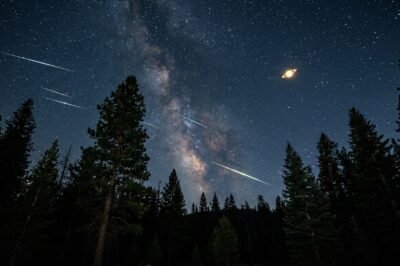
A Symphony of Light in the Autumn Sky
The vast, velvet expanse of the night sky has long served as a canvas for the most spectacular displays of cosmic choreography, and this month, observers are in for a rare double feature that bridges the gap between our planetary neighbors and the icy wanderers of the outer solar system. As the Earth moves through its orbital path, a unique alignment of timing and position brings the gas giant Saturn into sharp focus just as the debris from the most famous comet in history, Halley’s Comet, begins its fiery descent through our atmosphere. This convergence is more than just a visual treat; it is a profound reminder of the dynamic and interconnected nature of our celestial environment. For centuries, humans have looked to the heavens with a sense of wonder, but rarely do we get the chance to witness such a stark contrast between the steady, ancient light of a distant planet and the fleeting, incandescent streaks of meteoric dust. This detailed analysis explores the science, the history, and the sheer majesty of these two overlapping events, providing a guide for both the seasoned astronomer and the casual stargazer to appreciate the rare beauty of the Orionid meteor shower and the golden glow of Saturn. Whether you are peering through a high-powered telescope or simply standing in a dark backyard, the upcoming weeks offer a masterclass in the mechanics of our universe.
The Legacy of Halley’s Comet: Understanding the Orionids
The Orionid meteor shower is not merely a random occurrence of falling stars; it is the physical manifestation of Earth’s interaction with the trail of 1P/Halley, more commonly known as Halley’s Comet. Every 76 years, this iconic comet swings through the inner solar system, shedding layers of ice, dust, and rock as it is heated by the sun. Although the comet itself is currently far out in the depths of space, its ancient path is littered with these fragments. Twice a year, Earth’s orbit intersects these debris fields, giving rise to the Eta Aquariids in May and the Orionids in October. The Orionids are particularly celebrated because they are known for their speed and brilliance, often leaving persistent trains—glowing trails of ionized gas that can last for several seconds after the meteor has vanished.
The science behind these meteors is as fascinating as their appearance. Traveling at speeds of approximately 148,000 miles per hour, these particles are tiny, often no larger than a grain of sand or a pebble. However, their extreme velocity creates immense friction upon entering Earth’s upper atmosphere, roughly 60 to 100 miles above the surface. This friction generates temperatures high enough to vaporize the debris, resulting in the bright streaks of light we call meteors. During the peak of the Orionids, observers can expect to see between 15 and 20 meteors per hour under ideal conditions. The radiant point, or the area from which the meteors appear to originate, is located near the constellation of Orion the Hunter, which rises late in the evening and stands high in the sky by the pre-dawn hours.
Saturn’s Golden Hour: Observing the Ringed Giant
While the meteors provide a sense of fleeting motion, Saturn offers a sense of enduring stability. Currently positioned in a highly favorable part of the sky for viewing, the sixth planet from the sun is outshining many of the surrounding stars. Saturn is often called the ‘Jewel of the Solar System,’ and for good reason. Its magnificent ring system, composed primarily of water ice and rock fragments, reflects sunlight with incredible efficiency, making the planet appear as a steady, pale-yellow light to the naked eye. Unlike stars, which twinkle due to atmospheric turbulence, planets like Saturn provide a solid, unwavering glow because they represent a larger angular size in the sky.
For those utilizing binoculars or a small telescope, the view of Saturn becomes even more transformative. Even at modest magnifications, the planet’s rings are clearly visible, appearing as a thin, elegant disc encircling the main body of the planet. Astronomers note that Saturn’s current tilt relative to Earth allows for a particularly good look at the ring structure and the shadows they cast upon the planetary disc. Additionally, the moon Titan, Saturn’s largest satellite and one of the most intriguing worlds in the solar system due to its thick atmosphere and liquid methane lakes, can often be spotted as a tiny, star-like point of light nearby. The presence of Saturn in the same sky as the Orionids creates a layered viewing experience, where the distant, massive gas giant serves as a backdrop to the local, high-speed atmospheric entries of cometary dust.
The Physics of Atmospheric Entry and Ionization
To truly appreciate the Orionids, one must understand the physical processes occurring miles above our heads. When a piece of Halley’s Comet enters the atmosphere, it isn’t just burning; it is participating in a high-energy process of ionization. As the meteoroid compresses the air in front of it, it creates a shock wave that strips electrons from the atmospheric atoms. This creates a trail of plasma, a fourth state of matter, which emits light as the electrons recombine with the ions. This is why some Orionids appear to have a greenish or bluish tint, a result of the specific chemical composition of the debris reacting with the oxygen and nitrogen in our own air.
Furthermore, the Orionids are known for producing ‘fireballs,’ which are exceptionally bright meteors that can momentarily illuminate the entire landscape. These occur when larger fragments of the comet, perhaps the size of a marble, survive the initial entry and burn with greater intensity. These events are unpredictable but highly rewarding for those patient enough to spend several hours under the stars. The contrast between the silent, slow-moving Saturn and the sudden, violent death of a cometary fragment provides a striking demonstration of the scales of time and energy present in our corner of the galaxy.
Optimizing the Viewing Experience: Gear and Conditions
Watching these celestial events requires a combination of preparation and patience. To get the best view of both Saturn and the Orionids, one must escape the urban glow of city lights. Light pollution is the primary enemy of meteor watching, as it washes out all but the brightest streaks. Utilizing the Bortle Scale to find a ‘dark sky’ site can make the difference between seeing five meteors and seeing fifty. For Saturn, light pollution is less of an issue, but atmospheric stability is key. Viewing the planet through a telescope from a concrete rooftop or near a heat source can cause the image to shimmer and blur; a grassy field is usually the superior choice for high-magnification observation.
- Allow for Dark Adaptation: It takes the human eye approximately 20 to 30 minutes to fully adjust to the darkness. Avoid looking at your smartphone or any white light sources during this time, as even a brief flash can reset your night vision.
- Timing is Everything: While Saturn is visible earlier in the evening, the Orionids are best viewed after midnight, when the Earth is rotating into the debris stream. The peak hours are usually between 2:00 AM and dawn.
- Comfort is Key: Since meteor watching involves looking up for extended periods, a reclining lawn chair or a blanket on the ground is recommended. Dressing in layers is also essential, as temperatures can drop significantly during the early morning hours.
- No Specialized Gear Required: While a telescope enhances Saturn, the Orionids are best seen with the naked eye. This is because your eyes have a wider field of view than any telescope, allowing you to catch meteors that might appear anywhere in the sky.
Historical and Scientific Significance of Recurrent Events
The study of the Orionids and Saturn is not just for hobbyists; it is a vital part of planetary science. By analyzing the frequency and composition of the Orionid meteors, scientists can gain insights into the evolution of Halley’s Comet. Since the comet only visits the inner solar system once every few decades, the meteor showers it leaves behind are our best opportunity to study its material on an annual basis. Chemical analysis of the light spectra from these meteors tells us about the volatile compounds and organic molecules present in the early solar system, potentially shedding light on how the building blocks of life were delivered to Earth.
Similarly, ongoing observations of Saturn contribute to our understanding of planetary atmospheres and ring dynamics. Saturn acts as a laboratory for fluid dynamics on a massive scale, with its Great White Spots and hexagonal storm systems providing data that helps refine our models of weather and physics. When we watch Saturn shine next to the debris of a comet, we are witnessing the remnants of the solar system’s formation. These events connect us to the deep history of our cosmic neighborhood, reminding us that we live in a world that is constantly being reshaped by the movement of ice and gas across the void.
Conclusion: The Future of Celestial Observation
As we look toward the coming years, the dance of the planets and the debris of comets will continue to provide spectacular displays for those who take the time to look up. While the Orionids will return every October, the position of Saturn will continue to shift as it completes its long journey around the sun, eventually moving into different constellations and appearing at different times of the year. The current alignment represents a unique window of opportunity to see two very different astronomical phenomena simultaneously. In an age of digital screens and constant noise, these celestial events offer a rare chance for quiet reflection and a sense of connection to the broader universe. The next time you see a streak of light across the sky or the steady golden point of Saturn, remember that you are witnessing the legacy of billions of years of cosmic history, a performance that is as ancient as it is beautiful.




































Leave a Reply