
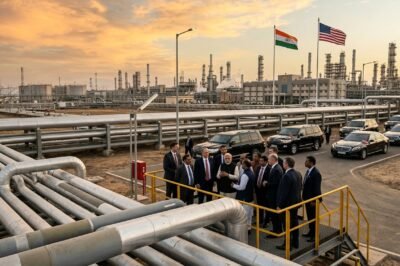
The sun-drenched plains of Jamnagar in Gujarat, India, serve as the backdrop for one of the most significant geopolitical and economic convergences of the decade. As Senator Marco Rubio, a high-ranking member of the Senate Foreign Relations Committee and a pivotal voice in American overseas strategy, prepares for his visit to the Reliance Industries refinery, the global community is watching with bated breath. This is not merely a diplomatic courtesy call to a private corporation; it is a high-stakes engagement at the world’s largest refining complex, a facility that processes over 1.24 million barrels of oil per day and serves as the beating heart of India’s energy exports. The visit signals a profound shift in how the United States views its strategic partnership with India, moving beyond defense and technology into the visceral world of energy security, global supply chains, and the complex dance of international sanctions. In an era where energy independence is equated with national sovereignty, Rubio’s presence at Jamnagar underscores a shared realization: that the path to a stable Indo-Pacific and a resilient global economy runs directly through the massive pipelines and cracking units of Gujarat. This 1000-word analysis explores the multifaceted reasons behind this visit, the economic stakes for Reliance, and the geopolitical ripples that will be felt from Washington to Moscow.
The Engineering Marvel of Jamnagar and Global Dominance
To understand why a senior American statesman would fly halfway across the world to visit a refinery, one must first grasp the sheer scale of the Jamnagar complex. Owned by Mukesh Ambani’s Reliance Industries Limited (RIL), Jamnagar is not just a refinery; it is an industrial ecosystem. It holds the title of the world’s largest grassroots refinery, boasting a Nelson Complexity Index that is among the highest in the world. This means the facility is capable of processing almost any grade of crude oil—from the light, sweet crudes of the North Sea to the heavy, sour, and difficult-to-refine crudes from Venezuela and Russia—into high-value products like Euro-VI compliant fuels and jet kerosene. For the United States, which has spent years navigating the complexities of energy markets, Jamnagar represents a critical node in the global energy map that cannot be ignored.
The refinery’s strategic importance has grown exponentially as global refining capacity in the West has stagnated or declined. While European and American refineries have faced closures due to aging infrastructure and stringent environmental regulations, Reliance has continued to invest billions in upgrading Jamnagar. This has turned the facility into a primary supplier for international markets, including the U.S. East Coast and Western Europe. Senator Rubio’s visit is a recognition of this industrial prowess. By engaging directly with RIL, the U.S. is acknowledging that the stability of global fuel prices and the availability of refined products are increasingly dependent on the operational efficiency and political alignment of this single Indian site. The visit also highlights the role of private enterprise in the broader US-India bilateral relationship, where RIL acts as a bridge between Indian domestic policy and global market requirements.
Navigating the Geopolitics of Sanctioned Oil
One of the primary, albeit sensitive, reasons for Rubio’s visit involves the complex landscape of international sanctions. India has famously maintained a pragmatic approach to energy procurement, significantly increasing its imports of Russian crude following the invasion of Ukraine and the subsequent Western sanctions. Reliance Industries, as a primary buyer, has had to balance its need for affordable feedstock with the risk of secondary sanctions from the U.S. treasury. Rubio, known for his hawkish stance on Russia and Iran, is likely using this visit to discuss the nuances of these trade flows. The U.S. objective is twofold: to ensure that India remains a primary partner in the Indo-Pacific while also tightening the net on the revenues that flow to sanctioned regimes.
Furthermore, the visit coincides with a period of renewed interest in Venezuelan oil. Following the temporary easing of U.S. sanctions on Caracas, Reliance sought permission to resume imports of heavy Venezuelan crude, which is ideally suited for Jamnagar’s advanced cracking units. Rubio, as a prominent representative of Florida—a state with a massive Venezuelan diaspora and a focal point for U.S.-Latin American policy—has a vested interest in how these deals are structured. His visit serves as a platform to communicate the U.S. legislative branch’s expectations regarding transparency and compliance. It is a diplomatic exercise in ensuring that India’s energy hunger does not inadvertently undermine U.S. foreign policy goals, while simultaneously recognizing India’s right to secure its own economic future.
The US-India Strategic Energy Partnership
Beyond the immediate concerns of oil and sanctions, the visit is a cornerstone of the broader US-India Strategic Energy Partnership. For years, the two nations have sought to align their interests under initiatives like the Initiative on Critical and Emerging Technology (iCET), but energy remains the most tangible area of cooperation. Rubio’s engagement with Mukesh Ambani and the leadership at Reliance is an attempt to foster a more resilient energy supply chain that is less dependent on Chinese-dominated sectors. While Jamnagar is currently a fossil fuel giant, Reliance is pivotally shifting toward green hydrogen and renewable energy components, areas where the U.S. is eager to collaborate to counter China’s monopoly on the green transition.
This partnership is also about technical exchange and safety standards. The U.S. has a long history of refinery excellence, and by visiting the Jamnagar site, Rubio is signaling support for deeper integration between American energy technology firms and Indian giants. This includes everything from carbon capture technologies to the digitalization of refinery operations. By strengthening the ties between the American political establishment and India’s private sector leaders, the U.S. aims to create a bulwark against the shifting alliances in the Middle East and the growing influence of the BRICS+ bloc. The visit is a statement that the U.S. views India not just as a consumer, but as a strategic energy hub that can stabilize the entire Asian continent.
Economic Implications and Market Sentiment
Market analysts are watching the visit closely for clues about future trade agreements and investment flows. Reliance Industries is a bellwether for the Indian economy; a successful visit from a high-profile U.S. senator can boost investor confidence and pave the way for more American institutional investment into RIL’s energy and infrastructure projects. For the global oil market, the visit suggests a period of relative stability in the U.S.-India energy dialogue. If Rubio and the Indian leadership can find common ground on the treatment of Russian and Venezuelan crudes, it reduces the risk of sudden supply disruptions or aggressive sanction enforcement that could send oil prices spiraling.
Additionally, the visit highlights the growing trend of ‘friend-shoring’ in the energy sector. As the U.S. seeks to move its supply chains away from adversarial nations, India emerges as the most viable alternative for large-scale industrial output. Jamnagar’s ability to export refined products globally makes it an essential part of the U.S. strategy to maintain global liquidity in fuel markets. The economic implications extend to the maritime industry as well, as the shipping routes between Jamnagar and American ports become increasingly vital. Rubio’s tour of the facility is an acknowledgment that the economic security of the American consumer, who relies on stable gas prices, is linked to the operational success of a refinery ten thousand miles away.
Green Hydrogen and the Future of Energy Transition
While the present is dominated by oil, the future is green, and this is a major talking point for the Rubio-Reliance meeting. Mukesh Ambani has announced a massive $75 billion investment in the New Energy business, aiming to turn Jamnagar into a hub for green hydrogen and renewable energy manufacturing. This aligns perfectly with the U.S. Department of Energy’s goals for global decarbonization. Senator Rubio’s visit provides an opportunity to explore how U.S. policy, such as the Inflation Reduction Act, can find synergies with India’s National Green Hydrogen Mission. The two nations are looking at ways to co-develop electrolyzer technology and establish a global market for clean fuels.
By engaging with Reliance’s green initiatives, Rubio is acknowledging that energy security in the 21st century is as much about solar panels and hydrogen as it is about crude oil. This helps bridge the gap between traditional energy hawks and those advocating for climate action. The Jamnagar complex, with its vast available land and existing industrial infrastructure, is uniquely positioned to lead this transition. For Rubio, supporting India’s shift to green energy is a strategic move to reduce India’s long-term reliance on imported oil from volatile regions, thereby making the world’s largest democracy more resilient and a more stable partner for the United States.
Conclusion on Future Implications
The visit of Senator Marco Rubio to Reliance’s Jamnagar refinery is a watershed moment in US-India relations. It signals that the relationship has matured into a complex, multifaceted partnership where energy, economics, and geopolitics are inextricably linked. The future implications are clear: we are likely to see a more coordinated approach to global energy shocks, a more nuanced application of sanctions that accounts for India’s domestic needs, and a surge in bilateral cooperation on clean energy technologies. This visit serves as a reminder that in the modern world, the most powerful diplomatic tools are not just treaties and summits, but the physical infrastructure of energy that keeps the global economy moving. As Jamnagar continues to expand its reach, the ties between the American political establishment and Indian industrial giants will only deepen, creating a new axis of energy power that will define the coming decades. The success of this visit will be measured not in the immediate press releases, but in the long-term stability of the Indo-Pacific energy corridor and the resilience of the global market against geopolitical volatility.






































Leave a Reply