
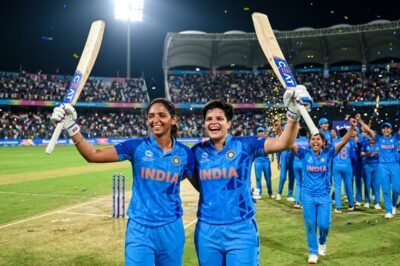
In a display of sheer cricketing dominance that sent a clear message to the rest of the international circuit, the Indian Women’s Cricket Team completed a comprehensive 3-0 series whitewash against their opponents, punctuated by a clinical performance in the final fixture. This victory was not merely about the final scorecard but served as a profound testament to the tactical evolution and mental fortitude that the side has cultivated under its current leadership. The final match was defined by the explosive brilliance of young opener Shafali Verma and the seasoned, calculated composure of captain Harmanpreet Kaur, both of whom registered vital half-centuries to dismantle the opposition’s bowling attack with surgical precision. Complementing the batting pyrotechnics was the rising star Nandani, whose incisive and disciplined three-wicket haul effectively broke the back of the opposition’s chase, ensuring that India remained unchallenged throughout the encounter. As the sun set on a series that felt like a masterclass in modern cricket, the narrative shifted from a mere regional victory to the establishment of a new hierarchy in women’s sports, where India now sits comfortably at the summit of clinical execution, strategic depth, and individual flair. This 3-0 sweep marks a pivotal moment for the team as they transition into a heavy global schedule, proving they possess both the star power and the systemic depth to maintain consistency at the highest level of the game.
The Powerhouse Partnership: Shafali and Harmanpreet Lead from the Front
The foundation of India’s success in the final match was built upon a formidable batting display that showcased two different yet equally effective styles of play. Shafali Verma, known for her fearless approach, lived up to her reputation by attacking the new ball from the very first over. Her ability to clear the infield and find boundaries at will put the opposition bowlers on the defensive, forcing them to deviate from their planned lengths. Shafali’s fifty was a whirlwind of power-hitting, characterized by her signature lofted drives and powerful pulls, which kept the run rate well above the required trajectory. Her performance in this series has been a revelation of her maturing game sense, as she now appears more willing to rotate the strike while waiting for the loose delivery, a trait that makes her even more dangerous for international bowling units.
On the other end of the spectrum was the captain, Harmanpreet Kaur, whose innings was a masterclass in strike rotation and late-innings acceleration. Harmanpreet entered the crease at a crucial juncture and immediately took control of the tempo. While Shafali provided the fireworks, Harmanpreet ensured that the middle overs were productive, using her feet expertly against the spinners and finding gaps with surgical precision. Her half-century was a reminder of her enduring class and her ability to anchor an innings under pressure. Together, the duo shared a partnership that effectively batted the opposition out of the game, demonstrating the synergy between youth and experience that currently defines this Indian squad. Their combined efforts not only set a massive target but also provided the bowlers with a significant psychological cushion to defend.
Bowling Mastery: Nandani’s Clinical Three-Wicket Haul
If the batters provided the platform, it was the bowling unit that ensured the victory was absolute, led by a standout performance from the young medium-pacer Nandani. Taking three crucial wickets, Nandani showed maturity far beyond her years, utilizing a mix of subtle variations and consistent lines to stifle the opposition batters. Her first wicket came during the powerplay, a delivery that nipped back sharply to catch the opener off guard, setting the tone for the rest of the innings. By maintaining a disciplined line and length, she forced the batters into playing risky shots, eventually reaping the rewards as she cleaned up the middle order. Nandani’s ability to bowl effectively in different phases of the game—the start, the middle, and the death overs—is a major find for India, adding a new dimension to their already potent bowling attack.
The secondary support from the spin department cannot be overlooked either. While Nandani took the headlines with her three-for, the collective pressure applied by the spin quartet ensured that the required run rate climbed steadily. The discipline shown by the bowlers reflected a broader tactical shift in Indian cricket, focusing on dot-ball percentage and building pressure over long periods rather than just searching for wickets. This systemic efficiency is what allowed India to bowl out the opposition well short of the target. Nandani’s performance specifically highlights the depth of the domestic structure in India, which is now producing world-class talents ready to perform on the international stage with minimal transition time. Her emergence provides the selection committee with healthy headaches as they look to finalize the squad for upcoming major ICC events.
Statistical Supremacy: A Deep Dive into the Series Numbers
Analyzing the statistics from the 3-0 sweep reveals a staggering gap between the two sides. India’s top order averaged over 45 throughout the three matches, a figure that is significantly higher than the opposition’s combined average. The strike rates of Shafali Verma and Harmanpreet Kaur remained above 130, ensuring that India was always ahead of the par scores. Furthermore, the bowling statistics were equally impressive; India managed to take all 30 wickets across the three games, while the opposition struggled to break through the Indian middle order in at least two of the three encounters. This statistical dominance underscores the clinical nature of the sweep, showing that India won not just the big moments but also the battle of attrition in the middle overs.
From a financial and market perspective, these statistics are driving a surge in interest in women’s cricket. High-performing players like Shafali and Harmanpreet are seeing their brand value skyrocket, leading to increased sponsorship opportunities and higher viewership numbers. The data shows that matches featuring India Women are now drawing audiences comparable to top-tier men’s domestic leagues, signaling a major shift in the sports economy. For the BCCI, this series win is a lucrative outcome that reinforces the viability of the Women’s Premier League (WPL) and the broader commercialization of the sport. The numbers don’t just tell a story of runs and wickets; they tell a story of a growing industry that is finally realizing its full potential on the global stage.
Tactical Innovations: India’s New-Look Aggression
One of the most notable aspects of this series was India’s tactical shift towards a more aggressive brand of cricket. In previous years, the team was often criticized for being too conservative in the powerplay and the middle overs. However, this series saw a marked change. The instruction from the coaching staff appears to be clear: play with freedom. This was evident in the way the openers approached the first six overs, taking calculated risks to ensure that the fielding side never felt settled. This proactive approach has been a breath of fresh air and has significantly improved India’s ability to set and chase high totals. By prioritizing intent over safety, India has moved closer to the playing style of world-leaders like Australia and England.
Moreover, the tactical flexibility shown in the bowling changes was a highlight for Harmanpreet Kaur’s captaincy. She was not afraid to bring on her strike bowlers in unconventional situations or use spinners to dry up the runs when the opposition tried to break free. The use of Nandani as a versatile option across different phases showed a high level of match awareness. This tactical fluidity is essential in the modern game where conditions can change rapidly. India’s ability to adapt their strategy mid-game was a major factor in their 3-0 success, proving that they are now a thinking team that can outmaneuver opponents both physically and mentally.
Comparative Analysis: Strengthening the Bench and Player Rotation
This series also served as an opportunity for the Indian team management to test their bench strength and implement a rotation policy. With a packed international calendar, the ability to rest key players without compromising on performance is vital. The fact that India was able to secure a sweep while giving opportunities to younger players like Nandani and other fringe performers speaks volumes about the depth of talent currently available. The competition for spots within the playing XI has never been more intense, which naturally drives up the standards of performance across the board. Every player knows that a single poor performance could mean losing their spot to a hungry youngster waiting in the wings.
When comparing this squad to previous iterations, the most significant difference is the fitness and fielding standards. India was once considered a lagging side in terms of athleticism, but this series showed a team that is fit, agile, and sharp in the field. The number of runs saved in the inner circle and the quality of catching were exceptional. This improvement is the result of rigorous training camps and a professionalized approach to sports science within the Indian setup. By narrowing the gap in fielding and fitness, India has removed one of the major barriers that previously prevented them from dominating international series so convincingly.
Future Implications: Road to the World Cup and Global Standing
The implications of this 3-0 series sweep extend far beyond the immediate celebration. With major ICC tournaments on the horizon, this victory provides India with the perfect momentum and a blueprint for success. The team has identified its core group of match-winners and has successfully integrated young talent into the system. The confidence gained from such a dominant performance will be invaluable when they face tougher opposition in neutral conditions. India has proved that they have the batting firepower to set big scores and the bowling variety to defend them, making them one of the favorites for any upcoming global crown.
In conclusion, the performance of Harmanpreet Kaur, Shafali Verma, and Nandani has solidified India’s position as a powerhouse in women’s cricket. The 3-0 sweep was a comprehensive team effort that highlighted growth in every department of the game. As the team looks forward, the focus will be on maintaining this level of consistency and continuing to innovate tactically. For fans and stakeholders alike, this is an exciting era for Indian cricket, one where the women’s team is not just competing but leading the way in professional excellence and sporting entertainment. The world of cricket has been put on notice: India is here to dominate, and they have the talent, the strategy, and the results to back it up.






































Leave a Reply