
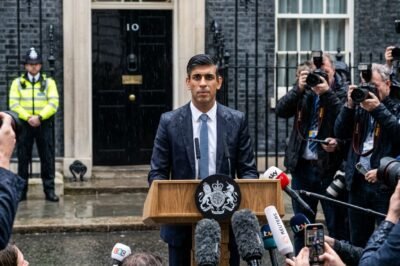
In a move that caught Westminster and the broader British public by surprise, Prime Minister Rishi Sunak stood in the pouring rain outside 10 Downing Street to announce a snap general election for July 4, 2024. This decision, arriving months earlier than many political analysts and even members of his own cabinet had predicted, represents one of the most significant and risky gambles in modern British political history. For a Prime Minister trailing significantly in the polls, the choice to go to the country now—rather than waiting for a late autumn window—signals a calculated belief that the economic “green shoots” are finally visible enough to convince a weary electorate. Sunak’s speech, punctuated by the faint sound of protesters and the rhythmic drumming of rain, framed the upcoming vote as a fundamental choice between stability and an uncertain future under the Labour Party. As the United Kingdom prepares for its first July election since the end of the Second World War in 1945, the stakes could not be higher. This is not merely a contest of personalities but a clash of divergent visions for the UK’s post-Brexit identity, its fiscal responsibility, and its role on the global stage. With the Conservative Party facing a double-digit deficit in opinion polls, Sunak is betting that a focused six-week campaign can bridge the gap and deliver a mandate for his vision of a “secure future.”
The Strategic Timing: Why July 4 and Why Now?
The timing of the election announcement is the most analyzed aspect of Sunak’s decision. Traditionally, a government trailing in the polls would cling to power until the last possible moment, which in this case would have been January 2025. By choosing July 4, Sunak is attempting to seize the narrative before the summer holidays and capitalize on a specific set of economic data points. The most prominent of these is the recent fall in inflation to 2.3%, the lowest level in nearly three years. This figure allows the Prime Minister to claim that his primary economic mission—halving inflation—has been successfully achieved, providing a platform to argue that the “plan is working.”
Furthermore, waiting until autumn carried significant risks. While the economy is showing signs of growth, there were concerns within Number 10 that a summer of small boat crossings in the English Channel and potential NHS wait-time spikes could further erode Tory support. By moving now, Sunak hopes to keep the focus on economic recovery and national security. The decision also preempts a potential interest rate cut by the Bank of England, which, while beneficial for mortgage holders, might not have been felt by voters until much later in the year. Strategically, the snap call aims to catch the Labour Party off-balance, forcing them to finalize their manifesto and candidate list in a compressed timeframe.
Economic Indicators and the Conservative Fiscal Narrative
Central to the Conservative campaign will be the argument of fiscal competence. Rishi Sunak and Chancellor Jeremy Hunt have consistently messaged that the UK has “turned a corner.” With GDP growth figures for the first quarter of 2024 coming in stronger than expected at 0.6%, the government is eager to frame the UK as the fastest-growing economy in the G7. The campaign will likely emphasize the recent National Insurance cuts and the promise of further tax reductions if the Conservatives are returned to power. Sunak’s pitch is built on the foundation of being a “safe pair of hands” compared to what he characterizes as the “unfunded spending taps” of a Labour administration.
However, the economic reality for many voters remains challenging. Despite the fall in headline inflation, the cost of living remains high, and the aggregate increase in prices since 2021 has left many households feeling poorer. The tax burden is also at a 70-year high, a point that Labour is certain to exploit. The Conservative strategy involves convincing voters that while things have been difficult, the current trajectory is the only one that guarantees long-term prosperity. They will argue that a change in leadership would risk the hard-won stability of the last eighteen months, potentially leading to market volatility and higher interest rates.
Labour’s Response: The ‘Change’ Mandate and Keir Starmer’s Strategy
Sir Keir Starmer and the Labour Party have spent years preparing for this moment, and their response was immediate and disciplined. Within minutes of Sunak’s announcement, Starmer released a pre-produced video with a simple, singular message: “Change.” Labour’s strategy is to frame the last 14 years of Conservative rule as a period of chaos, stagnant growth, and declining public services. By focusing on the concept of “national renewal,” Starmer aims to present Labour not as a radical departure, but as a return to normalcy and competence. The party is banking on the “time for a change” sentiment that appears to be pervasive across various demographics, from the traditional “Red Wall” seats to the affluent “Blue Wall” in the south of England.
Labour’s policy platform, while cautious, focuses on several key pillars:
- Economic Stability: Adhering to strict fiscal rules to prevent a repeat of the 2022 mini-budget crisis.
- Great British Energy: A publicly owned clean power company to lower bills and provide energy security.
- NHS Reform: Cutting waiting lists by increasing the number of appointments and incentivizing evening and weekend work.
- Border Security: Replacing the Rwanda plan with a new Border Security Command to tackle smuggling gangs.
The challenge for Labour will be maintaining their substantial lead under the intense scrutiny of a six-week campaign. The Conservatives will relentlessly attack Labour’s tax plans, suggesting a “black hole” in their finances. Starmer’s task is to reassure the markets and the electorate that Labour is a pro-business, fiscally responsible party that can be trusted with the nation’s purse strings.
Market Implications and Investor Sentiment
Financial markets generally dislike uncertainty, but the reaction to the election announcement has been relatively muted, suggesting that a Labour victory has already been largely priced in. The British Pound (GBP) saw minor fluctuations against the Dollar and Euro but remained stable. For investors, the primary concern is not necessarily which party wins, but whether the winner will have a clear mandate to govern. A landslide victory for either party is often viewed more favorably by markets than a hung parliament, which could lead to legislative paralysis. Analysts are looking for clues on future corporate tax rates, green investment incentives, and the UK’s future relationship with the European Union.
A Labour government is expected to seek a closer trading relationship with the EU, though Starmer has ruled out rejoining the Single Market or Customs Union. This potential for reduced trade friction could be a long-term positive for the FTSE 100 and FTSE 250. Conversely, the Conservatives are positioning themselves as the party of deregulation and lower personal taxes. The “Sunak Premium”—the sense of stability he brought after the Liz Truss era—will be weighed against the potential for a Labour “fresh start.” Markets will be watching the polls closely, particularly any narrowing of the gap that might suggest a more contested outcome than currently anticipated.
Key Battlegrounds and the Reform UK Factor
The geography of this election is complex. The Conservatives must defend a wide array of seats, ranging from post-industrial towns in the North to leafy suburbs in the South-East. A significant threat to the Tory flank comes from Reform UK, the successor to the Brexit Party. Led by Richard Tice (and with the influential Nigel Farage in a supporting role), Reform UK is siphoning off disillusioned Conservative voters who feel the government has failed on immigration and tax. Even if Reform does not win many seats, their presence could act as a spoiler, handing dozens of constituencies to Labour or the Liberal Democrats by splitting the right-wing vote.
The Liberal Democrats, meanwhile, are focusing their efforts on the “Blue Wall,” targeting seats where anti-Brexit and pro-environmental sentiments are high. Their strategy is highly localized, focusing on issues like sewage in rivers and local health services. For the Conservatives to retain power, they need a near-miraculous performance that involves holding off the Lib Dems in the South, squeezing the Reform vote, and preventing a total collapse in the North. Most pollsters agree that the path to a Conservative majority is narrow, requiring a significant shift in public opinion during the campaign period.
Conclusion: Future Implications and the Legacy of the Vote
The general election on July 4 will be a defining moment for the United Kingdom. If Rishi Sunak defies the odds and wins, it will be hailed as the greatest political comeback in British history, validating his “slow and steady” approach to governance. It would provide him with a personal mandate that he has lacked since taking office in October 2022, allowing him to push forward with his agenda on welfare reform, defense spending, and net-zero transitions. However, a defeat would likely trigger a profound period of soul-searching and a potential leadership crisis within the Conservative Party, as different factions battle over the future direction of the British right.
For the country, the election represents a fork in the road. One path continues the current trajectory of incremental changes and fiscal caution under the Conservatives. The other leads to a Labour government that promises to be more interventionist in the economy and more focused on public sector investment. Regardless of the outcome, the next government will face an unenviable list of challenges: a stagnant productivity rate, an aging population, crumbling infrastructure, and a volatile geopolitical environment. The decision made by voters on July 4 will determine not just the occupant of 10 Downing Street, but the social and economic fabric of Britain for the next decade. As the campaign begins, the eyes of the world are on the UK to see if it chooses the continuity of the incumbent or the promised renewal of the opposition.




































Leave a Reply