
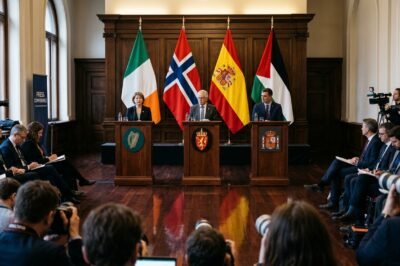
In a historic move that has reverberated across the global diplomatic landscape, the governments of Ireland, Norway, and Spain have formally announced their coordinated recognition of a Palestinian state. This decision, emerging amidst one of the most volatile periods in Middle Eastern history, marks a fundamental shift in European foreign policy and challenges the long-standing status quo maintained by several Western powers. By taking this collective step, Dublin, Madrid, and Oslo are not merely making a symbolic gesture; they are attempting to breathe new life into a two-state solution that many critics had deemed effectively defunct. The announcement, delivered through simultaneous press conferences by Prime Minister Pedro S!nchez of Spain, Taoiseach Simon Harris of Ireland, and Prime Minister Jonas Gahr St”re of Norway, underscores a growing impatience within the international community regarding the lack of a clear political horizon for Palestinian self-determination. This strategic alignment represents a direct challenge to the current Israeli administration’s policies and signals a broader movement within the Global North to address the root causes of the Israeli-Palestinian conflict beyond the immediate lens of security and counter-terrorism.
The Strategic Coordination Between Dublin, Madrid, and Oslo
The synchronization of this announcement was no diplomatic accident. For months, officials from Ireland, Spain, and Norway have been engaged in back-channel discussions to ensure that their recognition would carry maximum political weight. By acting as a unified bloc, these three nations aim to provide a counter-narrative to the idea that European support for Palestinian statehood is fragmented or peripheral. Spain, under the leadership of Pedro S!nchez, has emerged as a central advocate for this cause within the European Union, arguing that the only way to ensure long-term stability for Israel is to provide a legitimate, sovereign counterpart in Palestine. S!nchez has consistently framed this as a matter of justice and historical consistency, drawing parallels between the right to sovereignty for all nations under international law.
In Ireland, the decision reflects a deep-seated national empathy for movements of self-determination, often colored by Ireland’s own colonial history. Taoiseach Simon Harris emphasized that the recognition of Palestine is an affirmation of a right that should be universal. The Irish government has long been one of the most vocal critics of settlement expansion in the West Bank, and this formal recognition is seen as the culmination of years of parliamentary pressure and public sentiment. Norway, meanwhile, holds a unique position as the broker of the historic Oslo Accords in the 1990s. For Oslo to take this step now is particularly poignant; it signals a recognition that the framework established three decades ago has failed to deliver its promised outcome and that a new, more proactive approach is required to prevent the total collapse of the peace process.
Immediate Geopolitical Repercussions and Israel’s Stance
The reaction from the Israeli government was swift and severe. Foreign Minister Israel Katz immediately ordered the recall of Israel’s ambassadors from Dublin, Madrid, and Oslo for urgent consultations. The Israeli Ministry of Foreign Affairs characterized the recognition as a ‘reward for terrorism,’ arguing that such moves only serve to embolden extremist groups and undermine the possibility of direct negotiations. The Israeli narrative maintains that statehood should only be the result of a negotiated settlement between the two parties, rather than a unilateral declaration supported by third-party nations. This diplomatic rift has led to a cooling of bilateral relations, with Israel warning of further ‘severe consequences’ for the countries involved.
Furthermore, the Israeli government has utilized this moment to reinforce its domestic political position, framing the European move as an assault on Israeli sovereignty and security. However, the international community’s response has been mixed. While the United States remains steadfast in its position that Palestinian statehood must come through direct talks, other nations in the Global South and parts of the European Union have welcomed the move as a necessary jolt to a stagnant process. The diplomatic fallout extends to international forums like the United Nations, where these three countries will now be expected to vote in alignment with their new formal recognition, potentially shifting the balance in General Assembly resolutions concerning Palestinian rights and territories.
The Economic Dimension: Trade, Aid, and Market Stability
From a financial perspective, the recognition of Palestinian statehood carries significant implications for international trade and aid structures. The European Union is the largest provider of financial assistance to the Palestinian Authority, and the formal recognition by three key European states could lead to a restructuring of how that aid is administered. There is potential for increased direct investment in Palestinian infrastructure, as these nations may now seek to treat Palestine as a sovereign economic entity. This could involve direct bilateral trade agreements, the establishment of formal chambers of commerce, and increased cooperation in sectors such as agriculture, renewable energy, and telecommunications.
Conversely, the economic relationship between these three nations and Israel may face short-term turbulence. Israel is a major high-tech and defense exporter, and any diplomatic friction often spills over into trade considerations. Market analysts are closely watching for any signs of divestment or consumer boycotts that might arise from heightened political tensions. Additionally, there is the ongoing issue of the clearance of tax revenues that Israel collects on behalf of the Palestinian Authority. With the recognition of statehood, the pressure on Israel to release these funds consistently will likely increase, as the recognizing nations will now view these funds as the sovereign property of the Palestinian state. The financial stability of the Palestinian Authority is precarious, and this diplomatic shift could provide the political leverage needed to secure more reliable fiscal streams.
Internal EU Fractures and the Global Domino Effect
The decision by Ireland, Norway, and Spain has highlighted deep fissures within the European Union regarding the Middle East. While nations like Slovenia and Malta have indicated they may soon follow suit, heavyweights such as Germany and France remain more cautious. Germany, in particular, maintains a policy heavily influenced by its historical responsibility toward Israel, emphasizing that recognition should only occur at the end of a peace process. France has stated that recognition is not a ‘taboo’ but must be done at a ‘useful moment’ to maximize impact. This divergence creates a complex internal dynamic within the EU’s Common Foreign and Security Policy, making a unified bloc position nearly impossible to achieve in the near term.
However, the ‘domino effect’ is a real possibility. When significant European players break ranks, it provides political cover for other mid-sized nations to do the same. This could lead to a situation where a majority of EU member states recognize Palestine, effectively forcing a change in the Union’s official stance. Beyond Europe, this move resonates in the halls of the United Nations, where the push for full Palestinian membership has gained momentum. The recognition by these three nations, two of which are EU members and one a key NATO ally (Norway), lends a new level of Western legitimacy to the Palestinian bid for statehood that was previously lacking when recognition came primarily from the Soviet bloc or the Non-Aligned Movement.
Legal Implications for International Bodies and Human Rights
The formal recognition of a Palestinian state by these European nations also has profound legal implications, particularly regarding the jurisdiction of international courts. By recognizing Palestine as a state, these countries are affirming its capacity to be a party to international treaties and to seek redress through the International Criminal Court (ICC) and the International Court of Justice (ICJ). This bolsters the Palestinian Authority’s legal standing when bringing cases related to settlement activity, human rights violations, and territorial disputes. It also complicates the legal defense for Israel, as it can no longer argue as easily that the Palestinian territories are ‘disputed’ rather than ‘occupied’ in the eyes of these specific sovereign states.
Moreover, the move places a renewed focus on the Geneva Conventions and the responsibilities of an occupying power. If Ireland, Spain, and Norway recognize the West Bank and Gaza as the sovereign territory of the State of Palestine, then any activity that alters the demographic or physical character of that land is seen through a much more stringent legal lens. This could lead to more frequent and more formal legal challenges against companies operating in the settlements, as well as increased pressure for sanctions on products produced beyond the 1967 borders. The human rights discourse surrounding the conflict is also likely to shift, focusing more on the rights of a sovereign people to govern themselves rather than purely on humanitarian aid and basic protection.
Historical Context: From the Oslo Accords to the Present Crisis
To understand the gravity of this announcement, one must look at the long and tortured history of the peace process. The 1993 Oslo Accords were intended to be a five-year interim agreement leading to a final status settlement. Instead, the decades that followed saw the expansion of settlements, the rise of Hamas, the construction of the separation barrier, and repeated cycles of violence. For many years, the international community’s policy was to avoid recognition as a way to maintain leverage for negotiations. However, the total breakdown of the peace process over the last decade has led many to conclude that the ‘negotiated settlement’ model is being used as a stalling tactic to create ‘facts on the ground’ that make a two-state solution impossible.
Norway’s participation in this recognition is perhaps the most significant historical indicator of this shift. As the host of the original talks, Norway’s move is a tacit admission that the Oslo framework has reached a dead end. The current conflict in Gaza, which has seen unprecedented levels of destruction and loss of life, served as the final catalyst for this decision. The governments in Dublin, Madrid, and Oslo have argued that they cannot wait for a perfect moment that may never come while the reality of a two-state solution is being systematically dismantled. They view recognition as a way to preserve the possibility of a two-state solution by leveling the diplomatic playing field before the territorial basis for a Palestinian state disappears entirely.
Future Implications: A New Era for the Two-State Solution?
In conclusion, the formal recognition of Palestinian statehood by Ireland, Norway, and Spain marks the beginning of a new and uncertain chapter in Middle Eastern diplomacy. While it may not immediately change the day-to-day reality for Palestinians living under occupation or for Israelis living under security threats, it fundamentally alters the international framework of the conflict. It signals a shift from ‘conflict management’ to a more assertive ‘conflict resolution’ posture by Western nations. The future implications of this move will depend on whether other European and global powers follow suit and whether this diplomatic pressure can be translated into a meaningful political process on the ground.
Ultimately, the success of this move will be measured by its ability to catalyze a renewed and more honest dialogue about the requirements for peace. By recognizing Palestine, Ireland, Spain, and Norway have sent a clear message: the status quo is no longer tenable, and the international community has a responsibility to act even in the absence of a consensus from the warring parties. As the global order continues to shift, this decision may well be remembered as the moment when the international community began to move beyond rhetoric and toward the actualization of a sovereign Palestinian state, despite the immense challenges and opposition that remain.



































Leave a Reply